

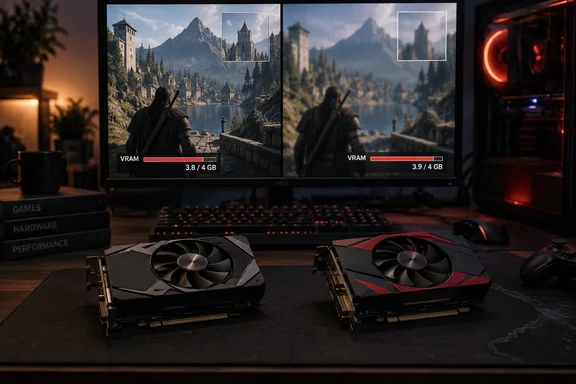
Biswas bought a used Nvidia GeForce GTX 1650 Super and a used AMD Radeon RX 5500 XT, both 4GB models. He meant them for a secondary streaming PC, which is a sensible job for cheap second-hand cards. Out of curiosity, he also tried recent AAA games on them. His conclusion has two sides: 4GB can still get you into some games, but he would not recommend it for everyday gaming.
The test bench: nothing exotic
Biswas put each card, one at a time, into his main PC:
- CPU: AMD Ryzen 5 5600X
- Memory: 16GB DDR4
- Drivers: clean install before testing, to rule out driver leftovers
- Output resolution: 1080p, usually with FSR 3 upscaling
He tested 13 games, including Onimusha: Way of the Sword and Control Resonant, which he says both launched in September 2026. The rest were Cyberpunk 2077, Elden Ring Nightreign, Armored Core 6: Fires of Rubicon, Mortal Shell 2, Final Fantasy 7 Rebirth, Black Myth: Wukong, Dragon's Dogma 2, Resident Evil Requiem, Marvel's Spider-Man Remastered, Monster Hunter Wilds and Final Fantasy XVI.
Keep in mind what this is. It's one writer's informal run, not a controlled lab benchmark. The report doesn't give driver versions, game patch numbers or test dates. The RX 5500 XT was also sold in an 8GB version, and the report only calls this one a 4GB card. The table below is his reported averages, not numbers anyone has reproduced.
The scorecard
| Game | Status | Preset | GTX 1650 Super | RX 5500 XT |
|---|---|---|---|---|
| Cyberpunk 2077 | Working | Medium | 43 FPS | 41 FPS |
| Elden Ring Nightreign | Working | Medium | 51 FPS | 50 FPS |
| Armored Core 6 | Working | High | 57 FPS | 50 FPS |
| Mortal Shell 2 | Working | Lowest | 27 FPS | 29 FPS |
| Final Fantasy 7 Rebirth | Working | Lowest | 28 FPS | 30 FPS |
| Black Myth: Wukong | Working* | Lowest | 24 FPS | 27 FPS |
| Dragon's Dogma 2 | Not working | — | — | — |
| Resident Evil Requiem | Working* | Lowest | 37 FPS | 30 FPS |
| Spider-Man Remastered | Working | Medium | 61 FPS | 60 FPS |
| Monster Hunter Wilds | Not working | — | — | — |
| Final Fantasy XVI | Not working | — | — | — |
| Onimusha: Way of the Sword | Working | Lowest | 41 FPS | 37 FPS |
| Control Resonant | Working | Lowest | 25 FPS | 22 FPS |
*The asterisks mark a contradiction in the report. The text says Resident Evil Requiem launched on the GTX 1650 Super but not on the RX 5500 XT, and that Black Myth: Wukong ran on the AMD card (after big resolution cuts) but not on the Nvidia card. Yet the table lists frame rates for both cards in both games. Treat those two rows with caution. Even taken as written, compatibility at this level clearly depends on the game and the GPU vendor.
The numbers fall into three groups:
- Comfortable: Spider-Man Remastered, Armored Core 6 and Elden Ring Nightreign ran around 50–61 FPS at Medium or High. These are older or lighter games.
- Playable if you're patient: Cyberpunk 2077 and Onimusha landed in the high 30s to low 40s.
- Barely there: Mortal Shell 2, FF7 Rebirth, Wukong and Control Resonant sat in the 20s even at the lowest preset.
Summary: Most of the list ran in some form, and three games wouldn't run at all. Many of the "working" results are below the 30 FPS that most PC players would call acceptable.
The failures, and why "misleading requirements" is too strong
Biswas says Monster Hunter Wilds and Dragon's Dogma 2 never reached the title screen, and that some games crashed while compiling shaders. Final Fantasy XVI also failed. He adds that Alan Wake 2 wouldn't boot, which makes it more surprising that Control Resonant ran, since both use Remedy's Northlight engine.
The headline claims developers "will have you believe" 4GB is dead. Monster Hunter Wilds is a good test of that claim, because Capcom published unusually specific requirements. AMD's own listing for the game gives the minimum GPU as a Radeon RX 5500 XT (VRAM 8GB), and states the game is expected to run at 1080p (upscaled from 720 native resolution) / 30 fps under the "Lowest" graphics setting. On the Nvidia side, TechRadar's rundown notes the minimum VRAM of 6GB if you're using a GTX 1660, and 8GB if you're using a Radeon RX 5500 XT.
The requirement names the same GPU Biswas tested, but the 8GB version, and he had the 4GB one. When his card failed to start the game, the published spec was simply right. The requirement wasn't misleading. It was precise.
Minimum requirements aren't a hard wall either. They describe what the publisher supports and the performance it expects, not the point where a game refuses to launch. A Steam Community thread about Wilds shows the other side. One player reported the game running on a laptop with an 3050 4GB VRAM, and said that at minimum-low quality it can run quite well. That's a single user's unverified report on different hardware. Next to Biswas's failure on a desktop RX 5500 XT, it still makes the point: below minimum spec, results vary, and nobody promises you anything. Capcom's own support FAQ is careful even about systems that do meet the spec, warning that some GPU types may not run properly with mobile GPUs even if they meet the minimum/recommended system requirements.
A fairer reading: games can sometimes run below spec, but you shouldn't buy a game on the assumption that yours will.
Summary: The failures line up with published minimums. The successes show requirements are conservative, not dishonest.
FSR 3 made most of this possible
Biswas says FSR 3 upscaling was effectively required to reach playable frame rates. He started with the Balanced preset and dropped to Performance in Mortal Shell 2, Resident Evil Requiem and Black Myth: Wukong. At that point, he estimates, these games were rendering at about 540p internally and upscaling to 1080p. Ray tracing was out entirely, even at 540p.
Some context on what upscaling does and doesn't do (general industry knowledge, not from the test):
- It doesn't add VRAM. It lowers the resolution the GPU actually renders at, which reduces the size of render targets and eases the load on the card. Textures, geometry and the game's other assets still have to fit in 4GB.
- It only works where the game supports it. Developers have to build FSR or XeSS into each game. Neither cheap card supports DLSS, which requires Nvidia RTX hardware.
- XeSS isn't Intel-only. Intel's support documentation says XeSS runs on other vendors' GPUs when the driver supports Shader Model 6.4. Whether it helps on a card this old is a separate question.
- These cards are stuck on FSR 3. AMD now describes its current FSR upscaling as a machine-learning upscaler, which is aimed at much newer hardware. The GTX 1650 Super and RX 5500 XT rely on the older, shader-based FSR 3 path.
The report doesn't say whether FSR 3 frame generation was on in any game. That matters: frame generation raises the FPS counter but doesn't make input feel more responsive, and it works worst at low base frame rates. Don't read these numbers as native performance, and don't assume they reflect frame generation either.
If you're stuck with a 4GB card: a practical checklist
This is general troubleshooting advice from common PC practice, not steps from Biswas's test. It gives you the best odds:
- Check the published minimums first, including the VRAM figure next to each GPU model. Wilds shows that the same GPU name can come with different VRAM amounts.
- Clean-install your graphics driver, as Biswas did, especially on a used card that came with old software.
- Start at the lowest preset, then lower texture quality separately. Textures are usually what fills up VRAM.
- Turn on FSR 3 or XeSS, start with Balanced, and drop to Performance only if you need to.
- Turn off ray tracing. Biswas's test shows it isn't realistic on these cards.
- Be patient with shader compilation. If a game keeps crashing at that stage, as some did in his test, you may have found a hard limit rather than a setting you can fix.
- Use in-game benchmarks or demos before buying when a publisher offers them.
The verdict
Biswas's own conclusion is the one to go with, and it's more measured than his headline. He can't recommend 4GB cards as everyday gaming hardware. VRAM demands are rising with Unreal Engine 5 and engines built around ray-traced global illumination, and he notes that even the 8GB RTX 4060 struggles with some new games because of its memory.
The takeaway: a 4GB GTX 1650 Super or RX 5500 XT is still a good buy for a streaming box, a light-gaming second PC, or a backlog of older and well-optimized games. For current AAA games it's a stopgap at best. If you're buying a new card with a new game in mind, check the VRAM figure in the requirements before the GPU name.
References
- 4GB GPUs can still game even if developers will have you believe otherwise MakeUseOf · 2026-09-28T18:30:14+00:00
- Monster Hunter Wilds requirements for PC | TechRadar techradar.com
- Will Intel® XeSS Work with Graphics Cards from Other Vendors? intel.com