

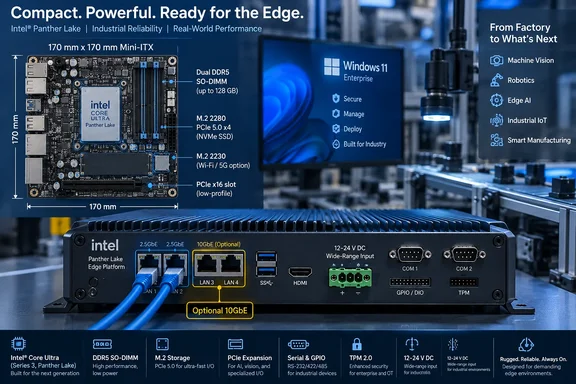
Notebookcheck first highlighted a Core Ultra 5 325 configuration with two DDR5 C/SO-DIMM slots supporting up to 128 GB at DDR5-6400. AAEON’s own product material and a separate report by IT Home confirm the broader platform: a Mini-ITX board for Intel Core Ultra Series 3 processors, 12 V to 24 V DC input, two standard 2.5GbE interfaces, optional dual 10GbE, PCIe expansion, and support for Windows 11 64-bit as well as Ubuntu 24.04.
The useful news for Windows and enterprise administrators is not merely that another small Intel board exists. It is that AAEON is fitting unusually dense wired networking, a socketed high-capacity memory arrangement, TPM 2.0, PXE boot, and wide-range DC power into a standard Mini-ITX footprint. Those are the ingredients for a compact appliance that can be serviced with conventional chassis, storage, cooling, and memory options rather than a sealed embedded box.
But the published specifications also show this is a configurable industrial platform, not a single fixed retail motherboard. Anyone treating the nameplate specifications as a guaranteed off-the-shelf configuration risks ordering the wrong networking, processor, or expansion combination.
Four Ethernet ports are a configured option
AAEON specifies two Intel 2.5GbE controllers as standard: an I226-LM and an I226-V. The 10GbE pair uses an Intel E610-XAT2 controller and appears only in the four-LAN SKU. AAEON’s product material describes the second pair as “by BOM optional,” while IT Home similarly reports that two 2.5GbE RJ-45 ports are standard and two 10GbE ports are optional.
That makes the board more interesting than a typical compact office PC motherboard, but it also changes the purchasing conversation. A two-port 2.5GbE model can serve as a small router, industrial controller, virtualized edge node, or compact Windows appliance where separate management and production networks are useful. The four-port version is aimed much more directly at high-throughput aggregation, network segmentation, video ingestion, and appliance deployments where the 10GbE interfaces have a defined role.
The mixed-speed design deserves planning. The optional configuration provides two 10GbE plus two 2.5GbE ports, rather than four interchangeable 10GbE ports. An organization intending to connect several 10GbE cameras, storage devices, or uplinks will still need switching capacity elsewhere. Conversely, a deployment that needs one or two fast uplinks and separate lower-bandwidth device or management networks may avoid an add-in network card entirely.
AAEON lists Wake-on-LAN and PXE support. For Windows administrators, those features make the board more suitable for managed deployments than a consumer Mini-ITX product: remote wake, network imaging, and unattended OS provisioning are explicitly part of the platform specification. They do not eliminate the normal work of validating drivers, switch configuration, boot policy, and firmware settings in the actual SKU purchased.
The Core Ultra 5 325 is one point in a wider processor range
The submitted reporting centers on Intel’s Core Ultra 5 325, an eight-core Panther Lake mobile-class processor with four performance cores, four efficiency cores, and four Xe3 graphics cores. That chip aligns with the reported DDR5-6400 ceiling. However, AAEON does not position the MIX-PTLWV1 as a board locked to that processor alone; its technical documentation describes support for Core Ultra Series 3 processors in the 15 W to 25 W range.
AAEON’s specifications separate the platform into processor-dependent configurations. The H404 class supports DDR5-6400, while the H484 class can reach DDR5-7200. The company also says the graphics hardware varies by CPU SKU, identifying either Intel Arc B390 graphics or Intel Graphics depending on the processor. In other words, the Core Ultra 5 325 configuration should not be used to infer the graphics performance, memory speed, or available PCIe capability of every MIX-PTLWV1 system.
This corrects some of the broad conclusions drawn from the 325 model’s synthetic benchmark comparisons. AAEON has published no workload-specific figures for this motherboard, no thermal data for a finished chassis, and no performance results for Windows 11 edge workloads. The CPU may be capable for moderately demanding local services, but an appliance’s actual result will depend on memory population, cooling, storage, network load, BIOS configuration, and whether the application uses CPU, GPU, or NPU acceleration.
The 128 GB memory capacity is substantial in this form factor, especially compared with compact systems using soldered LPDDR5x. It has practical value for Hyper-V test hosts, local video analytics buffers, multiple services, software-defined networking labs, and memory-heavy industrial data collection. Yet capacity alone does not turn the MIX-PTLWV1 into a small server. The platform supplies two C/SO-DIMM slots, so 128 GB requires two 64 GB modules, and buyers should obtain a validated-memory list or written confirmation from AAEON before standardizing on a particular module vendor.
Expansion is strong, but PCIe Gen 5 is not universal
AAEON lists an open-edge PCIe Gen 5 ×8 slot, an M.2 2280 M-key socket with PCIe Gen 4 ×4 for NVMe storage, an M.2 2230 E-key slot for Wi-Fi or CNVi modules, and an M.2 3042/3052 B-key socket with a Nano SIM provision for cellular hardware. It also exposes six serial connections in total: one configurable RS-232/422/485 header and five RS-232 headers, along with eight programmable GPIO bits.
The board’s PCIe language contains another important qualification. AAEON says Gen 5 ×8 availability depends on the CPU SKU; its more detailed material identifies it as an optional bill-of-materials feature on the H484 platform. The Core Ultra 5 325 configuration cited by Notebookcheck should therefore not be assumed to deliver a usable Gen 5 ×8 slot without confirmation from the vendor or distributor.
For an IT buyer, that matters more than the words “PCIe Gen 5” on a product brief. A PCIe slot may be intended for a capture card, fieldbus controller, accelerator, or specialized I/O card rather than a desktop-class GPU. Mechanical fit, lane allocation, card power, cooling, firmware support, and the chosen processor all need to be checked together. The board’s 12 V to 24 V DC input is valuable for industrial cabinets and vehicle-adjacent deployments, but it also means the system needs an appropriate external DC supply instead of the ATX power supply assumed by many Mini-ITX builders.
AAEON also provides four rear USB 3.2 Gen 1 ports at 5 Gbps, two more through an internal header, four DisplayPort 1.4 outputs, line out, LVDS/eDP display support, TPM 2.0, watchdog functions, and fan monitoring. Those connections reveal the intended use more clearly than the processor marketing does: digital signage, operator terminals, machine control, edge vision, and communications equipment where legacy serial hardware and modern displays must coexist.
Windows 11 support is documented, availability is not
AAEON explicitly lists Windows 11 64-bit support and Ubuntu 24.04 with Linux kernel 6.8. TPM 2.0 is onboard, removing one obvious barrier to a modern Windows deployment. The company also lists a 0°C to 60°C operating range and CE and FCC Class A certification, both relevant to commercial deployments but not substitutes for full system-level validation.
What AAEON has not published is equally important. Its current Mini-ITX catalog labels the MIX-PTLWV1 “Preliminary,” and the company directs prospective buyers to request a quote rather than offering a public price or conventional retail checkout. No public list price, general availability date, supported-memory list, complete ordering matrix, or Windows driver package was included in the launch material reviewed by Notebookcheck, IT Home, or AAEON’s own product pages.
That means the MIX-PTLWV1 has been introduced and its broad hardware design is documented, but it should not yet be described as a widely available consumer motherboard. Procurement teams should request the exact part number, processor, LAN count, PCIe implementation, memory validation details, BIOS revision, lead time, and support commitment before approving it for a Windows appliance rollout.
The board’s value is clearest in deployments that can use its unusual combination of socketed 128 GB memory, optional 10GbE, serial I/O, TPM 2.0, PXE, and 12–24 V power. For everyone else, the unanswered configuration and availability details matter more than the impressive maximum specifications.
References
- Compact Intel-powered Mini ITX motherboard arrives with up to 128 GB RAM and four Ethernet ports Notebookcheck · 2026-09-17T02:18:00+00:00