

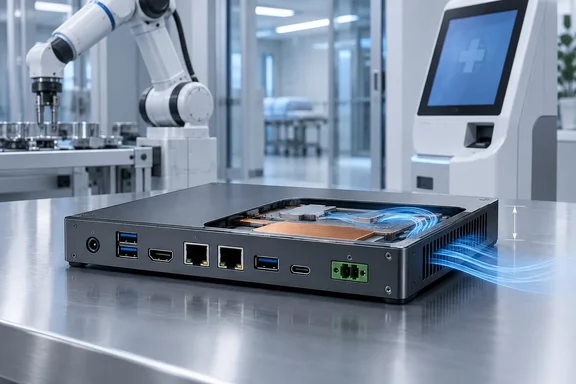
This is an industrial and embedded machine. Nobody will be gaming on it. For Windows IoT developers, robotics integrators and anyone who has listened to a kiosk fan whine through a hospital night shift, it is one of the more interesting thermal designs to reach the x86 edge this year.
What AAEON announced
AAEON (Stock Code: 6579) announced the release of the UP Xtreme PTL Edge Air, a Panther Lake-powered Mini PC featuring Frore Systems' AirJet® solid-state active cooling technology in a release dated October 1, 2026, from Taipei. The company's product page describes it as a fanless Edge AI system with AirJet® solid-state active cooling, with Intel® Core™ Ultra Series 3, up to 180 TOPS, and an ultra-slim design for robotics, AMR, and space-constrained applications.
The main claims, all from AAEON:
- Noise: under 21 dBA
- Size: 35% thinner than the fan-cooled sibling
- Weight: 43% lighter
- Vibration: none from a fan, because there isn't one
The comparison point matters. Some coverage says the Edge Air beats "actively cooled rivals" in general. AAEON's release is narrower: it says the UP Xtreme PTL Edge Air is 35% slimmer and 43% lighter than the fan-cooled UP Xtreme PTL Edge, released earlier this year. The percentages compare the Edge Air with its own fan-cooled sibling, not with every mini PC on the market. In absolute terms, the new system's height is listed as just 35.8mm and weighs in at 1.57 lb.
Tom's Hardware called this the first Panther Lake mini PC with AirJet cooling. I couldn't confirm that across the whole market. What is certain is that AAEON is selling it as a production Panther Lake system built around AirJet.
Section summary: This is a real product announcement with specific numbers. The size and weight savings are measured against AAEON's own fan-cooled PTL Edge.
"Fanless" is not the same as passive cooling
Readers who hear "fanless" may picture a box covered in fins that slowly gives off heat. AirJet works differently. Frore says its modules use ultrasonic-frequency membrane vibrations to generate high-speed pulsating airflow, as Notebookcheck put it.
Frore's own technical explainer goes further. It describes vibrating piezoelectric membranes, which move air through the chip at extremely high speeds - up to an astonishing 200km per hour. In Frore's description, cool air comes in through a dustproof filter. The pulsating jets hit a hot copper spreader and break up the thin, slow-moving layer of air that normally limits heat transfer. The heated air then leaves through a side exit spout.
So the system is still actively cooled. Air moves, but no motor spins and no bearing wears out. Think of a tiny high-pressure shower head for heat, not a ceiling fan. Removing the fan does three things, according to AAEON:
- No rotating parts: nothing to wear out or rattle.
- Less height: because of the reduced space taken up by thermal management components, the chassis shrinks.
- Dust: AAEON claims "cleanroom-grade" dustproof operation. I found no IP rating or certification behind that phrase, so treat it as marketing until a datasheet says more.
Section summary: AirJet still moves air, but without a fan. That is where the claims about noise, vibration and size come from.
Specs: Panther Lake with industrial I/O
You can choose from three processors. The UP Xtreme PTL Edge Air is available with a choice of the Intel® Core™ Ultra X7 processor 358H, Intel® Core™ Ultra 7 processor 356H, or Intel® Core™ Ultra 5 processor 325 from the Intel® Core™ Ultra Series 3 processors lineup (formerly Panther Lake).
| Configuration detail | What sources report |
|---|---|
| Top CPU | Core Ultra X7 358H: 16 cores (4P+8E+4LPE; 16 threads) at up to 4.8 GHz (per ServerNews) |
| Entry CPU | Core Ultra 5 325, 12M Cache, up to 4.50 GHz; Core 4P+0E+4LPE |
| Graphics/AI | integrated 12 Xe-core Intel® Arc™ GPU and Intel NPU 5.0 for up to 180 TOPs of AI performance |
| Memory | DDR5-7200, up to 128 GB across two SO-DIMM modules |
| Storage | 2 M.2 2280 PCIe NVMe slots alongside a dedicated bay for a wireless network card |
| External I/O | 2 USB-C 40Gbps connections, 2 2.5GbE RJ45 ethernet ports, 2 COM serial ports, and a 40 Pin GPIO header |
| Thermal | Active Fanless Cooler (Airjet) |
Tom's Hardware adds that the two COM ports support RS-232/422/485, that the system can drive up to four displays at once, and that the Arc B390 iGPU comes with the X7 part. The 12 Xe-core figure applies to the top configuration. VideoCardz says only the higher-end models offering an Intel Arc GPU with up to 12 Xe3 cores, so the Ultra 5 325 box does not get that graphics tier.
Notebookcheck says these units have the same hardware specs as the UP Xtreme PTL Edge models launched earlier this year, but come with considerably more compact cases. In short, the logic board stays the same and the enclosure is what changed.
Section summary: You get full Panther Lake performance and industrial ports in a much thinner box.
The trade-offs: power draw and temperature range
To its credit, AAEON lists the downsides itself. According to Tom's Hardware, the company cites "a 6% increase in power consumption and a narrower operating temperature range of -10°C to 45°C." Technetbooks reports the same figures and says the range is narrower than standard industrial hardware.
There is a small disagreement in the coverage. Notebookcheck wrote that the system draws 5% more power on average and the operating temperatures are reduced. AAEON's figure, as quoted by Tom's Hardware, is 6%. Use the vendor's number when planning, and ask AAEON what workload it was measured under.
What these limits mean in practice:
- 45°C maximum ambient rules out some uses. Think of a sealed kiosk in direct sun, a factory cabinet next to a furnace, or an AMR in a summer warehouse with no air conditioning. A box that is fine in a clinic hallway may struggle there.
- -10°C minimum covers most indoor and many cold-storage settings, but not deep-freeze or outdoor winter installs.
- A few percent more power matters little on mains power. On a battery-powered robot, it comes straight off runtime. The weight savings may partly make up for it, but only real testing will show by how much.
There is also an open question. AAEON's claims don't say how the Edge Air behaves under long, heavy loads, such as an X7 358H running continuous AI vision inference. Does it sustain the same clocks as the fan-cooled Edge, or does it throttle earlier? I found no independent reviews or acoustic measurements. The sub-21 dBA figure also comes without a stated test distance or workload.
Section summary: The power and temperature penalties are disclosed and modest, but they are real. Sustained performance under load hasn't been independently tested.
Who it's for
AAEON's target list is specific. Tom's Hardware quotes the company pitching the system for "ultra-thin kiosk setups, low-clearance AMR housing, and compact mobile healthcare units." VideoCardz notes that AAEON specifically lists robotics, autonomous mobile robots, machine vision and VSLAM among the intended applications.
The robotics argument is about physics. For robotics applications, AAEON state that combined, these features can reduce torque around moving joints and minimize mechanical disturbance for precision sensing equipment. A lighter controller on a robot arm means less load on the joints. A controller with no fan avoids adding vibration next to a camera or LiDAR. These are AAEON's claims, not test results, but the reasoning holds up.
For Windows readers, Tom's Hardware reports that the spec sheets list Windows IoT Enterprise and Ubuntu 24.04 LTS. This is not a consumer Windows 11 Home desktop. It is meant for locked-down, long-life deployments, where Windows IoT Enterprise's servicing model and lockdown features are useful.
A checklist for evaluating the Edge Air
If you're considering it for a deployment, this order makes sense:
- Check the ambient temperature first. Log the actual temperatures inside your enclosure, not the room's. If the cabinet goes above 45°C, stop here.
- Confirm the power budget. Add roughly 6% to the figures for the fan-cooled PTL Edge, and get AAEON's actual numbers for your configuration.
- Ask for test conditions. Request the measurement distance and workload behind the sub-21 dBA claim, plus results from long-duration load testing.
- Check the filter. Frore's design draws air through a dustproof filter. Ask AAEON whether it needs servicing and how often.
- Pick the CPU for the job. The X7 358H with the 12 Xe-core Arc GPU suits vision and AI work. The Ultra 5 325 suits lighter kiosk and HMI duty.
- Plan the operating system. Choose your Windows IoT Enterprise or Ubuntu 24.04 LTS image, and confirm driver support for the COM ports and the 40-pin GPIO header on your chosen build.
Pricing and context
As usual for industrial hardware, no price has been published. Buyers are expected to contact AAEON and negotiate by volume.
Tom's Hardware notes that the only other AirJet mini PC it had seen was Zotac's ZBox PI430AJ, which used Intel's 7W N300. That chip is far less powerful than a Core Ultra X7. If AirJet can cool Panther Lake H-class chips well in a 35.8 mm box, solid-state cooling has moved beyond low-power novelty.
My take
The Edge Air is a sensible, honestly marketed product. AAEON has replaced the most failure-prone and noisiest part of a small PC with a solid-state cooler, and it discloses what that costs in power and temperature range. For kiosks, medical carts and robots, quiet, vibration-free and lighter are real advantages.
The caution is that nearly every headline number comes from AAEON, and the whole idea depends on how the AirJet modules handle a Panther Lake H-series chip under constant load. Until independent sustained-load and acoustic tests appear, treat the Edge Air as a promising option to test in your own enclosure.
References
- First Intel Panther Lake mini PC cooled with solid-state AirJet tech operates at less than 21 dBA — Aaeon claims its fanless Up Xtreme PTL Edge Air is also slimmer, lighter than actively-cooled rivals Tom's Hardware · 2026-10-01T15:27:09+00:00
- UP XTREME PTL EDGE AIR: UP Xtreme PTL Edge Air aaeon.com
- Aaeon launches Panther Lake Edge mini PCs with Frore's AirJet active cooling system - Notebookcheck News notebookcheck.net