

What's inside
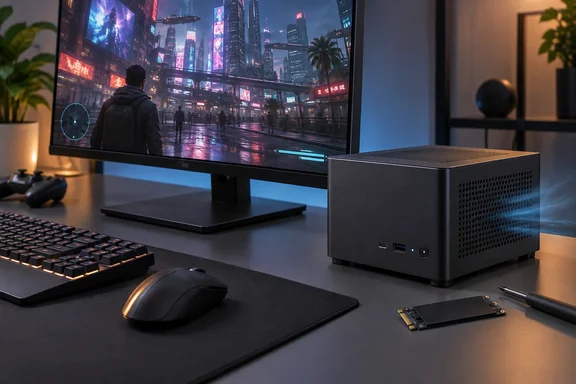
The chip is a 12-core, 24-thread Zen 5 part. Third-party spec sites describe it as four Zen 5 plus eight Zen 5c cores on the FP8 socket. They also list a January 5, 2026 launch. The graphics are a Radeon 890M, and the NPU is rated at 55 TOPS. AMD's total platform figure is 86 TOPS, which counts the CPU, GPU and NPU together.
The reviewed unit has these specs:
- Size and weight: 128 × 128 × 37 mm. The reviewer weighed it at 690 g.
- Memory: 32GB of soldered LPDDR5X-7467. It can't be upgraded.
- Storage: a 1TB faspeed P9 PCIe 4.0 SSD, plus a second M.2 2280 slot.
- Networking: Wi-Fi 7 (MediaTek MT7925), Bluetooth 5.4 and two 2.5GbE ports.
- Software: Windows 11 Pro 25H2, with no bloatware seen after setup.
- Warranty: two years.
The reviewer says the F2A runs a 54W sustained and 65W burst power profile. AMD's own configurable range for the chip is 15–54W, according to Notebookcheck's summary of a 28W base with up to 54W. So the 65W burst limit is the vendor's tuning, not AMD's headline figure.
The Copilot+ question
The review calls this a Copilot+ PC because the NPU is rated at 55 TOPS. Microsoft's Copilot+ bar is an NPU above 40 TOPS, so the chip clears that threshold on paper. But the processor's numbers alone don't prove that this particular F2A is a certified Copilot+ device. Microsoft also says Copilot+ experiences vary by device and market, and some features roll out over time. Treat the label as probable, not guaranteed. Also don't confuse the 86 TOPS total with NPU TOPS, because Copilot+ is judged on the NPU.
Ports and display caveats
- USB4: only the front USB-C port is USB4 (40Gbps). The rear USB-C is a 10Gbps USB 3.2 Gen 2 port. Both support DisplayPort 1.4 output.
- Four displays: the review says four monitors are physically possible using HDMI, DisplayPort and both USB-C ports. Only one USB-C port can supply power to a portable monitor.
- HDMI "2.1 TMDS": the reviewer says this label means HDMI 2.0-class bandwidth of about 18Gbps. That rules out 4K/120Hz. ACEMAGIC's listing says 4K/60Hz. If you own a high-refresh display, check the port's real limits instead of trusting the "2.1" label.
- DisplayPort version: the review's table says DP 2.0. ACEMAGIC's page says DP 2.1. I can't tell which is right.
- Second SSD slot: the review lists it as PCIe Gen 4 x4. ACEMAGIC's page describes it differently, as PCIe 5.0 x4. That conflict is unresolved, so check before you plan a drive purchase around it.
- Memory speed: ACEMAGIC's page cites memory speeds up to 8000MT/s. The review lists 7467MT/s, and Windows reports 8000MT/s. The reviewer blames the way Windows reads the platform firmware, but that is an interpretation, not a measured result.
Performance
The reviewer compared the F2A with a GEEKOM A9 MAX that uses the same chip, in dual-channel 64GB and single-channel 32GB setups. The results:
- Against dual-channel: the two trade blows within what the reviewer considers margin of error. Examples include Geekbench 6 multicore at 14,535 against 15,379, and Cinebench 2026 multicore at 4,973 against 4,926.
- Against single-channel: both are substantially faster than the single-stick A9 MAX. Geekbench 6 multicore there was 11,706.
- Graphics: the F2A edged ahead in 3DMark Time Spy (4,262 against 4,149) and Wild Life. The reviewer credits ACEMAGIC's power limits. That's plausible, but not proven.
- Browsers: in Speedometer 3.1, Edge scored 36.5–37.8, Chrome 31.4–32.4 and Firefox 29.4–30.3.
- SSD: it beat its rated speeds in CrystalDiskMark but came in under its write rating in AS SSD. The reviewer explains this by the different test data used.
These are the reviewer's measurements, not independent reproductions.
Gaming
In Cyberpunk 2077 at 1080p, the results were:
| Settings | Average FPS | Notes |
|---|---|---|
| Ray tracing Low, FSR 2.1 Auto | 23.24 | Lows around 18 FPS, which the reviewer calls unplayable |
| Ray tracing off, High preset, FSR 2.1 Quality | 35.84 | 28.7 minimum, 46.7 peak |
The reviewer says Quake Champions ran smoothly at an auto-selected 1440p, but gives no frame-rate figure. The 120–160+ FPS estimates in the review came from an unnamed "search", not from the reviewer's testing, so don't treat them as benchmarks.
The reviewer's own conclusion is that this isn't the box for graphically intensive games. They say it suits 1080p play with settings turned down, and that the USB4 port can drive an external GPU. The Radeon 890M is described as roughly GTX 1650 class. That comparison is the reviewer's, and the review doesn't back it with a test.
Thermals and power
- CPU temperature: the highest reading was 90.6°C, during PCMark 10 Extended.
- Outer shell: it stayed under 41°C on a thermal camera. The hottest spot was the right-side vent at 40.6°C.
- Noise: the single fan was quiet.
- Power draw: about 1.3W off, about 10W idle, and 34–35W at most during PCMark 10.
Windows issues
- Firmware protection: Windows Security showed Firmware Protection disabled. After the reviewer enabled it in the Secured-core PC settings and restarted, it still showed disabled. An ACEMAGIC contact reportedly blamed a CPU PI-code verification bug, said AMD hasn't yet shipped a fix, and said performance isn't affected. That is the vendor's explanation, not an independently confirmed diagnosis.
- September update: the reviewer says the September 2026 Patch Tuesday update made the F2A freeze at boot. They tested on the August update instead. No KB number or build is given, so the scope and cause are unverified. If you're an admin, test updates before wide rollout.
- Drivers: the test unit ran AMD graphics driver 26.8.1 and chipset driver 8.08.12.551. ACEMAGIC's support page did not yet list drivers or a BIOS update for the new F2A variants.
- BIOS: it's an AptiBIOS that isn't locked down.
Serviceability
Opening the case is the F2A's weakest point. The reviewer's steps:
- Remove four Philips screws hidden inside the rubber feet.
- Pry off the plastic bottom cover. The Wi-Fi antenna and DC power leads are attached to it, so be careful.
- Remove two brackets, with two screws each.
- Force the mainboard out of the chassis.
The fit is so snug that the power button popped out. Putting the board back took several attempts. The reviewer's advice is to skip it unless you're swapping or adding an SSD. ACEMAGIC includes no guidance on opening the case.
Price and availability
The review gives an MSRP of $1,699 and a $1,159 sale price on ACEMAGIC's site. ACEMAGIC's product page currently shows that same $1,159 price, marked as a pre-order with an estimated ship date of October 15, 2026. That page also lists a 30-day money-back guarantee. Prices and dates like these can change. The review reports Amazon US at $1,441.99, and says the UK site only carries the Intel version. The ACEMAGIC listing also advertises an "OpenClaw pre-installed" option, which the reviewed unit's review doesn't mention.
Verdict
Reasons to buy:
- It's small, quiet and efficient.
- It has a strong NPU and quad-display potential.
- It comes with a Windows 11 Pro licence.
Reasons to hesitate:
- You can't upgrade the memory.
- The internals are hard to reach.
- There's a reported Windows Security quirk.
- The September update freeze is unresolved.
- There's only one USB4 port.
- The price is high.
I'd wait for ACEMAGIC to publish BIOS and driver updates and settle the spec conflicts before spending $1,159.
References
- ACEMAGIC F2A HX 470 review: Gaming finally arrives on a Mini PC Neowin · 2026-10-03T15:00:01+00:00
- ACEMAGIC F2A Intel Core Ultra X7 358H & Ryzen AI 9 HX 470 with Arc B390 Graphics acemagic.com
- AMD Ryzen AI 9 HX 470 Processor - Benchmarks and Specs - Notebookcheck Tech notebookcheck.net