

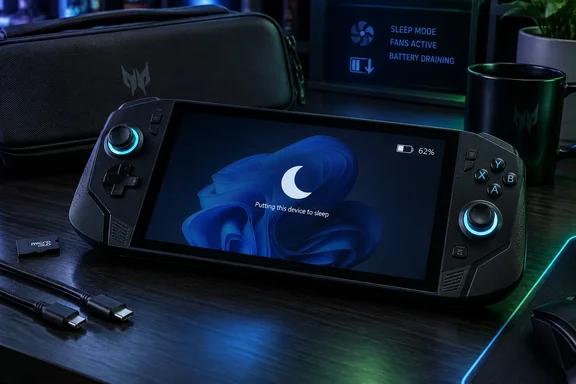
The report is encouraging in several hardware areas. The owner describes strong early gaming performance, a bright display comparable to the Asus ROG Xbox Ally X, quiet cooling, and a generous port selection. But a single unit arriving early is not evidence of a broad retail launch, and the same account raises questions Acer will need to answer quickly: mushy face controls and D-pad input, an apparent mismatch between listed and actual weight, odd speaker behavior, and a suspend mode that leaves the fans running.
For a Windows handheld marketed on console-like convenience, the sleep problem is the one that deserves the closest attention. Acer’s own launch material positions the Atlas 8 as a full Windows 11 gaming system with dedicated handheld controls, PredatorSense performance management, and Xbox-oriented gaming access. If putting it to sleep does not reliably quiet the system or preserve the expected portable experience, buyers are being pushed back toward the less seamless hibernation workaround familiar to laptop owners.
Early UK delivery does not yet equal a full launch
Acer announced the Predator Atlas 8 in May 2026 and said it would reach North America, EMEA, and Australia in October. The company’s product pages identify the device as model PA08-I51 and confirm the fundamentals: Windows 11 Home, an 8-inch 1,920 x 1,200 120Hz VRR touchscreen, Intel Arc G3 or G3 Extreme silicon, dual-fan cooling, TMR analog sticks, Hall-effect triggers, two Thunderbolt 4 ports, Wi-Fi 7, and UHS-II microSD support.
The reported Currys delivery on September 19 is therefore early relative to Acer’s public October target, but only by days rather than months. It also does not establish that all UK preorders are shipping, that Acer has formally moved its launch date, or that other EMEA markets have stock. Notebookcheck’s account rests on one buyer’s delivery and impressions, while Acer has not publicly announced a revised release timetable.
That distinction is important for prospective buyers. Early dispatches can result from retailer inventory arriving ahead of a formal street date, rather than an intentional regional release. Anyone waiting on a preorder should treat this as a sign that retail fulfillment has begun somewhere, not as confirmation that the Atlas 8 is broadly available.
The sleep-mode report is the first practical Windows warning
According to the Reddit owner quoted by Notebookcheck, selecting sleep leaves the Atlas 8’s fans running. The owner has switched to hibernation instead. That is a sensible short-term workaround: hibernation writes the active Windows session to storage and powers down rather than maintaining a low-power sleep state.
It is also less convenient. A handheld used in short bursts needs to be put away quickly, slipped into a case, and resumed without worrying about hot fans, battery drain, or a system that remains partly awake in a confined bag. Hibernation generally avoids the lingering-power issue, but it takes longer to resume and can interrupt the instant-on expectation that Windows handheld makers increasingly promote.
There is not yet enough evidence to call this a Predator Atlas 8-wide defect. The report comes from one retail unit, and Acer has not acknowledged a sleep or firmware problem. It could prove to be a device-specific fault, a Windows power-management configuration issue, an early driver problem, or a behavior connected to a particular PredatorSense power profile.
Still, it is a meaningful early warning because the Atlas 8 combines a new Intel Arc G-series platform with Acer’s first Predator-branded handheld implementation. Windows sleep has long been inconsistent across portable PCs, particularly where modern standby, drivers, vendor utilities, USB peripherals, and performance-control software interact. A new handheld has to get those unglamorous basics right before faster graphics or a higher refresh rate can translate into a better daily device.
Owners receiving an Atlas 8 should test sleep before relying on it outside the house. Put the handheld to sleep after a game session, wait several minutes, check whether the fans and indicator lights remain active, and confirm battery percentage before and after. Until Acer provides a software fix or a clear explanation, hibernation is the safer choice for transport.
Strong thermals, but “Balanced” mode needs real testing
The owner’s initial take on cooling is notably positive. The fans are described as quiet, with no distracting high-pitched whine, even while gaming. That aligns with Acer’s central design claim: the Atlas 8 uses dual fans, including a thin metal AeroBlade fan, alongside the company’s Vortex Flow internal airflow tuning.
Quiet cooling is not a minor quality-of-life win on an 8-inch handheld. In this category, sustained performance often comes at the cost of fan noise near the player’s hands and face. If Acer’s cooling system can maintain performance without a shrill tone, it would separate the Atlas 8 from machines whose thermals are acceptable in benchmark graphs but unpleasant in a quiet room.
The early report also notes inconsistent power draw when the system is set to its 30W “Balanced” setting. That claim needs much more testing before it can be treated as a performance flaw. Power behavior can vary sharply with game engine, frame cap, display refresh rate, upscaling, shader compilation, battery charge, Windows background activity, and firmware.
Acer has not published a detailed explanation of how PredatorSense’s modes set sustained and peak power limits, or how those limits interact with Intel’s Arc G3 Extreme platform. That gap matters more than a generic “30W” label. A handheld should make its operating modes predictable: users need to know whether Balanced prioritizes battery life, acoustics, sustained clocks, or a mixture of all three. Independent testing across multiple games and plugged-in versus battery operation will be needed to establish whether the reported inconsistency is normal power management or a tuning problem.
Controls and weight could undermine the premium pitch
The same owner describes the controls as mixed. Face buttons and the D-pad are said to feel mushy, even as the device’s overall ergonomics have drawn more favorable comments in early discussion. That criticism is particularly awkward for a £1,300 handheld because Acer has made input hardware a major part of the Atlas 8’s identity.
The company emphasizes TMR sticks, Hall-effect triggers, rear macro buttons, and adjustable trigger modes that can shift between a shorter micro-switch-like response and full analog travel. Those are useful features on paper, especially for players moving between shooters, racing games, and emulation. But premium sensor technology does not compensate for a D-pad or primary buttons that feel vague in regular use.
The reported unit also weighs roughly 870 grams, according to its owner, who says that is heavier than advertised. Acer’s public materials emphasize large battery options and a substantial cooling design, so the Atlas 8 was never positioned as an ultralight device. Yet exact weight matters more on a handheld than on a laptop because it is held continuously rather than placed on a desk.
Acer’s regional product pages vary by configuration, and the company says specifications differ by market and model. That makes a single advertised weight especially difficult to assess without the exact UK retail listing and part number attached to the delivered unit. Buyers should check the weight listed for their precise configuration rather than assuming a figure from Acer’s global product page applies to every battery, memory, and storage variant.
The display and connectivity look like safer early positives
The owner’s favorable comparison of the screen with the ROG Xbox Ally X is subjective, but it fits Acer’s published display specification. The Atlas 8 uses an 8-inch 16:10 WUXGA panel with a 120Hz refresh rate, VRR support, 500 nits of claimed peak brightness, touch input, and a matte protective layer. The extra vertical space of a 16:10 display is useful for Windows game launchers, desktop controls, inventory-heavy games, and system overlays that can feel cramped on 16:9 handhelds.
Connectivity is another area where the Atlas 8 is unusually well equipped. Its two Thunderbolt 4 ports mean the device can charge while remaining connected to a display, storage device, Ethernet adapter, or dock without immediately consuming its only high-bandwidth connection. UHS-II microSD support should also be more useful than basic microSD implementations for owners moving large game libraries, provided they buy media capable of those higher transfer rates.
The speakers are less settled. Notebookcheck reports that the first owner found them very loud but noticed an unusual echo. Acer advertises dual 2W speakers with DTS processing, but no second owner report has yet corroborated the echo observation. It should be treated as an early unit-specific impression, not an established audio defect.
The Atlas 8’s first retail impressions make it look like a technically ambitious Windows handheld with convincing display, cooling, and expansion hardware. But its first meaningful test is now software polish: Acer needs to show that sleep, power modes, and control feel are as dependable as the specification sheet suggests. Until then, the practical buying advice is simple: do not base a £1,300 purchase on one encouraging early delivery report, and do not assume sleep mode is safe for travel until it has been fixed or independently verified on retail units.
References
- Acer Predator Atlas 8: First units arrive, initial impressions surface Notebookcheck · 2026-09-19T16:15:00+00:00