

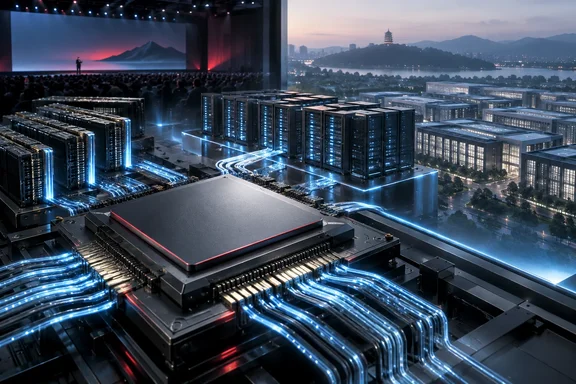
Zhenwu V900 triples the M890 on Alibaba's own numbers
The V900 comes from T-Head, Alibaba's semiconductor subsidiary. The Associated Press reported, in a story carried by the Taipei Times, that CEO Eddie Wu called it the "most powerful AI chip in China today." Alibaba says the 3x gain over the M890 applies to both model training and inference, which is the computation a trained model performs to answer users. Neither Alibaba nor the reporting has named the benchmark, workload or precision used for that comparison. Read "3x" as a vendor headline, not as a result you can expect across every AI workload.
T-Head filled in more detail. Gao Hui, a T-Head vice president, said the V900 will carry 216 gigabytes of high-bandwidth memory and inter-chip bandwidth of 1.2 terabytes per second, with mass production slated for the first quarter of 2027. TechNode adds that the chip supports the low-precision FP8 and FP4 formats natively. Technology.org supplies the best before-and-after comparison: Alibaba listed the M890 at 144 GB and 800 GB/s when it launched. On paper, then, memory per chip and chip-to-chip bandwidth both rise by half from one generation to the next.
| Specification (vendor-reported) | Zhenwu M890 | Zhenwu V900 |
|---|---|---|
| Memory per chip | 144 GB | 216 GB |
| Inter-chip bandwidth | 800 GB/s | 1,200 GB/s |
| Claimed performance | Baseline | 3x M890 |
| Status | Launched May 2026, commercially deployed | Mass production and sale targeted for Q1 2027 |
T-Head says the extra memory can cut the overhead of splitting a large model across chips and moving data between them. It also says low-precision math can make some workloads more efficient and lower inference costs. Both are reasonable engineering arguments, but they depend on the workload, and nobody outside Alibaba has tested the V900 yet. One analysis published on Yahoo Finance makes the same point: "These are vendor-reported figures, not independently benchmarked, and the gap between announcement and production is real."
Alibaba is also moving quickly. Quartz notes that the company released the Zhenwu M890 in May, saying at the time that it offered triple the performance of its predecessor. Two chips announced within about four months, each claiming a threefold jump, is an aggressive pace. It also means buyers will probably see another generation shortly after the V900 ships.
T-Head's ICN Switch makes the V900 a building block for supernodes
Look past the headline performance number and T-Head is mostly talking about systems. According to TechNode, T-Head links V900 chips into supernodes with its own ICN Switch interconnect chips. These are tightly coupled groups of accelerators that share unified memory addressing. T-Head says more than 1,000 V900s can operate as a single system. That 1,000-chip figure is different from the 500,000-accelerator number that appeared in many headlines.
The larger figure describes a whole cluster. T-Head says one AI computing cluster can scale to as many as 500,000 accelerators when V900 systems are combined with Alibaba Cloud's newly designed data-center network. The supernode is the tightly coupled unit, and the cluster is many of those units networked together. Reports that describe 500,000 chips "working together" as one machine merge the two levels.
Alibaba also showed a new supernode server at the conference. It combines the V900, the ICN Switch, a Panmai smart NIC and a Zhenyue SSD controller. T-Head's argument is that once models reach trillions of parameters, the bottleneck shifts from raw compute to chip-to-chip communication, memory capacity and data movement. Constellation Research quoted Alibaba describing a T-Head portfolio that includes the "Zhenwu" series for GPU chips, the "Yitian" series for CPU chips, the "Panmai" series for smart NICs, and ICN interconnect chips.
The CPU roadmap follows the same approach. TechNode reports that the Yitian 720 and Yitian 730 server CPUs are scheduled for the third quarter of 2027. The Yitian 730 uses a T-Head-designed microarchitecture, and Alibaba claims it reaches up to 1.4 times the single-core SPECint2017/GHz score of the Yitian 710. The later Yitian 750 will speak T-Head's ICN protocol, so the CPU can connect directly to Zhenwu accelerators. T-Head also ran workshops at the event on its SAIL software stack for training, inference and optimization. Developers will not use chips that lack a working toolchain, so the software stack matters as much as the silicon.
Qwen 4 is in training; the 10-trillion-parameter target is for Qwen 4.5 and Qwen 5
The model announcement is easy to misread. Wu said Alibaba's Qwen team plans to train a model with 5 to 10 trillion parameters, aimed at more complex, longer-horizon tasks. Technology.org reports the staging: Alibaba is training Qwen 4 and expects the Qwen 4.5 and Qwen 5 series to reach 5 trillion to 10 trillion parameters, up to four times the 2.4 trillion in today's flagship, Qwen 3.8 Max. Quartz, citing CNBC, confirms that Qwen 4 is already in training, with Qwen 4.5 and Qwen 5 to follow. Alibaba has not said how large Qwen 4 will be, and no 5–10 trillion parameter model has been trained or released yet.
A parameter is one of the learned numerical weights inside a model. Parameter count is a rough measure of a model's size and capacity. It does not measure quality, speed or cost directly. For comparison, Alibaba's current flagship, Qwen3.8-Max, has 2.4 trillion parameters. Moonshot AI calls its Kimi K3, released in July, the world's largest open model at 2.8 trillion parameters. The Yahoo Tech report says Qwen 3.8-Max ranks as the second-highest-scoring Chinese system on a widely cited AI benchmark, just behind Kimi K3.
Alibaba also made a larger research claim. Constellation Research quoted the company saying that "Alibaba's Qwen team is exploring RSI (recursive self-improvement) and has made meaningful progress." According to Reuters, Wu described this as models that find their own weaknesses, run experiments and generate training data with limited human involvement. Alibaba has not quantified "limited," named a system that demonstrates it, or submitted it to outside review. For now it is a statement of research direction, not a capability anyone can check.
The model and chip plans depend on each other, and TechNode's reporting shows how. M890-based supernode servers are already in large-scale commercial deployment and support models above 2 trillion parameters, including Qwen3.8 and Kimi K3. Developers can reach those capabilities through Alibaba Cloud's Bailian platform. The V900 is what Alibaba is counting on to take the next step, to models two to four times larger.
Alibaba Cloud's 20-gigawatt target runs into supply shortages
The third announcement concerns data-center capacity. Alibaba said it aims to exceed 20 gigawatts of global data-center capacity by 2032, pointing to "exponentially" rising demand for AI computing. Wu also admitted the constraint: the company's ability to ramp up its computing infrastructure is being held back by shortages throughout the AI data center supply chain. In his keynote, as the Taipei Times reported, he said Alibaba is "mobilizing every resource" to meet customer demand.
The timelines are different and should be kept apart. Reuters reports that Alibaba Cloud begins bringing AI supernodes online at commercial scale this quarter. The V900 does not enter mass production until Q1 2027, and the 20 GW figure is a target for 2032. Anyone planning cloud capacity should not treat these three dates as one rollout.
Alibaba's framing also matters. The Yahoo Tech report says he identified AI models, AI chips and the AI cloud as the three pillars of what he called the machine intelligence era. Investors reacted immediately: Alibaba stock rose as much as 5.1% in Hong Kong on Tuesday.
T-Head says its Zhenwu chips already serve more than 650 enterprise customers, in sectors including autonomous driving, finance, large language models, energy and manufacturing. According to the Taipei Times, Zhenwu chips run in Alibaba's data centers and supply computing to Alibaba itself and to its cloud clients. Companies consume these chips as cloud capacity, not as cards they install in their own servers. Alibaba has said V900s will "go on sale" in Q1 2027, but it has not said whether that means anything beyond Alibaba Cloud services.
US export controls explain why the Zhenwu V900 exists
These announcements come as US-led export restrictions cut China off from Nvidia's most advanced accelerators and from the most capable chipmaking equipment. The Taipei Times notes that frontier model training in China has often relied on Nvidia hardware. Chinese-designed chips are gaining ground as Nvidia's sales of its top parts to China remain blocked. Huawei unveiled its own new chip technologies the week before Apsara. The timing also lines up with diplomacy: Quartz points out that the launch came as Chinese and U.S. leaders prepare to meet this week in Washington with AI competition expected to feature prominently in their talks.
Analysts at Counterpoint Research describe the trade-off. Vice president Neil Shah told the AP that "using extra computing power to make up for chip limits helps China stay strong locally." That is essentially the approach behind the 500,000-accelerator cluster design: when each chip trails the global leaders, scale and interconnect make up the difference. Senior analyst Parv Sharma added that how far the gap between the US and China narrows will depend on China's ability to advance its chip foundries, not only on chip design.
This context is also a limitation. Nothing in the public record compares the V900 with a named Nvidia, AMD or Huawei part under the same test conditions. "Most powerful in China" is Alibaba's own ranking. Alibaba has also not said where the V900 is manufactured or on which process node, even though that could determine whether the Q1 2027 schedule holds.
What this means for Alibaba Cloud buyers and Qwen developers
For most readers, no decision needs to be made yet. The V900 is a data-center accelerator that Alibaba mainly delivers through its own cloud, and it will not ship until 2027. It has no direct effect on Windows PCs or on Microsoft's products. It is most relevant to organizations that already use or are evaluating Alibaba Cloud, particularly for work in China. It also matters to developers who build on Qwen models and want to know how large future versions will be.
If you are planning around it, keep what exists today separate from what has only been announced. Bailian's M890-backed services are available now. V900 capacity, Qwen 4.5 and Qwen 5 are future commitments without firm release dates beyond the chip's Q1 2027 production target.
- Plan any Alibaba Cloud AI capacity for 2026 around M890-based supernodes, which are in large-scale commercial deployment and serve Qwen3.8 and Kimi K3 through the Bailian platform.
- Treat the V900's threefold gain, 216 GB of memory and 1,200 GB/s bandwidth as vendor specifications until independent benchmarks appear after the Q1 2027 launch.
- Do not assume Qwen 4 will have 5 to 10 trillion parameters, because Alibaba has assigned that size range to the Qwen 4.5 and Qwen 5 series.
- Expect availability limits, since Alibaba itself says shortages across the AI data-center supply chain are slowing how fast it can add compute.
- Check with Alibaba before counting on V900 hardware outside Alibaba Cloud, because the company has not said how the chip will be sold beyond its own data centers.
- Watch T-Head's SAIL software stack and the Yitian 750's direct ICN link to Zhenwu chips, since tooling and CPU integration will decide how easily workloads can move onto the platform.
Alibaba is betting that a vertically integrated stack can make up for being cut off from the best Western chips. That stack covers its own accelerators, interconnect, CPUs, models and a cloud aiming for 20 gigawatts. Three dates will show whether the plan works: V900 mass production in the first quarter of 2027, the Yitian 720 and 730 in the third quarter of 2027, and the release of whichever Qwen model first reaches the 5-trillion-parameter range. Until the V900 is running customer workloads that outside testers can measure, the M890 is the Alibaba hardware enterprises can actually buy capacity on.
Update: Report says Alibaba moved V900 target forward from Q3 to Q1 2027 (September 23, 2026)
According to Tom’s Hardware, Alibaba’s previous May roadmap had placed the Zhenwu V900’s commercial arrival in the third quarter of 2027. The newly announced first-quarter 2027 mass-production and release target would therefore represent a roughly two-quarter acceleration, rather than simply a newly disclosed schedule.
That change matters for Alibaba Cloud customers evaluating future large-model capacity: V900-backed services could arrive earlier than buyers using the May roadmap had expected. It remains a roadmap change, however, not evidence that production risks or supply constraints have been resolved.
Tom’s Hardware also reports that T-Head has increased its stated external customer count from more than 400 in May to more than 650 now, while maintaining an annual Zhenwu refresh cadence. Alibaba has not provided independent performance testing for the V900, and the chip’s process node, power draw, FLOPS figures and manufacturing partner remain undisclosed.
Update: TechRadar reports a J900 successor is planned for Q3 2028 (September 25, 2026)
According to TechRadar, T-Head vice president Gao Hui has outlined a one-generation-per-year roadmap after the V900, with a Zhenwu J900 accelerator targeted for the third quarter of 2028. Alibaba has not separately published detailed specifications or a formal launch timetable for that successor.
TechRadar also notes that Alibaba’s disclosed V900 specifications remain limited beside Huawei’s Ascend 960DT, which is expected in the same quarter. Huawei has published higher memory and interconnect figures for its part, but the two chips cannot yet be compared on actual performance because Alibaba still has not disclosed V900 FLOPS, process technology, power draw, internal memory bandwidth or independent benchmarks.
The report adds that Alibaba has not clarified whether its 20-gigawatt 2032 capacity target refers to IT equipment load or total data-center facility power. That distinction matters for cloud buyers assessing how much usable AI capacity the target may represent.
References
- Alibaba unveils Zhenwu V900 AI accelerator, claims it's 'the most powerful AI chip in China' Tom's Hardware · 2026-09-23T12:00:00+00:00
- T-Head unveils Zhenwu V900 AI chip in Alibaba’s push to expand its AI infrastructure stack · TechNode technode.com