

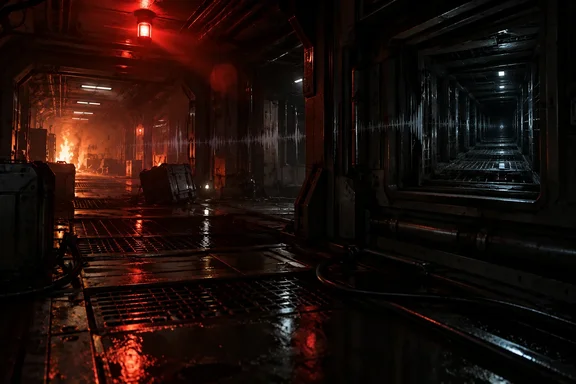
In the Gamescom interview, principal environment artist Archie Whitehead described Unreal as “a great base” while explaining why Creative Assembly wanted specialized systems. Earlier reporting supports the broad architecture: IGN’s June preview described custom lighting built atop Unreal Engine 5 and custom audio during a 30-minute viewing of the game. That corroborates the use of those systems, rather than proving their superiority over an alternative implementation.
For PC players, the important distinction is between a developer explaining its visual and acoustic goals and a finished game demonstrating how efficiently it achieves them. For developers, the more interesting story is where Creative Assembly chose to supplement a general-purpose engine—and why darkness makes those decisions consequential.
Alien: Isolation 2 adds custom systems to Unreal Engine 5
The September interview develops a technical direction Creative Assembly had already discussed. In June, creative director Alistair Hope told TechRadar that the team was using Unreal Engine while developing its own lighting and audio technology to fine-tune the experience. The later comments supply specific examples of what that customization is intended to accomplish.
Whitehead emphasized reactivity: lighting responding to changing environmental elements rather than merely producing an attractive static scene. His examples included fire flicker, spinning sirens and weather effects. “We felt that a custom solution would give us that perfect frame response that you want in that really, really dark environment,” he told TechRadar.
“Perfect frame response” needs careful reading. In this interview, it describes the desired behavior of lighting as events happen. It does not establish a frame-rate target, a measured reduction in rendering latency or an improvement in controller responsiveness. None of those measurements accompanies the claim.
Nor does the interview disclose the boundary between Creative Assembly’s technology and Unreal’s existing renderer. It does not establish whether Lumen is entirely replaced, selectively bypassed or retained alongside custom components. Using Unreal Engine 5 does not establish which of its lighting features a game uses, and the phrase “custom lighting” does not resolve that question by itself.
The documented development choice is therefore straightforward: Creative Assembly is retaining Unreal as its foundation while building specialized lighting and audio systems for this project. What has changed in the September account is the explanation of the requirements behind that choice, rather than an announcement that the studio has abandoned Unreal.
Lumen’s documented trade-offs explain the concern, not a universal limitation
Whitehead characterized Lumen, Unreal Engine 5’s dynamic global illumination and reflections system, as optimized for brighter scenes. That is his assessment of its suitability for this particular project. Epic’s own technical explanations show a broader picture: Lumen was designed to handle changing illumination, including interiors, indirect shadows and reflected light.
Global illumination describes light bouncing between surfaces. Direct lighting illuminates a surface from a light source; indirect lighting accounts for light that reaches it after bouncing elsewhere. Reflections provide another part of the image, particularly on smooth or metallic surfaces. In its May 2022 technical overview, Epic explained that Lumen calculates these effects dynamically, allowing changes in the world to affect lighting without rebuilding a fixed, precomputed lighting solution.
The practical difficulty is doing that work within the time available to render each frame. Epic describes tracing a limited selection of rays, caching lighting information and filtering results to reduce noise. Some reflection information is accumulated across multiple frames. These techniques make an expensive calculation usable in real time, but their quality and update behavior are part of the engineering trade-off.
Epic’s January 2023 account of bringing Lumen to Fortnite Battle Royale Chapter 4 provides a concrete example. The team targeted an average four-millisecond budget for global illumination and reflections within a 60fps console experience. Epic reported that more aggressive downsampling reduced temporal stability and made noise more noticeable in dark areas. Those are historical findings from that implementation, not measurements of Alien: Isolation 2 or a diagnosis of its renderer.
That history gives Whitehead’s emphasis on lighting response a plausible technical context. A system can produce convincing illumination while still requiring compromises over how rapidly and cleanly it resolves changes. However, Whitehead did not identify temporal accumulation, sampling noise or a particular Lumen defect as the cause of Creative Assembly’s decision. Connecting those specific mechanisms to the sequel would go beyond his explanation.
Epic also documented successful handling of dark interiors, with controls to preserve usable shadow detail and manage exposure. Its record supports the existence of difficult trade-offs, rather than the sweeping claim that Unreal Engine 5 cannot produce the atmosphere Creative Assembly wants. No independently reported comparison establishes the September interview’s claimed response advantage.
Alien: Isolation 2’s metal problem is a lighting problem
Whitehead’s second example concerns metal in dark exterior environments. He told TechRadar that metals are difficult to render convincingly because their appearance depends heavily on what they reflect. With so much of the surrounding scene dark, he said, making metal “behave properly” becomes a difficult balance.
The useful implication is that darkness affects more than overall brightness. A scene may need to remain dim while still giving reflective materials enough visual information to read as the intended surface. According to Whitehead, Creative Assembly’s custom lighting helps the team strike that balance.
The interview does not explain how. It supplies no evidence of a particular reflection technique, altered material model or ray-tracing requirement. Naming any of those as the solution would turn a description of an artistic and technical problem into an invented implementation.
Epic’s Fortnite account offers a relevant comparison without supplying the missing answer. Before Chapter 4, Epic said its console reflections were limited to screen-space reflections, which can only reflect information visible on screen. Artists had worked around shortcomings indoors by largely avoiding specular response on interior materials. Epic reported that Lumen reflections let those artists render metals and smooth surfaces correctly indoors.
That is an important counterweight to treating Creative Assembly’s comments as a general verdict on Lumen. Epic describes Lumen resolving a material-rendering limitation in Fortnite; Whitehead describes additional control being useful for Alien: Isolation 2’s dark environments. Both accounts can be accurate because they concern different scene requirements and development decisions.
Epic’s treatment of darkness also illustrates the role of art direction. For Fortnite Chapter 4, the company introduced “Skylight Leaking” to add limited ambient illumination indoors and “Diffuse Color Boost” to amplify bounced light. It also used Local Exposure to preserve highlight and shadow detail in high-contrast images. These are documented developer-side choices from Fortnite’s implementation, not recommended player settings or confirmed components of Alien: Isolation 2.
Alien: Isolation 2’s audio makes the layout part of the sound
The audio explanation follows the same project-specific logic. According to Whitehead’s TechRadar interview, the sequel’s system is an evolution of the original Alien: Isolation technology. He said it had been repeatedly iterated on and used in other Creative Assembly projects, although he did not name them.
His example is a sound originating in a room separated from the player by a vent. The system creates what he called a “spatial setup of the world,” with the sound reverberating through that arrangement. The studio’s goal is a response that feels realistic and frightening.
This describes environmental relationships as part of sound presentation. The relevant information includes where a sound occurs and how the surrounding spaces connect. Whitehead’s example makes that intention understandable without establishing exactly how the acoustic calculation works.
It would nevertheless be premature to call this a fully simulated acoustic environment or attach a particular audio technology label to it. The interview does not identify middleware, a propagation algorithm or processing costs. It also does not establish requirements for headphones, surround speakers or Windows spatial-audio settings. The custom audio announcement is not a reason to buy new audio hardware.
IGN’s earlier preview offers limited observational support for the broader presentation: its writer described machinery sounds and the creature’s audio cues as being provided by custom audio systems. That account does not supply a controlled comparison with the original game or Unreal’s standard audio facilities. The supported before-and-after is a developer-described evolution of existing technology, with a concrete explanation of its spatial ambitions.
PC players should wait for requirements, not infer them from the engine
Keep hardware decisions separate from this development interview. TechRadar reports that Alien: Isolation 2 is in development for PC, PlayStation 5, Xbox Series X and Series S, and Nintendo Switch 2. The September report gives no release date, and the evidence here does not establish minimum PC specifications, performance targets or how the custom systems scale across those platforms.
For developers, Epic’s historical examples demonstrate why evaluating lighting in representative scenes is more informative than judging an engine by its feature list alone. Creative Assembly’s account adds its own priorities: rapid changes in very dark environments, convincing metallic surfaces and sound shaped by connected spaces. It does not provide enough implementation detail to reproduce the studio’s solution.
The practical takeaways are narrower than the headline’s engine-versus-custom framing:
- Treat Alien: Isolation 2 as an Unreal Engine 5 project with custom lighting and audio, not as a switch to an entirely proprietary engine.
- Read “perfect frame response” as Whitehead’s lighting objective, rather than a promise of high frame rates or low input latency.
- Do not infer a hardware ray-tracing requirement, a particular GPU requirement or a Windows audio configuration from these comments.
- Keep the reported platform list separate from visual parity; the interview does not explain whether every version uses identical lighting and audio implementations.
- For a PC purchase decision, wait for published requirements and independent performance testing rather than using the engine name as a shortcut.
Creative Assembly has identified specific reasons to customize its technology: the timing of changing light, the appearance of metal in darkness and the acoustic relationship between rooms. Those details make this a substantive development story. The eventual PC release will still need to demonstrate the result at a documented hardware cost; for now, the evidence explains the studio’s design priorities, not the upgrade players will need to experience them.