

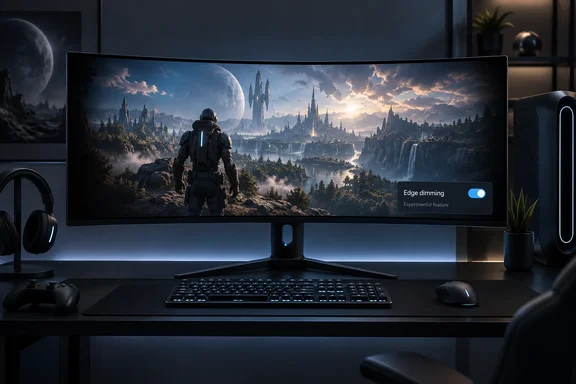
The story is interesting because the flaw looks like a firmware setting. That makes it fixable, but Alienware is holding off, most likely because turning the setting off means giving up some burn-in protection. The same question will come up on any OLED monitor that ships with panel protection users can't adjust.
Alienware's AW3926QW statement commits to testing and nothing more
The company's position comes from one short statement. TFTCentral published it on September 15, 2026. PC Gamer later attributed the same words to Kris Graft, Alienware's monitor expert, in connection with a Reddit Ask Me Anything session. Alienware said: "We hear the feedback on uniformity and are actively testing a potential toggle that could give customers more control over uniformity. We want to make sure we understand the full customer experience implications before we enable anything. More to come soon."
Read it closely and the commitment is small. Alienware says it is actively testing a possible toggle but has not confirmed that the option will be released. Guru3D came to the same conclusion: Alienware has not committed to releasing the option and has not provided a firmware date. The statement also never names Convex Power Control, the feature widely blamed for the dimming. It talks only about "uniformity," meaning how evenly brightness is spread across the screen.
PC Gamer's reviewer, who gave the monitor a glowing review apart from this one issue, went further. He wrote that Graft appears to be saying that Alienware is planning a firmware update that will add a toggle for CPC in the AW3926QW OSD menu. That is a fair reading, and other outlets have reported the story the same way. Still, it is an interpretation. An on-screen-display switch for CPC is the likely result, but Alienware has not described it.
Club386 adds useful background. It spoke with Vincent Seajun Kim, Alienware's monitor lead planner, at IFA 2026. According to Club386, Kim confirmed this was the likely cause and told us Alienware was considering making this a toggleable feature. So the company was already thinking about a user control before its public statement, which suggests the plan is more than a reaction to bad press.
Convex Power Control explains the vignette on the AW3926QW
The AW3926QW is a 39-inch ultrawide with a 5K2K resolution. PC Gamer describes its pixel density as similar to a 32-inch 4K panel. It uses LG Display's latest Tandem WOLED technology with an RGB-stripe subpixel layout, and PC Gamer puts the price at around $1,100. The problem is what PC Gamer's reviewer described in his review: "during gaming the edges of the panel gradually dim ever so slightly," an effect usually called vignetting.
Reviewers blame CPC, short for Convex Power Control. TFTCentral describes it as an OLED care feature that is designed to reduce the risk of image retention. On the AW3926QW, it can lower brightness around the edges of the panel under certain conditions. Club386 explains why the edges are the target: this should mitigate any image retention from surrounding static HUD elements, which are usually on the edges, while the natural dynamism of content in the centre of the display takes care of such concerns in that area.
The feature is common. What's unusual is that owners can't switch it off. TFTCentral says CPC is used on other OLED monitors, although some manufacturers allow users to disable them. Alienware gives owners no such option today. TFTCentral says this means the feature can activate in a range of situations where some users may find the brightness difference distracting. PC Gamer's reviewer had predicted in his review that if CPC was the cause, a firmware update could fix it. In his words, the problem looked like a configuration issue rather than a hardware limitation.
TFTCentral's review also found that LG's equivalent 39″ OLED has the same behaviour. Buyers comparing the two panels won't avoid CPC by switching brands. This is a trait of the panel family, and each manufacturer decides how much control to give users.
Reviewers measured AW3926QW edge dimming at different levels
The severity depends on who measured it. Club386 found curiously poor uniformity we measured on our sample, with deviances in brightness of up to 21% from the centre of the panel. TweakTown, summarising TFTCentral's findings, reported that TFT Central's sample showed about 40% lower luminance around the edges than the middle, and that CPC can aggravate existing uniformity issues. These figures come from single review units tested in different ways, so they can't be compared directly. They do show that the dimming can be measured and is more than a viewing-angle impression.
How much it bothers people varies a lot. TFTCentral, which measured the effect, said the feature is currently enabled without any user control, but that its own testers cannot turn it off either. Even so, the outlet did not find it overly problematic or obvious in everyday use. It said it would still prefer an option to disable it and accepted that many people would find it distracting. PC Gamer's reviewer liked the monitor enough to call it his favourite of the moment, and this is the one issue that stopped him from giving it an unqualified buy recommendation.
In the Reddit AMA, owners described the same thing. One player said interface elements in World of Warcraft looked duller at the sides and bottom of the screen than in the middle, while other owners said they didn't notice it. These are individual reports, not controlled tests. Games that put maps, status bars or health readouts along the screen edges are where you would expect the effect to show most, because CPC dims exactly those areas.
Guru3D points out a limit. Providing a toggle would not necessarily solve every uniformity concern. OLED panels naturally vary between samples, while near-black presentation, room lighting and the monitor's selected picture mode can affect perceived uniformity. A CPC switch should deal with the vignette caused by CPC. It won't fix unevenness that some panels have from the factory.
Burn-in and warranty are the unanswered questions behind any CPC toggle
Alienware's mention of "customer experience implications" is what's holding the fix back. The company hasn't said what it means. TFTCentral's interpretation is that the phrase would include things like its potential impact on image retention and burn-in, warranty cover etc so it's certainly reasonable for everything to be tested, evaluated and considered. That is the outlet's own reading, not Alienware policy.
The reasoning is simple. CPC exists to reduce stress on the parts of the panel most likely to show static game interface elements. Turning it off puts that stress back. Guru3D argues that if Alienware adds the option, the firmware should clearly explain the tradeoff. Users selecting reduced protection need to understand that prolonged static desktop elements, browser toolbars or game interfaces could place additional stress on the panel.
Warranty is the bigger worry for buyers. PC Gamer's reviewer suggested that switching CPC off might affect burn-in warranty coverage. He also suggested the monitor could record how many hours were spent with the feature disabled and void coverage past some limit. He described both ideas as speculation. Alienware has not announced any warranty change, usage counter or burn-in exclusion linked to a toggle, and no outlet has reported one.
It's also worth being clear about what this issue isn't. VideoCardz notes that the current discussion is therefore not about a panel failure or recall, but about giving users more control over an existing OLED protection feature that can affect perceived screen uniformity. Guru3D agrees that the reported issue does not indicate that every AW3926QW panel is defective, nor has Alienware announced a recall.
What this means for AW3926QW owners and buyers
Current owners should keep the settings as they are and wait for official firmware. If the edge dimming is a dealbreaker, buyers should decide based on how the monitor behaves today, not on a toggle Alienware hasn't promised to ship. Dell's support page for the Alienware 39 5K OLED Gaming Monitor AW3926QW has sections for drivers and downloads, manuals and advisories. Any firmware update and any updated user guide explaining a new setting should appear there first.
If you're still within your retailer's return period and the vignette bothers you in the games you play, that period is a firm deadline, while "more to come soon" isn't. Moving to LG's 39-inch equivalent won't help, since TFTCentral found CPC active on that screen too. If you've barely noticed the effect, as TFTCentral mostly didn't, there's no reason to do anything.
Owners should avoid unofficial workarounds such as hidden service menus. No official workaround exists, none has been shown to be safe, and changing panel-protection behaviour outside Alienware's firmware could make warranty claims harder while the company is still deciding how to handle exactly that question.
- Alienware is testing a possible uniformity toggle for the AW3926QW, but it has not confirmed that one will ship and has given no release date.
- Reviewers link the edge dimming to Convex Power Control, an OLED protection feature that dims the panel edges to reduce the risk of image retention from static interface elements.
- Measured edge dimming varies between reviews, with Club386 reporting up to 21% deviation from the centre on its sample.
- Alienware has not said whether turning off the protection would affect burn-in risk or warranty coverage, so don't assume either way.
- LG's equivalent 39-inch OLED also uses CPC, so switching brands won't avoid the behaviour.
- Watch Dell's AW3926QW support page for firmware and documentation, and don't use service-menu workarounds while the warranty question is open.
The AW3926QW's biggest criticism looks fixable with a firmware setting, and Alienware has said it is listening. What happens next depends on details Alienware hasn't released: whether a toggle ships, what CPC's default setting will be, and whether the burn-in warranty still applies when owners turn protection down. If Alienware ships the switch and keeps warranty coverage the same, the AW3926QW will have fixed its main weakness, and other OLED monitor makers will have a harder time justifying panel protection that users can't turn off.