

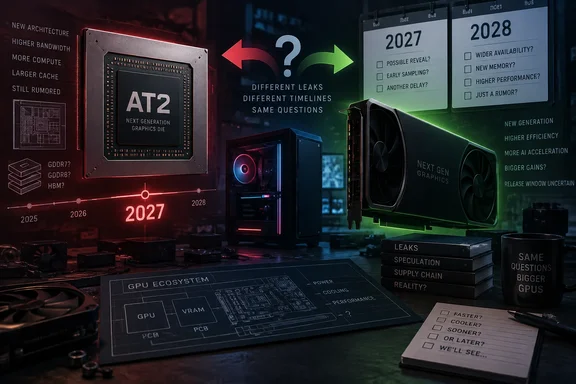
For PC builders, the useful conclusion is much narrower than the headline: there is no dependable 2027 GPU roadmap yet. There are two incompatible leak narratives, neither AMD nor Nvidia has published a consumer-GPU launch schedule, and the only concrete AMD detail in the new claim is an alleged midrange die whose gaming performance, board configuration, branding, price, and release window have not been established.
The rumor deserves attention because it comes from a named source with an earlier public record of discussing AMD’s alleged next-generation die layouts. It does not deserve the 70 percent confidence rating Wccftech assigned to it. A direct forum post establishes that Kepler_L2 made the claim; it does not establish that either vendor has committed production capacity, board-partner plans, or a retail date.
Kepler_L2’s claim is unusually broad
The wording reported by 3DCenter leaves little room for interpretation. Kepler_L2 reportedly said AT2 is the only GPU “getting released next year,” and that “everything else from both AMD and NVIDIA is 2028.” If accurate, that covers far more than a delayed flagship: it implies no broader RDNA 5 or UDNA desktop rollout from AMD in 2027 and no GeForce RTX 60-series introduction from Nvidia in that calendar year.
That is a much bigger assertion than the evidence currently supports. No launch quarter was provided for AT2. There is no indication whether “released” means a desktop Radeon card, a laptop part, a die entering mass production, or a product announcement. Nor did the post identify a Radeon product name, partner boards, memory capacity, process node, or regional availability.
The Nvidia half is equally unresolved. Earlier reporting from Tom’s Hardware, based on reporting by The Information, had already described a scenario in which memory constraints could push RTX 60-series production into 2028. But this week, Moore’s Law Is Dead told viewers that Nvidia had approved a first-half 2027 launch for gaming-oriented Rubin, a claim subsequently covered by Notebookcheck and Tweaktown.
These reports are not corroboration of one another. They are competing accounts based on unnamed sources, and they disagree on the only detail enthusiasts most want to know: whether the next GeForce generation arrives in 2027 at all.
AT2 is a die codename, not a confirmed Radeon product
The part called AT2 is not new to GPU-rumor watchers. In August 2025, Kepler_L2 posted alleged diagrams for four AMD next-generation graphics dies at the AnandTech Forums: AT0, AT2, AT3, and AT4. Those diagrams showed AT2 with 40 Compute Units, four Shader Engines, six memory controllers, and what appears to be a 192-bit memory interface.
ComputerBase and PC Gamer both documented those diagrams at the time. Their reporting also exposed why any performance claim based on this material is premature: the rumored CU numbers may use a changed definition of a Compute Unit. If AMD were to count a larger block similar to a prior Work Group Processor as one CU, an apparent drop in unit counts would not be comparable generation to generation.
That caveat undermines one of the most eye-catching parts of Wccftech’s framing. The article suggests AT2 could take on a high-end Blackwell product such as the GeForce RTX 5080. The available alleged block diagram does not demonstrate that. A 40-CU label and 192-bit bus reveal neither actual shader throughput nor cache behavior, clocks, ray-tracing performance, memory speed, power consumption, or the amount of working silicon AMD could turn into retail cards.
Even the reported AT2 layout has oddities. The same set of diagrams gave the smaller AT3 die eight memory controllers and a purported 256-bit interface, wider than AT2’s six controllers and 192-bit interface. ComputerBase flagged that inconsistency in its original coverage. It could reflect different intended markets or memory technologies; it could also mean the public diagrams are incomplete, misunderstood, or simply not product-ready specifications.
AMD has not announced RDNA 5, UDNA as a consumer Radeon architecture, AT2, or any 2027 Radeon launch. Treating an internal-looking codename as a finished graphics-card plan skips every commercial decision between a die diagram and a board on a store shelf.
The “RDNA 2 AT2” label is wrong
There is a basic factual error in the submitted report’s own headline treatment: it calls AT2 an “RDNA 2” GPU in one place. The surrounding text, its specification table, and the earlier coverage all refer to the alleged next architecture as RDNA 5 or UDNA. RDNA 2 is AMD’s 2020-era gaming architecture, used in Radeon RX 6000-series cards and the current-generation console designs.
It may be a typographical slip, but it matters in a rumor report built around unexplained code names. AMD’s architecture naming has already become a source of confusion, especially because “UDNA” has been used in reporting as a potential unification or successor label rather than a retail product family. Readers should not mistake an unconfirmed AT2 die for any known RDNA 2 product or expect compatibility conclusions from the name alone.
The claimed core totals require similar care. Wccftech’s table converts the rumored 40 CU AT2 design into 5,120 cores by assuming 128 stream processors per CU. That assumption comes from another unconfirmed leak, not from AMD documentation. It is a mathematical extrapolation, not a disclosed specification.
Memory supply is a plausible explanation, not proof
The reports share a plausible market backdrop: high-bandwidth graphics memory and advanced semiconductor capacity are constrained enough to influence which products manufacturers prioritize. Nvidia acknowledged to Tom’s Hardware earlier this year that GeForce demand was strong and memory supply constrained, while declining to confirm the rumored product delays.
That statement supports the existence of a supply constraint. It does not confirm that RTX 50 Super products were cancelled, that RTX 60-series consumer cards slipped to 2028, or that AMD chose to launch only AT2 in 2027. Those are three separate claims involving different product lines and, in AMD’s case, a different company.
For Windows gamers and IT buyers, the practical risk is assuming that a delayed generation will make current hardware cheaper or easier to source. It may do the opposite. If vendors restrict new high-memory cards while demand stays high, the market can remain anchored around existing products for longer, with fewer pressure points for price cuts. But that is an economic consequence to watch for, not an announced policy or a forecast that can yet be planned around.
Do not postpone a needed build on this rumor
Anyone who needs a GPU for a Windows 11 gaming PC, a local AI workstation, CAD, rendering, or GPU-accelerated development should buy against present workload requirements, verified benchmarks, VRAM needs, power limits, and warranty support. A vague 2027-or-2028 timeline cannot tell a buyer whether an AT2-based Radeon will ship with 12 GB, 16 GB, or 24 GB of memory—or whether it will materially outperform the card available today at the same price.
Enthusiasts considering an optional upgrade have a clearer reason to wait for more evidence: either AMD or Nvidia must eventually show a product. Watch for official architecture disclosures, investor presentations that distinguish data-center Rubin from consumer GeForce silicon, regulatory filings, board-partner registrations, and credible leaks that agree on a specific die and launch period.
As of September 16, 2026, the only solid development is that Kepler_L2 has publicly placed AMD’s alleged AT2 die in 2027 and the broader AMD and Nvidia transitions in 2028. The competing Nvidia 2027 claim means the next GeForce launch window remains disputed, while AMD’s purported AT2 remains a diagram and a codename rather than a graphics card anyone can buy.
Update: Kopite7Kimi now also places GeForce RTX 60 in 2028 (September 21, 2026)
Tom’s Hardware reports that Nvidia leaker Kopite7Kimi has revised his own outlook, saying the consumer Rubin-based “GR20x” products are now planned for 2028 rather than a possible late-2027 arrival. That is a meaningful shift because it independently aligns with Kepler_L2’s broader claim that Nvidia’s next GeForce generation will miss 2027.
The report does not make a 2028 launch official. Nvidia had not responded to Tom’s Hardware at publication, and neither the leaker’s post nor the report identifies a launch quarter, specific RTX 60 models, or retail-board specifications.
Still, the new claim weakens the earlier first-half-2027 Rubin narrative. It also reinforces the possibility that Nvidia may prioritize Rubin data-center and workstation products, along with constrained advanced-node and memory capacity, before committing comparable resources to gaming cards.
For Windows PC buyers, the practical position remains unchanged: do not plan a build around an assumed RTX 60 launch in 2027. The latest rumor consensus is moving toward 2028, but an official Nvidia roadmap is still required before that becomes a dependable purchasing timeline.
References
- Leaker Claims AMD And NVIDIA Delay Next-Gen GPUs To 2028, Except One RDNA 5-Based AT2 Chip Launching In 2027 Wccftech · 2026-09-16T13:40:45+00:00
- Nvidia's next-gen RTX 60 GPUs might not be released until 2028, prominent leaker claims — gaming takes a back seat as company focuses on delivering data center products Tom's Hardware · 2026-09-21T09:52:19+00:00