

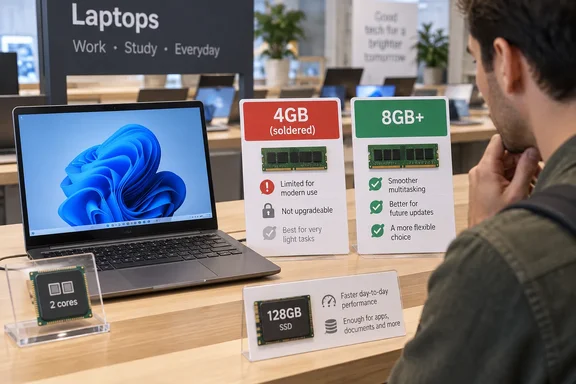
What the Athlon Silver 10 actually is
AMD's own spec page answers most of the question. It lists the Athlon Silver 10 under the former codename Mendocino, with the Zen 2 processor architecture, two CPU cores, no simultaneous multithreading (SMT), and two threads. The maximum boost clock is up to 3.5 GHz, base clock 2.4 GHz, with 1 MB of L2 cache, 2 MB of L3 cache, a 15W default TDP and TSMC's 6nm FinFET process. AMD gives the launch date as 10/1/2025. TechRadar points out that no launch event came with it.
The "new" label is mostly a rename. Notebookcheck says the Athlon Silver 10 is pretty much a renamed AMD Athlon Silver 7120U from 2022 and should offer identical performance, although this depends on cooling and TDP settings. AMD hasn't said in so many words that the two chips are the same. That's Notebookcheck's reading, and the specs match it closely.
A few more limits matter for buyers:
- Graphics: The integrated Radeon 610M uses RDNA 2 with just two compute units, according to Notebookcheck's spec listing.
- Expansion: The chip supports only four PCIe 3 lanes, which Notebookcheck reads as a sign AMD doesn't want laptop makers pairing it with dedicated graphics.
- Memory: The integrated memory controller supports only LPDDR5 (5500 MT/s max). LPDDR5 is normally soldered to the motherboard, which is why so many of these laptops have RAM you can't upgrade.
The Silver 10 also belongs to a wider renaming. Notebookcheck lists it in the Mendocino family next to the Athlon Gold 20, Ryzen 3 30 and Ryzen 5 40. Those are the same 2022-era designs under new numbers. The Ryzen 3 30 and Ryzen 5 40 at least have four cores and eight threads. The Silver 10 is the bottom of that range.
Section summary: The Athlon Silver 10 is a two-core, two-thread Zen 2 chip with a 2025 launch date and a 2022 design. On paper it is the 7120U under a new name.
How slow is it?
TechRadar cites a PassMark multithreaded average of 3,543 for the Silver 10. An independent spec aggregator, SiliconCat, shows the same numbers: 2089 single-core and 3543 multi-core.
The comparison scores come from TechRadar, and I couldn't check them myself here. The site says Intel's Core 3 100U (two Performance cores plus four Efficient cores) averages 12,308, and the 2023 Core i5-1334U (two P-cores plus eight E-cores) averages 12,991. If those figures are right, the Intel chips score more than three and a half times higher in multithreaded work.
Treat those as database averages, not promises. Laptop makers set different power limits, cooling designs and firmware, and a cheap chassis can hold back a good chip. Notebookcheck's own assessment is still harsh. It says the Silver 10's CPU performance is only just good enough to compete with Intel's low-end quad-core N-series chips from 2023.
What does that mean day to day? A dual-core chip without SMT can only run two threads at once. In a modern browser, a dozen tabs, a Teams or Zoom call, Windows Update in the background and Defender scanning all compete for those two threads. You won't see a blue screen. You'll see a laptop that keeps making you wait.
Which laptops use it, and the 4GB question
The core of TechRadar's complaint is less about the CPU than about how some of these laptops are configured. It says ASUS, Lenovo and HP sell Silver 10 or 7120U machines, often with as little as 4GB of soldered memory and no way to add more.
There are listings that fit that description:
| Maker | Example configuration | Memory |
|---|---|---|
| ASUS | Vivobook Go 15 (E1504FA-PS04 series) | 4GB RAM, 128GB SSD, Windows 11 Home |
| HP | OmniBook 3 14z-hy000 | 8 GB onboard, 256 GB PCIe Gen4 NVMe SSD |
| HP | OmniBook 3 17.3-inch | 8 GB onboard, 128 GB PCIe NVMe M.2 SSD |
| Lenovo | IdeaPad Slim 3 15.6-inch | 8GB RAM, 128GB SSD |
LaptopMedia's database also lists a 14-inch HP OmniBook 3 with 4GB RAM and a 128GB SSD, and on Newegg the 4GB ASUS Vivobook Go appears in several colours. So 4GB versions do exist, but not every Silver 10 laptop has 4GB. HP and Lenovo both sell 8GB versions, and LaptopMedia lists a 17.3-inch OmniBook 3 with 16GB. Model names don't tell you the memory configuration, so you have to check the exact SKU. Prices and stock also change quickly, so check the listing on the day you buy.
Why 4GB is a problem on Windows 11
Microsoft's official Windows 11 hardware requirements set system memory at "4 gigabytes (GB) or greater." That's the minimum needed to install Windows, not a recommendation for a pleasant experience. The same document asks for at least 64GB of free storage and warns that updates and features may need more space over time. Keep that in mind with the 128GB SSDs common on these machines.
TechRadar says Windows 11 uses 2.5 to 3GB of memory when idle. That's TechRadar's estimate. The real number depends on the build, drivers, OEM preinstalled software and how much memory the integrated GPU takes. The general point holds anyway: on a 4GB system, Windows and its background services take a large share before you open anything. When memory runs out, Windows pages to the SSD, and on a small budget drive that slows everything further.
And because the memory is soldered, you're stuck with it. A cheap laptop with a SO-DIMM slot can be fixed with a $20 stick of RAM. One with 4GB onboard will have 4GB for its whole life.
Section summary: Silver 10 laptops ship with 4GB, 8GB or even 16GB depending on the SKU. The 4GB, soldered, 128GB-SSD versions are the ones to avoid.
The alternatives argument
TechRadar says better options sell in the same rough $350 to $500 range, including Dell systems with the Core 3 100U and a similarly specced ASUS, usually with 8GB of RAM. Those specific listings and prices weren't independently confirmed here. The general advice still makes sense: in this price range, a four-core-or-better chip with 8GB is usually worth a modest premium over a two-core chip with 4GB.
You don't have to leave AMD to get that. Lenovo and others sell the same chassis with the Ryzen 3 30 or Ryzen 5 40, the four-core, eight-thread chips from the same renamed family. If the price difference is small, that's usually the easiest upgrade you can make.
Is "e-waste" fair?
Here's the other side. A Silver 10 laptop with 8GB, used for email, documents and a few browser tabs, will work. Schools, kiosks and very light home users have got by on weaker hardware. AMD and the OEMs are serving a real low-cost segment, and memory and storage prices are under pressure across the industry right now. TechRadar itself mentions an ongoing AI-driven squeeze on memory, storage and compute.
The fairer criticism is about how these machines are presented. Calling a 2022 design the "Athlon Silver 10," launching it without any announcement and putting it in an "OmniBook" or "Vivobook" with 4GB of soldered RAM makes it look more modern than it is. TechRadar also cites the UN's Global E-waste Monitor 2024 to make its environmental case. The report counted 62 million metric tons of e-waste in 2022, with only 22.3% documented as properly collected and recycled. Whether one 4GB laptop adds to that problem is debatable. A machine that frustrates its owner within two years is more likely to be replaced early than one that ages well.
A pre-purchase checklist for budget Windows laptops
- Look up the exact processor. If you see "Athlon Silver 10" or "7120U," you're getting two cores and two threads. "Athlon Gold 20" gives you two cores and four threads. "Ryzen 3 30" or "Ryzen 5 40" gives you four cores and eight threads.
- Check installed RAM, not maximum RAM. Ignore "supports up to 16GB" and find the configured amount. Aim for 8GB at minimum.
- Check whether memory is soldered. HP lists soldered RAM as "onboard." Lenovo's PSREF spec sheets say "soldered" and list slot counts. If you already own a machine, open Task Manager, go to Performance, select Memory and look at "Slots used."
- Check storage. A 128GB SSD with Windows 11 on it fills up quickly. 256GB is a more realistic floor.
- Compare against the next tier up. A $50 to $100 step up often doubles the cores and the RAM.
The bottom line
The Athlon Silver 10 isn't a scam. It's a cheap, slow, two-core chip from 2022 with a new name. It's fine for a narrow set of light tasks when paired with 8GB or more. The 4GB, soldered-memory versions sold by ASUS, HP and others are the real problem: they meet Windows 11's minimum and not much more, and they can't be upgraded. If your budget can stretch even a little, buy a laptop with more cores and at least 8GB of RAM.
References
- Asus, Lenovo, and HP are selling cheap AMD Athlon Silver 10 laptops — for your own sake, do not spend your money on inferior e-waste TechRadar · 2026-10-01T19:10:00+00:00
- AMD Athlon Silver 10 Processor - Benchmarks and Specs - Notebookcheck Tech notebookcheck.net
- AMD Athlon Silver 10 - Specs, Benchmark Tests, Comparisons, and Laptop Offers laptopmedia.com