

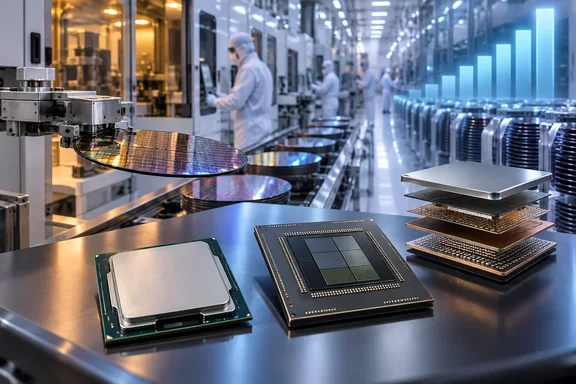
For PC buyers, the important distinction is between more chips leaving the manufacturing chain and more of the hardware they want reaching retailers at an acceptable price. Su’s remarks establish the former as AMD’s goal. They do not provide a product-specific guarantee for the latter.
What AMD has actually committed to
According to Reuters, Su said AMD increased supply during 2026 and intends to expand it substantially again in 2027. She did not specify a percentage increase or unit target. AMD also needs additional advanced wafer capacity and is now planning three to five years ahead.
The Taipei Times adds an important qualification: demand still exceeds AMD’s supply despite this year’s expansion. Su highlighted computing demand, particularly CPUs, and described the need to coordinate capacity across manufacturing partners. The company previously planned only one or two years ahead.
That makes this an effort to catch a moving target, rather than an announcement that shortages are about to disappear. If demand continues rising alongside production, a substantial supply increase need not create a surplus.
The takeaway: AMD is expanding its manufacturing pipeline, but has not said when supply will match demand or how the increase will be divided among product families.
Wafers are only part of the equation
Su’s Taiwan visit also concerned the less glamorous—but essential—parts of chip production. The Taipei Times reports that AMD is seeking capacity from backend manufacturing and substrate partners, not just TSMC’s wafer fabrication operations. Su emphasized advanced packaging, including chip-on-wafer-on-substrate, or CoWoS, as critical to AMD’s high-performance computing portfolio.
The same report describes a US$10 billion commitment AMD made in May 2026 to secure advanced-packaging capacity over three years. Separately, Reuters reports that AMD is working with memory manufacturers to secure sufficient supplies.
The practical inference is straightforward: expanding one manufacturing stage is not enough if another remains constrained. AMD’s longer planning horizon reflects the need to bring those capabilities online together. A wafer-capacity headline is not, by itself, a finished-product delivery schedule.
The Radeon RX 9070 XT comparison needs precision
The discussion around TechPowerUp’s report raises an understandable consumer question: what good is greater supply if the advertised price remains elusive?
A useful factual anchor comes from AMD’s own launch announcement. Published on February 28, 2025, it listed the Radeon RX 9070 XT at a $599 US suggested e-tail price, with board-partner availability expected to begin March 6, 2025. That is a historical launch price—not a verified current retail price.
There is also a timing correction worth making: March 6, 2025, to October 6, 2026, is exactly 19 months, rather than merely a little over a year.
More importantly, three different questions should not be bundled into one:
- Production: How many chips can AMD and its partners manufacture?
- Availability: Can buyers obtain the particular finished card or processor they need?
- Affordability: Can they obtain it at a price that makes sense?
AMD’s launch announcement establishes its suggested price and intended availability date. It does not establish retailers’ wholesale costs, rebate arrangements, or motives. Claims about those matters in reader comments should not be treated as documented explanations.
Nor does Su’s 2027 forecast resolve today’s Radeon pricing debate. The reported remarks contain no desktop Radeon allocation, retail-price commitment, or Ryzen-specific shipment timetable.
What PC buyers and IT teams should watch
As purchasing guidance, this announcement is best treated as a planning signal—not a reason on its own to delay an upgrade.
For a Windows desktop build or an enterprise hardware order, the useful follow-up evidence would be:
- Product-specific shipment or allocation announcements.
- Firm delivery dates for the required configuration.
- Sustained availability across multiple sellers.
- Actual quoted prices, rather than suggested-price comparisons alone.
AMD’s expansion could improve its ability to serve customers. But the announcement’s value should ultimately be judged by delivered products, not the size of the adjective attached to supply. “Substantial” is encouraging; an obtainable system at a workable price is the result that matters.
References
- AMD CEO Lisa Su Says 2027 Will Bring a "Substantial" Supply Increase - TechPowerUp TechPowerUp · 2026-10-06T23:01:27+00:00
- AMD plans to substantially increase supply in 2027, CEO says By Reuters investing.com
- AMD Unveils Next-Generation AMD RDNA™ 4 Architecture with the Launch of AMD Radeon™ RX 9000 Series Graphics Cards :: Advanced Micro Devices, Inc. (AMD) ir.amd.com