

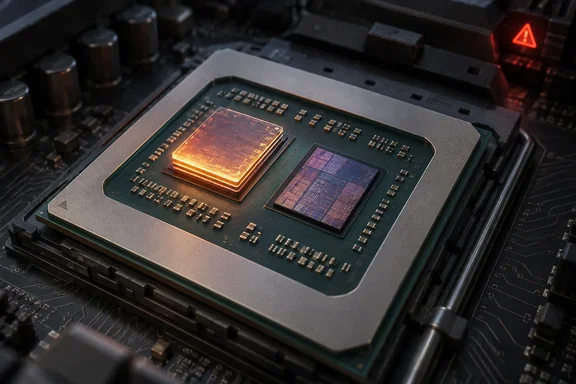
The October 2, 2026 coverage from VideoCardz, Softonic, TweakTown and Technetbook concerns the same reported discovery. The underlying account comes from China’s Chiphell forum; multiple headlines should not be mistaken for multiple independently authenticated samples. Softonic also identifies the processor as an unreleased Zen 3 sample with 128MB of cache.
For PC enthusiasts, this is an intriguing architectural footnote. For anyone hoping for another straightforward AM4 upgrade, the firmware caveat puts a sizeable speed bump in the road.
What the 128MB cache figure actually means
VideoCardz describes two core compute dies, commonly abbreviated as CCDs, with different L3 capacities:
| Reported component | Conventional L3 | Added 3D V-Cache | Resulting L3 |
|---|---|---|---|
| Cache-equipped CCD | 32MB | 64MB | 96MB |
| Other CCD | 32MB | None | 32MB |
| Processor total | 64MB | 64MB | 128MB |
The important distinction is that 128MB is the total L3 capacity, not the amount of added stacked cache. The proposed configuration adds 64MB to the processor’s existing 64MB across two chiplets. It is also asymmetric: the two CCDs do not have matching local cache capacities.
An independently documented comparison helps put that number in perspective. AMD’s official Ryzen 7 5800X3D specifications list eight cores, 16 threads and 96MB of L3 cache, alongside the AM4 socket and Zen 3 architecture. The reported Ryzen 9 sample therefore combines a higher core count with a larger aggregate L3 capacity—but those totals alone do not establish better performance.
The takeaway: this is a different cache arrangement, not simply a 5800X3D with every specification turned up.
Not the same configuration AMD showed in 2023
The distinction from earlier prototypes matters. VideoCardz recounts that AMD showed Gamers Nexus working 12-core and 16-core Zen 3 prototypes during a 2023 visit to its Austin laboratories. Those processors reportedly carried 3D V-Cache on both CCDs, producing 192MB of total L3. The newly reported sample instead has one stack and 128MB.
That comparison establishes two different reported configurations. It does not establish their development order, whether the newly surfaced unit was closer to a commercial design, or why AMD did not sell it. A prototype appearing online years later is not, by itself, evidence of a revived product plan.
There is also a useful boundary between prototype history and a documented release. AMD lists the retail Ryzen 7 5800X3D’s launch date as April 20, 2022, with an official maximum boost clock of up to 4.5GHz. Those are published product specifications; the newly surfaced Ryzen 9’s software readings belong to a different category of evidence.
Clock readings are not benchmark results
TweakTown identifies the engineering sample with code 100-000000652 and describes screenshots showing 12 cores, 24 threads and a 105W TDP designation. It reports a CPU-Z frequency reading around 4.65GHz, while noting other reports of a maximum as high as 4.85GHz. Neither figure establishes sustained clocks under gaming or productivity workloads.
Technetbook presents 4.85GHz more definitively as a maximum boost figure. The cautious interpretation is preferable: this is engineering-sample reporting, not an AMD specification sheet.
TweakTown’s coverage supplies no benchmark scores. Consequently, there is no supported basis here for claiming that this sample outperforms the 5800X3D, the ordinary 5900X, or the earlier dual-stack prototype. Nor do the readings prove that leaving one CCD without stacked cache caused higher frequencies. That remains a hypothesis, not a demonstrated result.
A screenshot can reveal an interesting configuration. It cannot substitute for repeatable performance testing.
The BIOS limitation is the practical warning
According to VideoCardz, the Chiphell owner says the sample failed to boot with the latest motherboard BIOS, stopping at error code 90. An older BIOS containing SMU firmware 56.70.0 reportedly allowed it to run. The owner also reportedly contacted ASRock about support in a newer BIOS.
That is an account of one sample’s behavior—not a compatibility guide. An SMU version is not a motherboard-specific BIOS release number, and the reporting does not establish a generally supported board-and-firmware combination.
For Windows PC owners, the practical conclusion is straightforward: do not interpret this sighting as a dependable drop-in upgrade path. The reported boot problem occurs before Windows can become the relevant troubleshooting layer. Nothing in this evidence establishes that a Windows update, driver installation or scheduler setting would resolve it.
An interesting discovery, not a buying signal
The strongest supported reading is that the reported sample offers another look at AMD’s unreleased higher-core-count Zen 3 X3D work: 12 cores, two CCDs, and additional cache on only one of them. Its authenticity and everyday reliability have not been independently established by the cited coverage, and TweakTown reports no AMD comment confirming this particular unit.
The architectural curiosity is real; the performance verdict is still missing. Until there is authenticated hardware, controlled testing and a clearly documented support path, this Ryzen 9 5900X3D belongs in the history of intriguing PC prototypes—not on an AM4 upgrade checklist.
References
- Unreleased AMD Ryzen 9 5900X3D Prototype Emerges with 128MB Cache - Technetbook Technetbook · 2026-10-02T22:42:00+00:00
- AMD Ryzen 9 5900X3D engineering sample surfaces with a single 3D V-Cache stack and 128MB of L3 cache - TweakTown TweakTown · 2026-10-02T18:45:13+00:00
- AMD Ryzen 9 5900X3D engineering sample surfaces with 128MB L3 cache - VideoCardz.com VideoCardz.com · 2026-10-02T14:50:45+00:00