

What shipped, and when
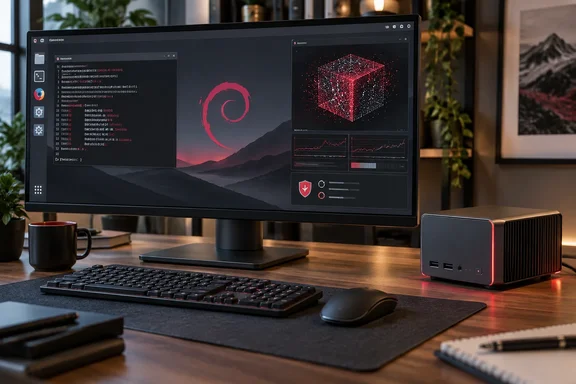
Phoronix's Michael Larabel notes that the Ryzen AI Halo's Linux preload turned out to be a customized AMD distribution, not stock Ubuntu or Debian, and that a new version was released "yesterday" relative to his October 2 report. AMD's release notes date the system image to October 1, 2026. They list the baseline as Debian 13 "Trixie" 13.7 plus further updates, and the image kernel as 7.2.7+rex-amd64. The product is named AMD Ryzen AI Developer Platform 1, codename "rex".
Phoronix says the platform moved from Linux 6.18 LTS to Linux 7.2, which it links to upstream AMDGPU and AMDKFD driver improvements. It also says the distro now runs ROCm 10.0 in place of ROCm 7.14. A new Developer Center bundle and a 4.00 BIOS for the Ryzen AI Halo are included too.
Phoronix reads this as a monthly release cadence. That is Phoronix's reading, not a published AMD schedule. AMD's own notes also warn that they may be superseded by later updates.
Why ROCm 10.0 matters
ROCm 10.0 succeeds the 7.x series as the newest major release of AMD's open-source GPU compute stack. Phoronix describes it as the first ROCm release since AMD moved to a six-week release cycle. AMD's ROCm blog calls ROCm.AI, a new AI-native developer experience, the headline of the release. Phoronix also reports that Windows will follow the same ROCm release cadence as Linux. That cadence is the Windows tie-in. It does not mean this Debian image runs on, or applies to, other platforms.
Version table from AMD's release notes
These are the versions AMD says it validated together on this image. Several moved a long way:
| Component | September release | Previous |
|---|---|---|
| ROCm | 10.0 | 7.14 (per Phoronix) |
| Developer Center | 1.4.0 | n/a |
| Kernel package | 7.2.7-1+rex1 | 6.18 LTS series |
| BIOS | 4.00 | n/a |
| PyTorch | 2.13.0 | 2.10.0 |
| TorchVision | 0.28.0 | 0.25.0 |
| TorchAudio | 2.11.0.2 | 2.10.0 |
| vLLM | 0.27.1 | 0.22.1 |
| ComfyUI | 0.34.2 | 0.21.1 |
| Lemonade | 11.8.1 | 11.5.0 |
| ggml | 0.22.0 | 0.13.1 |
| fwupd | 2.1.7 | 2.1.4 |
Node.js 20.19.2, Python 3.13.5 and amd-debug-tools 0.2.20 are unchanged. These are image-specific package versions. They should not be assumed to match what you get from other ROCm install methods.
Developer Center 1.4.0: a security channel
The main user-facing change is a Developer Platform Security section in the Manage tab. It appears when security updates are available and gives a dedicated channel for Debian CVE fixes. AMD's behavior notes:
- The app checks for security updates in the background once a week.
- Updates apply automatically after 5 days and need a reboot.
- You can install sooner by clicking the update button, which AMD says does not update your system configuration.
If you leave a box running long jobs, plan for that reboot. A five-day timer is a sensible default for patching, but it is not a promise that every OS fix arrives on that schedule.
Power management for unattended AI jobs
Suspend is on by default. The screen blanks after 5 minutes and the system suspends after 15. A suspend-inhibition feature in Developer Center is also on by default. It can block suspend when the machine is used headless or a GPU-intensive workload is running. AMD gives no detection guarantees or benchmarks, so test it with your own long-running jobs before trusting it overnight.
Application updates (AMD's claims)
These are release-note statements, not independent benchmarks.
- Lemonade 11.8.1: adds two experimental backends. One is TheNoise ROCm image generation, serving Anima and Krea-2. The other is ds4 (DwarfStar), serving DeepSeek V4 Flash. The catalog also adds Muse-Glimmer-30B-GGUF with draft decoding, vision and tool calling, plus Flux-2-Klein image models and OpenMOSS speech models.
- vLLM 0.27.1: more stable shared-RAM memory handling, which AMD says allows larger context sizes. It also has more mature gfx1151 ROCm/Triton support with no custom build patches needed, plus better multi-device tensor parallelism on Strix Halo.
- PyTorch 2.13.0: expandable memory segments, rocSHMEM symmetric memory collectives, FlexAttention pipelining and AOTriton performance improvements.
Fixes and security items
Listed bug fixes include:
- a GPUVM minimum page size of 4K on dcn35/36 displays
- random DMA corruption
- eGPU enclosure problems
- GPU oversubscription handling
- a TLB flush after MES queue eviction
- duplicate Plymouth logos on tiled displays
- package auto-removal during updates
The security list is long. AMD names twelve kernel CVEs and says the list is non-exhaustive. It also lists a set of libdrm hardening fixes, many GDM security fixes it attributes to Mythos, and a Developer Center fix for sudoers wildcard rules that allowed argument injection. The notes give no severity, exploitation status or affected-user details, so treat the list as an inventory, not a risk assessment.
AMD's one troubleshooting tip is for when Developer Center seems slow to update or stuck. Run sudo systemctl restart halo-lp. That is AMD's tip for this specific symptom, not a general fix for update failures.
Background and caveats
Phoronix's earlier review found the Ryzen AI Halo ships with Windows 11 or Linux options, and that the Linux option is this Debian-based platform. That review described a GNOME desktop with a GUI Developer Center for managing apps such as llama.cpp, vLLM, ROCm and Node.js. It also covered telemetry toggles, graphics performance settings and SSH remote-access controls. The review covered the Ryzen AI Max+ 395 "Strix Halo" configuration. The September notes do not say which of those Developer Center features are new in 1.4.0.
Bottom line: if you own a Ryzen AI Halo on the Linux image, this is a substantial stack refresh with a new automated security-update path. Back up first, expect a reboot, and test your inference workloads after updating. Everyone else should treat it as a signal that AMD's ROCm releases are now moving on a faster cadence.
References
- AMD Ryzen AI Developer Platform OS Updated With ROCm 10.0, Linux 7.2 - Phoronix Phoronix · Fri, 02 Oct 2026 14:25:00 GMT
- Ryzen AI Developer Platform: AMD's Own Linux Distribution Built Atop Debian - Phoronix phoronix.com
- ROCm 10.0: A Decade of Open Compute, Built for the Age of Agentic AI — ROCm Blogs rocm.blogs.amd.com