

The short version
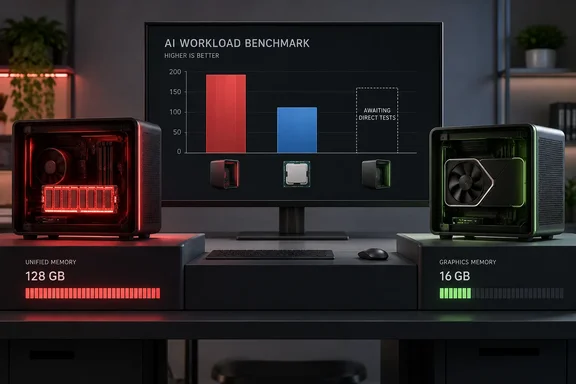
- AMD's benchmark comparison is against Intel's Core Ultra X9 388H, not RTX Spark. Tom's Hardware says no real RTX Spark performance results exist yet, apart from a few questionable Geekbench leaks.
- Tom's Hardware reports that the Microsoft event where the launch is expected is on Wednesday, October 7. Nvidia's own announcement only said RTX Spark Windows PCs arrive in October, so treat the exact date as an expectation, not a confirmed fact.
- Gorgon Halo's real edge over RTX Spark is memory capacity, not demonstrated speed.
What AMD tested
According to Tom's Hardware, AMD used ComfyUI to measure generative AI performance. It averaged several runs across various models and compared total throughput.
The test systems were unevenly matched:
- The AMD system was the top 192GB configuration of the Ryzen AI Max+ PRO 495.
- The Intel system was a Core Ultra X9 388H machine with 64GB of memory. Panther Lake supports up to 128GB, so the Intel box was not maxed out.
- The two chips also sit in different classes of device. Tom's Hardware notes AMD would argue it is simply comparing top-of-stack part against top-of-stack part.
AMD's claimed advantage runs from 1.1x to 32.2x. Tom's Hardware calls the 32.2x end an outlier. It also says it searched Hugging Face for the model behind it, labeled "Yuve", and found nothing. The outlet floats two possible explanations, an optimization issue or a model too big for the Intel machine. Neither is confirmed, so don't read 32.2x as a general speed ratio.
The local LLM claims
AMD also gave "up to" token rates for large mixture-of-experts (MoE) models:
| Model | AMD's claimed peak | Notes |
|---|---|---|
| GLM 5.3 Flash (320B total, 18B active per token) | 20 tokens/sec | Unsloth UD-IQ4_XS mixed quantization |
| Qwen 3.8 Flash Next (multimodal MoE, 5B active per token) | 42 tokens/sec | Unsloth dynamic 4-bit with multi-token prediction |
These are vendor figures, not independent tests. Tom's Hardware warns that "up to" is carrying a lot of weight. Token throughput falls as context length grows, and a model that manages 20 tokens per second on a short prompt could become unusable in a long agentic session.
For rough context, Tom's Hardware's own earlier measurements were 64 tokens per second on Nvidia's DGX Spark running GPT-OSS 120B at 4-bit, and 56 on the older Ryzen AI Max+ 395. The models and platforms differ, so these are not a head-to-head with AMD's GLM number.
Gorgon Halo is a refresh, not a new architecture
Tom's Hardware describes Gorgon Halo as largely a Strix Halo refresh. It has the same core counts and microarchitectures, a 100 MHz higher boost clock on the 495, and unified memory raised from 128GB to 192GB.
Other coverage shows how modest the other changes are:
- Compute-Market's analysis says capacity rises 50% while memory bandwidth rises only 6.6%, from 256 GB/s to 273 GB/s. The GPU keeps the same 40 RDNA 3.5 compute units.
- Its conclusion is that the extra memory lets you load models the 128GB part cannot, but it won't generate tokens faster on models both can hold. That is the site's own analysis, not a lab test.
- VideoCardz reports that systems like the Minisforum and HP's ZBook Ultra G3a can allocate up to 160GB of unified memory to Radeon graphics.
Where RTX Spark fits
Nvidia's September 3 announcement describes RTX Spark as a Windows PC platform. It has an RTX Blackwell GPU, a 20-core Grace CPU and up to 128GB of unified memory. Nvidia pairs it with the new Windows Agent framework, which it says runs agents in the background under OS-level control.
Tom's Hardware notes that RTX Spark is nearly identical to the GB10 chip in DGX Spark. It uses that as a proxy, and the earlier Strix Halo tests trailed DGX Spark in time to first token and tokens per second. That is an inference, not a direct comparison. More memory means bigger models, not faster ones.
Price and shipment claims
Gorgon Halo hardware is expensive:
- Tom's Hardware says top configurations sit around $7,000 and one has reached $7,099. That figure is GMKtec's regular price for its Evo-X5 Pro with 192GB and a 4TB SSD. The 2TB version lists at $6,799.
- VideoCardz reports the Minisforum at $7,399 and HP's ZBook Ultra G3a at $7,449.
- Phoronix reports Framework Desktop pre-orders starting at $6,799 for the DIY edition and $7,449 for the pre-built one with 2TB of storage.
Memory is a big part of that cost. The prices are system prices, not what the processor costs on its own.
AMD also told press it had shipped "10s of millions" of AI PCs, then clarified it had shipped "over half a million" agentic PCs. Tom's Hardware assumes the smaller number refers to Strix and Gorgon Halo devices. That attribution is not confirmed.
What this means for Windows buyers
- Wait for matched tests. Until RTX Spark systems are benchmarked against Gorgon Halo on the same models, quantization and context lengths, "AMD wins" is marketing.
- Match the tool to your model. If you need to load very large models locally, 192GB is a real advantage over RTX Spark's stated 128GB ceiling. If you run smaller models fast, capacity matters less.
- Test with long contexts. Agentic workflows use long contexts, which is where headline token rates fall.
- Budget for the premium. At roughly $6,800 to $7,450 per system, 192GB is a niche purchase today.
I'd treat AMD's benchmarks as a flag planted before the Nvidia event, not a verdict. The first independent RTX Spark reviews should show whether the memory advantage matters.
References
- AMD attempts to get ahead of expected RTX Spark launch with Gorgon Halo benchmarks Tom's Hardware · 2026-10-05T15:38:45+00:00
- First AMD "Gorgon Halo" PC with Max+ PRO 495 launches at $7,399, comes with 192GB of memory - VideoCardz.com videocardz.com
- AMD Gorgon Halo Benchmarks Hit Back at RTX Spark (2026) - shattered.io shattered.io · 2026-10-06T02:13:40+00:00