

Notebookcheck first detailed the X1’s intended mix of Android, cloud gaming and PC-game compatibility tools. Arc’s own product and preorder pages confirm the central specifications, pricing, India-only initial availability, and the tentative Q1 2027 delivery window. Gadgets 360 separately reports the same Snapdragon G2 Gen 2, 7-inch 120Hz LCD, 8GB RAM, 128GB storage, and October 2 reservation date.
At ₹33,500 at regular price, or ₹29,500 for Arc’s limited community batch, the X1 is positioned well below most Windows handheld PCs. But the lower price reflects a different machine with a different software proposition. Buyers expecting a plug-and-play alternative to a Steam Deck, ROG Ally, Legion Go, or other Windows portable should wait for real-world testing before treating Arc’s PC-game messaging as a buying reason.
A 7-inch Android handheld built around sustained play
The Arc X1 uses a 7-inch LTPS LCD with a 1,920 × 1,080 resolution, 120Hz refresh rate, and a conventional 16:9 aspect ratio. Arc lists brightness at more than 500 nits, while Gadgets 360 specifies 500 nits and Gorilla Glass 3 protection. It is an LCD rather than OLED panel, which separates it from premium Android competitors such as the Ayn Odin 2 Portal, but the resolution and refresh rate are appropriate for game streaming, Android titles, emulation, and video playback.
Internally, the X1 combines the Snapdragon G2 Gen 2 with 8GB of LPDDR5X memory and 128GB of UFS 3.1 storage. A microSDXC slot supports cards up to 1TB. The chip is built for Android gaming hardware rather than Windows PCs, and that distinction carries more weight than any marketing comparison based on screen size.
The hardware also includes Wi-Fi 6E, Bluetooth 5.4, a 3.5mm audio jack, USB OTG, and USB-C display output. Arc explicitly says the X1 does not support a dock, though a USB-C video-out port means it should still be possible to use an external screen with an appropriate adapter or display. Those are not the same thing: a docked handheld experience needs charging, display handling, USB peripherals and software behavior to work consistently, none of which Arc has demonstrated publicly.
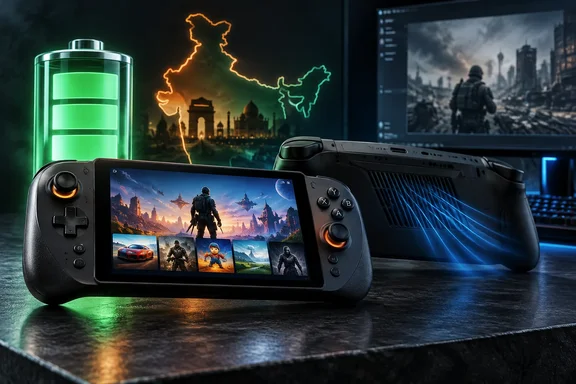
Arc is also including a centrifugal cooling fan, with rear intake and top exhaust vents. That is a sensible inclusion for an Android handheld expected to run high-refresh games, emulators, long cloud-streaming sessions, and translation-layer workloads. The X1 is listed at 450 to 500 grams, which puts it in handheld-PC territory rather than phone-controller territory. Its larger battery helps explain the weight.
The 9,300mAh battery is substantial, but the eight-hour claim needs context
The X1’s 9,300mAh battery is the headline specification. It is larger than the 8,000mAh pack in several 7-inch Android handheld competitors and supports 27W USB Power Delivery charging. Arc says users can expect more than eight hours of gaming and up to 10 days of standby time.
Those figures should be read as vendor claims rather than measured results. Gadgets 360 reports that the stated eight-hour figure applies in Silent Mode, while Arc has not published a breakdown covering display brightness, Wi-Fi use, fan behavior, emulation, streaming, or demanding Android games. Each of those can materially alter battery life.
The useful practical takeaway is that the X1 has more battery capacity than the typical compact Android handheld, not that it has demonstrated eight hours of performance in demanding games. A 120Hz panel, active cooling and PC-game translation can all draw considerably more power than lightweight native Android play. Independent battery testing will matter more here than the raw milliamp-hour number.
Arc does include an 80% charging limit, according to reporting by Gizmochina and Gizchina, though that option is not detailed on the company’s public specification page. If it ships as described, it could be valuable for owners who regularly leave the handheld charging at a desk or beside a television. Its practical benefit will depend on whether Arc exposes the feature reliably in OwlOS and continues to maintain it through firmware updates.
OwlOS is the real differentiator — and the biggest unknown
Arc is shipping the X1 with OwlOS, its controller-first operating environment built on the Android Open Source Project. Rather than dropping users into a conventional touch-first Android launcher, Arc says OwlOS will provide a unified game library, configurable performance modes, per-game profiles, resolution scaling, FPS overlays, custom controls, and a quick-resume function.
The company’s software page adds a few implementation details worth watching. Arc says OwlOS can suspend a session to storage and restore it after a cold boot; it also promises system and controller firmware updates together, including rollback after an update failure. For an Android handheld, where controller firmware, launcher behavior, power modes and fan curves can easily become a maintenance mess, an integrated update path is a meaningful design decision.
It remains a promise. OwlOS is an unproven platform from a first-time handheld vendor, and Arc has not published a detailed compatibility list, software roadmap, security-update policy, or a public demonstration of the launcher under real workloads. It has also not stated how long it plans to support Android version upgrades.
The more important omission for PC-oriented buyers is Windows compatibility. Notebookcheck says the X1 should run PC games through third-party Android tools including Winlator, GameNative and GameHub. Arc’s own public X1 specification page does not list Windows game translation or name any of those applications. It advertises native Android gaming, cloud gaming, gamepad mapping and controller remapping, but does not promise compatibility with a specific Windows game, storefront, anti-cheat system, launcher, or x86 title.
That leaves the X1 in familiar Android-handheld territory: some Windows games may work through translation or emulation tools, but success can vary sharply by game, renderer, DRM, controller implementation, driver support and user configuration. The device will not have native access to the standard Windows game library, Windows desktop applications, Game Pass PC installations, or the traditional Steam-on-Windows experience. Cloud gaming can bridge some of that gap, but cloud gaming is streaming from another PC or service, not local Windows execution.
Repairability is the part of Arc’s pitch that deserves attention
The X1 uses TMR analog sticks, Hall-sensor triggers with mechanical trigger locks, microswitch face buttons and D-pad, two programmable rear buttons, a six-axis gyroscope, and dual linear-resonant-actuator haptics. Those are solid choices on paper, particularly in a category where stick drift and weak membranes can end a device’s useful life long before its processor becomes obsolete.
More notably, Arc says it will make the battery pack, joystick modules and daughterboards replaceable, with spare parts available. Gizmochina and Gizchina also report the replaceable-module claim. This is a better starting point than treating a handheld’s battery and controls as sealed consumables, but it is not yet a repairability verdict.
Arc has not provided public part prices, repair instructions, warranty terms for self-service work, teardown documentation, or a schedule for parts availability. “Replaceable” can range from a straightforward hatch-and-screws job to a difficult repair requiring heat, adhesive removal and proprietary parts. The X1 should be judged on the availability and cost of its battery and stick modules after launch, rather than on the promise alone.
Reservations open in October, but delivery and availability are limited
Arc plans to open Batch 01 reservations on October 2, 2026. The reservation token is ₹999, is applied to the eventual balance, and Arc says it is refundable until one day before the final payment link is issued. Buyers will be asked to pay the remainder about 30 days before their expected delivery date, with a 72-hour window to complete payment and confirm their address.
The company’s official preorder material says the first batch is tentatively targeted for Q1 2027. It also states that preorders will initially be available in India only, with no announced date or market list for broader availability. That limitation matters for U.S. and European readers: the quoted rupee prices are not export prices, and international buyers should not assume local warranty, support, taxes, shipping, replacement parts or regulatory compliance.
The Arc X1 looks like a thoughtfully specified Android handheld with unusually large battery capacity and a potentially important repairability promise. It is also a first-generation product from a new vendor, with reservations opening months before the planned deliveries. For Android gaming, retro emulation and cloud streaming, the hardware merits attention; for local Windows gaming, the evidence supports caution rather than equivalence with a Windows handheld.
References
- Arc X1 is a new Android handheld with a 7-inch display and a near 10,000mAh battery Notebookcheck · 2026-09-20T14:32:00+00:00