

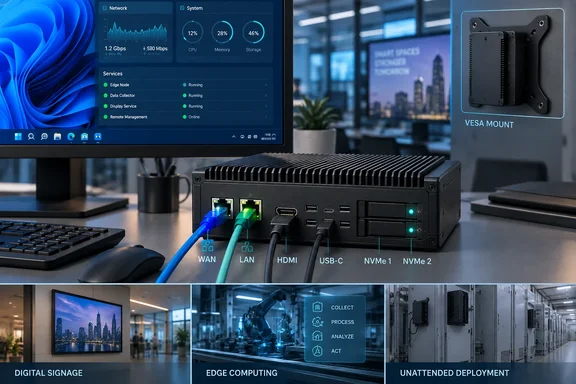
The important qualification is that these are not general-purpose performance NUC replacements aimed at enthusiasts. ASRock’s own documentation places them in its fanned embedded BOX range, and the hardware choices make them a credible fit for compact Windows endpoints, small network appliances, signage controllers, light edge workloads, and desk-mounted office systems where dual Ethernet and VESA mounting matter more than multi-core horsepower.
ASRock’s product pages and support portal confirm the models, with BIOS, Windows 11 driver packages, and documentation already published. But the company has not announced a recommended price, a retail availability date, or preconfigured RAM and SSD options. Buyers should treat the NUC BOX-320 and NUC BOX-304 as barebones systems until a distributor provides an actual configuration and delivery commitment.
Dual 2.5GbE is the practical differentiator
The shared platform includes one Intel I226V 2.5GbE controller and one Realtek RTL8125BG 2.5GbE controller. That mixed-controller arrangement is more useful than a second Ethernet jack on a typical consumer mini PC: it allows a single box to separate WAN and LAN traffic, serve as a compact firewall or VPN endpoint, or sit on both an automation network and a corporate network without consuming a USB adapter.
For Windows administrators, the controller mix also means driver validation should be part of deployment rather than an afterthought. ASRock supplies separate Intel and Realtek LAN drivers for Windows 11 x64. Organizations standardizing a golden image should test link negotiation, VLAN handling, power management, and wake behavior on both ports, particularly when the system is being used as an unattended appliance.
The rest of the I/O is strong for a machine this small. ASRock specifies two USB 3.2 Gen 2x2 Type-C ports on the front, each capable of 20Gbps data transfer and DisplayPort output, alongside one USB 3.2 Gen 1 Type-A port. The rear adds two USB 3.2 Gen 2 Type-A ports, two HDMI connectors, the two Ethernet ports, and DC input.
Storage is less flexible than the physical count of M.2 slots may suggest. One slot accepts a short 2242 SSD over PCIe 4.0 x1, while the other accepts 2242 or 2280 drives over PCIe 4.0 x2. There is no 2.5-inch SATA bay in ASRock’s specification. A two-drive configuration is possible, including RAID with matching PCIe interfaces, but neither slot gets the four PCIe lanes common in higher-performance desktop-class NVMe designs.
The 64 GB headline comes with one memory channel
The “up to 64 GB” specification is real, but it should not be read as a dual-channel workstation configuration. Both NUC BOX models provide one DDR5-6400 SO-DIMM slot, and Intel lists one memory channel for both the Core 5 320 and Core 3 304.
That limitation is architectural rather than a cost-cutting omission by ASRock. Intel’s Wildcat Lake-derived Core Series 3 parts support up to 64 GB of DDR5-6400 or LPDDR5X memory through a single channel. The result is a useful capacity ceiling for memory-heavy browser sessions, thin-client virtualization, caching services, or a Windows machine with several line-of-business applications open, but it does not offer the memory bandwidth advantage that comes with two populated channels.
ASRock also advertises In-Band ECC support. That is a worthwhile feature for compact systems expected to run continuously, but prospective buyers should verify the exact memory module qualification list before assuming that any 64 GB DDR5 SO-DIMM will enable it. The product page establishes platform support; it does not identify which retail modules ASRock has certified for that configuration.
The systems ship as fanned barebones with a 90 W power adapter and VESA bracket. RAM, storage, and Windows licensing are separate purchasing decisions. That detail is especially relevant for IT buyers comparing the platform with fully configured business mini PCs, where a seemingly lower barebones price can disappear once a 64 GB module, NVMe storage, Windows 11 Pro licensing, and deployment labor are included.
Core 5 320 is the model to buy for Windows multitasking
The NUC BOX-320 uses Intel’s Core 5 320, a six-core part with two Performance-cores and four Low Power Efficient-cores. Intel rates it at 15 W base power and up to 35 W turbo power, with a maximum turbo frequency of 4.6 GHz. It has six threads, not twelve: these cores do not provide the familiar doubling of logical processors associated with Hyper-Threading on older Intel designs.
The NUC BOX-304 cuts the configuration to one Performance-core and four Low Power Efficient-cores, for five cores and five threads. Its headline turbo frequency is still 4.3 GHz, but that figure should not obscure the much smaller performance-core allocation. The Core 3 model is appropriate for a focused role—digital signage, a lightweight Windows kiosk, a network-attached utility system, or basic productivity—but the Core 5 version is the safer choice for a machine expected to run several simultaneous Windows applications, background security tools, browser tabs, and remote-management software.
Intel positions both chips as mobile processors with embedded options, and ASRock’s hardware reflects that orientation. The two systems include a watchdog timer and can be configured for AT-style automatic power-on after power is restored, features that matter for installations without a person nearby to press the power button after an outage.
Intel lists VT-x and VT-d support for both processors, so basic local virtualization and device-directed I/O capabilities are available. However, Intel Active Management Technology is not supported. The chips do include Intel Standard Manageability, but administrators should not mistake that for the out-of-band remote-control workflow associated with vPro and AMT-equipped business fleets.
AI acceleration exists, but this is not a Copilot+ PC
Both processors include an NPU and support Windows Studio Effects, according to Intel. The Core 5 320 NPU is rated at 16 TOPS, while the Core 3 304 is rated at 15 TOPS. That can still be useful to applications designed to use the NPU through Windows ML, ONNX Runtime, or OpenVINO, and it may reduce CPU load for supported local inference tasks.
It does not make either machine a Copilot+ PC. Microsoft’s published requirement for that category is an NPU capable of more than 40 TOPS. The NUC BOX-320 and NUC BOX-304 fall well below that threshold, so buyers should not expect the hardware qualification required for Windows features reserved for Copilot+ PCs.
There is a second specification trap in the connectivity list. Intel says the Core 5 320 and Core 3 304 platforms can support Thunderbolt 4, but ASRock does not list Thunderbolt on either NUC BOX model. Its published specification promises USB 3.2 Gen 2x2 Type-C ports with DisplayPort 1.4a output. In practical terms, buyers should assume 20Gbps USB-C—not Thunderbolt docks, PCIe tunneling, or the broader compatibility that comes with a certified Thunderbolt port—unless ASRock revises the specification.
Likewise, ASRock labels the display connectors HDMI 2.1, but its stated maximum is 4K at 60 Hz. Intel’s processor documentation also specifies HDMI 2.0b TMDS output and 4K60 maximum output. The useful promise here is three-display support for office, kiosk, or monitoring installations, not 8K output or high-refresh gaming capability. Although the rear panel has two HDMI ports and the front offers two DisplayPort-capable Type-C ports, only three displays can operate at once.
Windows support is documented; commercial details are not
ASRock lists Windows 10 and Windows 11 support, along with Intel Platform Trust Technology firmware TPM support and CE/FCC certifications. In 2026, the Windows 10 entry should be understood as a compatibility statement, not a recommendation for a new unmanaged deployment: standard Windows 10 support ended on October 14, 2025, and organizations still using it need to account for their applicable Extended Security Updates arrangements.
The more immediate issue is purchasing clarity. ASRock’s support files show the platform is far enough along to have an initial BIOS release dated August 28 and Windows 11 drivers dated September 1 through September 4. Yet ASRock has not published U.S. pricing, an orderable SKU list with memory and storage choices, or a broad retail launch date. One ASRock Industrial distributor lists the NUC BOX-320 as available, but provides no public price.
For buyers who need a tiny dual-LAN Windows box, the NUC BOX-320 is the meaningful model: it combines the stronger six-core processor with 64 GB capacity, two NVMe drives, and management-friendly appliance features. The NUC BOX-304 preserves the same chassis and connectivity, but its single Performance-core design makes sense only when the workload is tightly defined and the lower acquisition cost is substantial enough to justify the performance trade-off.
References
- Compact mini PCs with up to 64 GB DDR5 RAM and Intel Core 300 CPUs go official Notebookcheck · 2026-09-16T02:18:00+00:00