

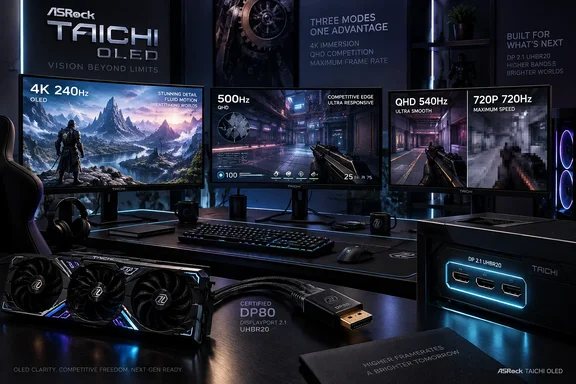
Wccftech presented the TCO27USA, TCO27QXA, and TCO27QXB as a new flagship launch on September 16. ASRock’s own Computex announcement and independent show-floor coverage from ComputerBase and TFTCentral show a more qualified reality: these three monitors were publicly shown in Taipei in early June, and ASRock had not published retail pricing or firm regional availability. As of September 16, the products remain an announced family rather than a retail launch readers can act on.
That distinction is important for anyone timing a GPU or monitor purchase. An attractive spec sheet is not a shipping product, and no U.S. retail date, warranty terms, bundle contents, firmware support policy, or confirmed street pricing has been announced by ASRock.
The three Taichi models target three very different PC builds
The Taichi TCO27USA is the image-quality option: a 27-inch 3840×2160 QD-OLED display running at 240Hz. ASRock says it uses a Penta Tandem OLED panel, offers 99% DCI-P3 coverage and Delta E below 2, carries VESA DisplayHDR True Black 400 certification, and includes AMD FreeSync Premium Pro.
For a Windows gaming PC, 4K at 240Hz is still a severe workload. High-end GPUs can reach it in esports titles and older games, while contemporary AAA games will generally require settings compromises, upscaling, or frame generation to approach the panel’s ceiling. The display therefore makes the most sense for someone who wants a single high-resolution desktop and creative-work screen that can also deliver unusually high refresh rates in games—not for a buyer expecting every new release to run natively at 240 frames per second.
The TCO27QXA takes the opposite approach with a 2560×1440 QD-OLED panel at 500Hz. This is the least visually extravagant model on paper, but it may be the practical sweet spot for competitive PC gaming. Modern high-end graphics cards can drive 1440p far more readily than 4K, and 500Hz leaves enough headroom for players who prioritize latency and motion clarity in titles such as Counter-Strike 2, Valorant, Overwatch 2, and Fortnite.
The TCO27QXB is the headline-grabber. It runs at 2560×1440 and 540Hz in its native mode, then switches to 1280×720 at 720Hz. ComputerBase, which inspected the models at Computex, identifies this as a Tandem WOLED panel and reports the reduced-resolution mode as 1280×720—not generic “HD,” a description that risks obscuring how steep the resolution trade-off is on a 27-inch screen.
At 1280×720, desktop text and ordinary Windows applications will look markedly coarse. The 720Hz mode is purpose-built for full-screen competitive games where frame rate, input response, and persistence blur matter more than pixel density. It should be treated as a specialized alternate mode, not as a replacement for QHD gaming or general desktop use.
720Hz is a mode switch, not a free performance upgrade
ASRock’s marketing number can be technically accurate without being broadly useful. A 720Hz monitor only refreshes 720 times per second when the PC sends a supported 720Hz signal; it does not create 720 frames per second from a game that is rendering at 180 fps.
Players pursuing the TCO27QXB’s maximum mode will need a game that can sustain extraordinarily high frame rates, CPU performance capable of feeding the GPU, and settings low enough to keep frame times consistently below about 1.4 milliseconds. This places the monitor firmly in the professional and enthusiast esports segment. Even powerful GPUs will not reach 720 fps in many current games, particularly with ray tracing, high-detail presets, or heavy CPU simulation enabled.
The native 1440p-at-540Hz mode is the more interesting specification. It retains a sensible resolution for a 27-inch Windows desktop while reducing the frame-time interval to about 1.85 milliseconds. That is still a demanding target, but it can be useful in well-optimized esports games and avoids turning a premium OLED monitor into a 720p display for everyday use.
There is also a naming issue worth keeping straight. ASRock’s Computex materials described the TCO27QXB as offering 540Hz and Dual Mode functionality, while Wccftech described the panel as running “up to 720 Hz at HD resolution.” The independent reports agree on the essential behavior—QHD at 540Hz and 720p at 720Hz—but ASRock has not yet published the full supported-timing tables or manuals that would show every permitted combination of refresh rate, color depth, HDR, and adaptive-sync operation.
UHBR20 solves a bandwidth problem—but only on the right PC
DisplayPort 2.1 UHBR20 is more than a version-number upgrade. It is DisplayPort’s top current Ultra-High Bit Rate tier: four lanes operating at 20Gbps each, for 80Gbps of aggregate link bandwidth and roughly 77.4Gbps of usable payload after encoding. VESA’s DP80 cable certification exists to identify cables built for that maximum rate.
That bandwidth can allow demanding high-resolution, high-refresh HDR configurations to run without leaning as heavily on Display Stream Compression. It also gives monitor makers more room to support 10-bit color and full chroma at modes that would overwhelm the 25.92Gbps payload of DisplayPort 1.4. In other words, UHBR20 is a meaningful capability for the TCO27USA’s 4K 240Hz target and ASRock’s extreme-refresh QHD displays.
But a monitor-side UHBR20 port alone does nothing. The graphics card, cable, and display must all negotiate the link at the required rate. Nvidia’s GeForce RTX 50-series reference specifications list DisplayPort 2.1b with UHBR20 support, including on the RTX 5090. AMD’s Radeon RX 9070 XT specifications list DisplayPort 2.1a, but AMD’s public product page does not state the specific UHBR rate. Buyers should not assume that every product labeled “DisplayPort 2.1” delivers the 80Gbps UHBR20 ceiling.
The cable will matter as well. A cable advertised merely as “DP 2.1” may not be certified for the highest link rate. For a system being purchased specifically for these displays, a VESA-certified DP80 cable is the sensible baseline rather than an inexpensive cable selected on version branding alone.
ASRock’s use of two UHBR20 ports is unusual in this class, as Wccftech noted, but it should not be mistaken for a method of combining two cables to double bandwidth to a single PC. Each DisplayPort connection is its own input. The extra connector is potentially useful for connecting multiple systems or working with the monitors’ KVM-oriented feature set reported from Computex, but ASRock has not yet published final input-behavior documentation for these models.
The story changed between the Computex booth and the September report
The Taichi line was not first revealed on September 16. ASRock announced the three relevant models at Computex 2026, and TFTCentral previewed the 540Hz/720Hz TCO27QXB and 500Hz TCO27QXA before the show. ComputerBase’s June report also documented a fourth Taichi OLED model, the TCO27USB, a separate 4K 240Hz and 1080p 480Hz dual-mode display using an RGB-stripe Tandem WOLED panel.
That fourth product is absent from the three-model lineup in Wccftech’s report. It is not a trivial omission because it changes the apparent panel story: ASRock’s Taichi monitors are not one unified OLED technology launch. The TCO27USA and TCO27QXA use QD-OLED, while the TCO27QXB uses Tandem WOLED, and the separately shown TCO27USB uses another Tandem WOLED implementation aimed at better text rendering.
For Windows users, panel type is not academic. QD-OLED and WOLED panels have different subpixel layouts, text-rendering behavior, coatings, peak-brightness characteristics, and color-volume trade-offs. Anyone using one of these monitors for work, coding, spreadsheets, and browser-heavy desktop use should wait for full independent reviews rather than choose solely by refresh rate or an OLED technology label.
Pricing and release details are still the missing specifications
TFTCentral’s monitor launch tracker has listed the TCO27USA at an expected $799 and the TCO27QXA and TCO27QXB at expected $699, with September availability anticipated. Those are tracker estimates rather than prices confirmed by ASRock, and Wccftech likewise reported that pricing and availability had not been disclosed.
That makes the wait sensible. At around $699, a 1440p 500Hz or 540Hz OLED display with UHBR20 inputs would be aggressive against established premium monitor brands. At a significantly higher price, ASRock will have to convince buyers that its firmware support, burn-in coverage, quality control, and post-sale service are as mature as the screen specifications.
For now, the Taichi TCO27QXB’s 720Hz mode is real as an announced specification, and the line’s full-bandwidth DisplayPort support is meaningful for a narrow but growing group of high-end PC builds. The buying decision remains on hold until ASRock converts its Computex showcase into a product with a price, a ship date, a final manual, and an actual place on a retailer’s shelf.