

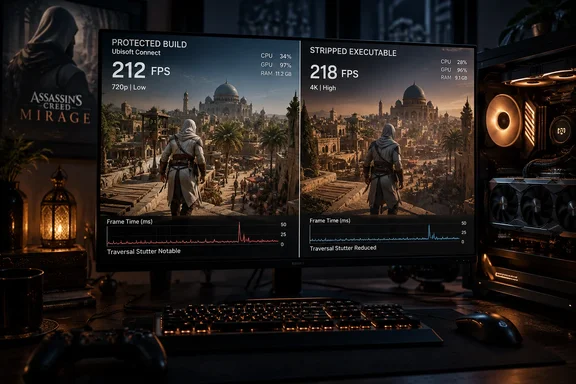
The comparison follows reports that RUNE removed both Denuvo and VMProtect from the game executable. It also differs from an earlier benchmark covered by TwistedVoxel, which reported approximately 15% higher average performance for the cracked version on an Intel Core i7-13700K system. These are different test configurations, not independent reproductions of the same experiment.
What DSOGaming tested
According to DSOGaming’s John Papadopoulos, the comparison used an AMD Ryzen 9 7950X3D, 32GB of DDR5-6000 memory and an NVIDIA GeForce RTX 5080, running Windows 10 64-bit with GeForce driver 616.92.
He tested the Ubisoft Connect and RUNE versions at 4K, 1080p and 720p using Ultra High settings, with one important adjustment: Adaptive Quality was disabled. DSOGaming reports that the Ultra High preset otherwise sets Adaptive Quality to a 60 FPS target, explaining why the benchmark interface displayed “Custom Settings.”
That adjustment makes the comparison easier to interpret. An adaptive quality target introduces another variable into a performance test; disabling it keeps that mechanism from adjusting quality while the two versions are compared.
DSOGaming describes the results as follows:
| Test condition | Protected Ubisoft Connect version | RUNE version |
|---|---|---|
| 4K, Ultra High, Adaptive Quality off | Similar performance; described as GPU-limited | Similar performance |
| 1080p, Ultra High, Adaptive Quality off | Similar performance; described as mostly CPU-limited | Similar performance |
| 720p, Ultra High, Adaptive Quality off | 212 FPS average; 79 FPS minimum | 218 FPS average; 82 FPS minimum |
| Traversal stutter | Observed | Observed |
The numerical results here are DSOGaming’s measurements, not WindowsForum testing. No independent reproduction of this exact configuration is established by the available reporting.
A small difference is not an identical result
DSOGaming characterizes the two versions as running “EXACTLY” alike. Its published 720p measurements support the more precise description of similar performance: the RUNE version’s average is approximately 2.8% higher, while its minimum is approximately 3.8% higher, calculated from the reported figures.
Those differences are much smaller than the double-digit improvement reported elsewhere. However, without repeated-run results or a measure of variability, they cannot confidently be classified as either a reproducible protection-related gain or ordinary benchmark variation.
The resolution choices help explain what this experiment can reveal. At 4K, DSOGaming identifies the graphics card as the limiting component. In that situation, a modest difference in CPU work might not produce a noticeable change in overall frame rate because the GPU still determines how quickly frames finish.
Lowering resolution reduces the graphics workload and can make CPU-side differences easier to expose. DSOGaming describes its 720p run as consistently CPU-limited, making that result more informative about potential CPU overhead than the 4K comparison.
Nevertheless, a CPU-limited test on a Ryzen 9 7950X3D does not predict every slower processor’s behavior. It establishes a result for that processor and workload. DSOGaming’s suggestion that weaker CPUs should produce similar findings extends beyond the hardware it actually tested.
Why the earlier 15% report remains a separate finding
TwistedVoxel reported a comparison at 1080p using the game’s default settings on a Core i7-13700K, GeForce RTX 5080, 64GB of memory and Samsung 990 Pro SSD. According to that report, the protected version averaged 162 FPS and the cracked version averaged 186 FPS—an increase of approximately 14.8%.
A ResetEra post describing that earlier benchmark identifies the game as version 1.1.1 and the operating system as Windows 11 25H2. It also labels 162 and 186 FPS as averages, with separate minimum figures.
The two comparisons therefore differ in processor, operating system and stated settings. DSOGaming explicitly disabled Adaptive Quality; “default settings” alone does not establish an equivalent configuration in the earlier test. DSOGaming’s benchmark text also does not specify the game build number, preventing a documented build-for-build comparison between the reports.
These differences do not explain the conflicting results by themselves. They mean the numbers should not be combined into a single expected uplift, nor should either test be treated as a direct refutation of the other. A stronger comparison would need matched game builds, explicit graphics settings, repeated runs and frame-time measurements.
What removal and persistent stutter tell us
DSOGaming reports that RUNE removed both Denuvo and VMProtect. Release notes reproduced on ResetEra likewise claim that both protection systems were stripped from the executable. That remains an attributed technical claim, rather than an independently audited finding.
Removal is relevant to the experiment because bypassing a protection check does not necessarily remove the surrounding protected code. A genuinely stripped executable provides a more direct comparison of performance with and without those layers. It still changes two protections together, so any measured difference cannot isolate Denuvo’s contribution from VMProtect’s.
For players experiencing pauses while moving through the game world, DSOGaming’s observation that both versions exhibit traversal stutter is particularly useful. Under its test conditions, using the reportedly stripped version did not eliminate that symptom. The comparison does not identify the stutter’s underlying cause.
The practical conclusion is configuration-specific: DSOGaming found closely matched performance, including under its CPU-limited test, while another reported comparison found a larger gain. Neither establishes a universal result for all Mirage players, and the new test provides no basis to expect protection removal alone to cure traversal stuttering.