

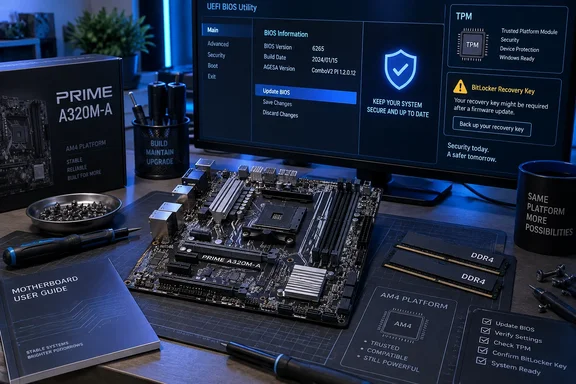
The broader attraction is easy to understand: keeping a working motherboard and DDR4 memory can avoid part of the cost of a platform replacement. But a fresh BIOS does not establish universal processor compatibility, a guaranteed future support period, or a reason for every new PC buyer to choose A320. The useful story is in what ASUS actually changed, and what its release history tells owners to check before installing it.
ASUS BIOS 6265 brings security maintenance to an early AM4 board
ASUS’s official PRIME A320M-A firmware listing gives BIOS 6265 two specific changes: an update to “ComboV2 PI 1.2.0.12” and mitigation of fTPM vulnerabilities identified as CVE-2026-6726 and CVE-2026-6727. The entry is dated August 27, rather than the September 22 publication date of Wccftech’s report. It is therefore an available motherboard firmware release, not a promise of future support.
The board’s age is also grounded in its support history. ASUS lists its first-release BIOS on July 7, 2017, followed by further releases in August and September that year. That establishes a firmware history extending beyond nine years by September 2026. AMD’s April 2017 Ryzen 5 announcement placed A320 alongside B350 and X370, promoting A320 motherboards as a mainstream gaming option with partner pricing starting at approximately $50.
AMD supplies the underlying firmware components, while ASUS packages and distributes the BIOS for this particular board. That division matters: the update belongs to the PRIME A320M-A, not to every motherboard carrying an A320 chipset or an AM4 socket. A shared platform name does not make firmware images interchangeable.
Wccftech reports that other vendors’ A320 motherboards have also received the same AGESA revision and points to the GIGABYTE GA-A320M-S2H as another example. The ASUS release record directly establishes the central event, but the broader cross-vendor claim remains Wccftech’s reporting here; a second independently inspected current release record is not available to establish its full reach. Owners of other boards should treat the news as a reason to look for a model-specific release, rather than assume BIOS 6265 applies to them.
The PRIME A320M-A history shows both continued support and compatibility limits
The latest release is part of a documented maintenance sequence. ASUS published BIOS 6254 on January 27, 2026, with the description “Improve system compatibility.” In 2025, its releases included AGESA updates, security changes and a beta fTPM firmware upgrade. BIOS 6265 is not labeled beta in the ASUS listing, unlike versions 6253 and 6251.
Selected entries show how the board’s support has evolved:
| ASUS PRIME A320M-A BIOS | Release date | Documented change |
|---|---|---|
| 5862 | November 5, 2021 | Added processor support through a newer AGESA and removed Bristol Ridge processor support. |
| 6042 | May 13, 2022 | Updated to AGESA V2 PI 1.2.0.7, supported more Ryzen processors and fixed an fTPM issue causing random stuttering. |
| 6210 | October 31, 2023 | Updated AGESA and the fTPM version for AMD 5000/3000 Series CPUs, with a BitLocker recovery-key warning. |
| 6253 beta | September 24, 2025 | Listed an fTPM firmware upgrade for specified Ryzen G-Series systems and warned owners to preserve their recovery key and suspend BitLocker. |
| 6265 | August 27, 2026 | Updated to ComboV2 PI 1.2.0.12 and listed mitigation of two fTPM vulnerabilities. |
This history supports a useful, narrower conclusion than a blanket promise of longevity: ASUS has continued delivering meaningful firmware changes for this board. It does not establish that AMD guarantees a particular number of major updates each year, or that every A320 model receives the same treatment.
The removal of Bristol Ridge support is particularly important for a machine that has gone years without a BIOS update. ASUS explicitly names AMD seventh-generation A-Series and Athlon X4 processors in the BIOS 5862 removal notice. An owner still using one of those processors cannot safely equate “newer BIOS” with “better support for my existing system.” Processor compatibility must be resolved before attempting a move to later firmware.
The same distinction applies to adding a newer CPU. Wccftech cites the Ryzen 5 5500F as an example of continued AM4 processor releases, but the PRIME A320M-A BIOS 6265 description does not announce support for that processor. A new AM4 chip and a new A320 BIOS are separate developments; their appearance in the same news cycle does not prove that they work together.
For an upgrade, the relevant evidence is a CPU-support entry naming the exact processor, the exact motherboard and any required BIOS version. Without that match, buying on socket compatibility alone is a gamble the firmware announcement does not justify.
The fTPM update makes BitLocker preparation part of the job
The security-related component in ASUS’s release notes is the firmware Trusted Platform Module, or fTPM. The immediate Windows concern is the interaction between changes to that firmware and BitLocker recovery. ASUS has repeatedly attached recovery-key warnings to earlier PRIME A320M-A fTPM updates.
The clearest warning accompanies BIOS 6253 beta. It tells users of the specified Ryzen 5000 G-Series, 4000 G-Series, 3000 G-Series and 2000 G-Series systems to back up their BitLocker recovery key and suspend BitLocker before proceeding, to prevent potential boot issues. That processor scope belongs to the 6253 description; it should not be silently transferred to the shorter 6265 release note as though ASUS had repeated it there.
Nevertheless, that history gives owners a practical preparation step before another fTPM-related change: secure the BitLocker recovery key before flashing. Preserving the key and suspending protection are distinct precautions in ASUS’s warning. Neither should be replaced by simply assuming that a familiar Windows sign-in password will be sufficient if recovery is requested.
A safe preparation sequence, within what the release record establishes, is:
- Confirm that the motherboard is the ASUS PRIME A320M-A, rather than a similarly named A320 model.
- Establish the installed processor and current BIOS version, paying particular attention to the documented removal of Bristol Ridge support.
- If BitLocker is enabled, preserve an accessible copy of its recovery key before beginning the firmware work.
- Suspend BitLocker protection before the fTPM-related update, following the precaution ASUS gives in its earlier firmware warning.
For a work-managed PC, those preparations should be handled with the administrator responsible for the machine and its recovery information. This is not a personal Microsoft-account recovery procedure, and the motherboard release notes do not establish where any particular organization stores its keys.
The evidence does not provide a complete BIOS 6265 flashing and rollback procedure, so it would be unsafe to invent universal USB formatting requirements, button sequences or downgrade instructions. Older ASUS entries recommend EZ Flash for particular releases, but that does not establish every prerequisite for moving from every historical BIOS to 6265.
There is a similar boundary around the security claims. ASUS identifies CVE-2026-6726 and CVE-2026-6727, but the available release text does not explain their severity, attack prerequisites or exploitation status. Those identifiers should be understood as the manufacturer’s stated mitigation targets; they do not support a claim that all A320 systems face an active attack.
Nor should this release be confused with the older fTPM stuttering fix. ASUS specifically documented that symptom in BIOS 6042 in May 2022. BIOS 6265 describes security mitigations, not a newly discovered Windows stuttering problem or a promised performance improvement.
DDR5 prices strengthen the reuse argument, not a blanket A320 buying recommendation
Memory costs provide context for continued interest in AM4, but they require dates and boundaries. In January 2026, Tom’s Hardware reported that rising DDR5 prices were encouraging interest in DDR4 alternatives as GIGABYTE introduced additional AM4 motherboards. Its report also stressed that DDR4 itself had become more expensive as production declined.
That reporting supports the existence of price pressure earlier in 2026. It does not establish a September 22 price comparison or prove that AM4 is now the only affordable way to build a PC. Wccftech’s stronger current-market claim would require current, like-for-like prices to substantiate it.
For an existing AM4 owner, the calculation is more straightforward. Retaining compatible memory and a functioning motherboard avoids replacing those components. A security update adds value to that reuse decision because the board continues receiving maintenance; it does not need to deliver extra frame rates to be worthwhile.
A new build has a different calculation. The buyer must still pay for the motherboard and memory, so there is no automatic saving from already-owned parts. Without a current platform-price comparison and confirmed processor support, this BIOS release cannot establish A320 as the best purchase. It chiefly improves the case for responsibly maintaining hardware already in service.
What this means for A320 owners planning an update
Treat BIOS 6265 as a model-specific maintenance release to evaluate, and keep any processor purchase separate until compatibility is established.
- Owners of the ASUS PRIME A320M-A have a documented August 27, 2026 release that updates AGESA and lists fTPM security mitigations.
- Owners using Bristol Ridge A-Series or Athlon X4 processors should resolve the documented loss of support before attempting to install later firmware.
- BitLocker users should preserve their recovery key and suspend protection before fTPM-related firmware work, following ASUS’s published precaution.
- Owners of other A320 motherboards need a release for their exact model and revision; the ASUS BIOS cannot be used as a platform-wide update.
- Buyers considering the Ryzen 5 5500F should require explicit motherboard CPU-support confirmation rather than infer compatibility from the AM4 socket.
- Builders comparing DDR4 and DDR5 systems should use current total-platform prices, while existing owners should account for the parts they can actually retain.
The concrete benefit of this release is continued maintenance for an inexpensive board with a firmware history stretching back to 2017. For a compatible PRIME A320M-A system that still meets its owner’s needs, BIOS 6265 creates another opportunity to keep that hardware in service with updated security firmware. The next useful action is a careful compatibility and recovery-key check—not an automatic platform replacement, and not an assumption that every AM4 upgrade path remains open.