

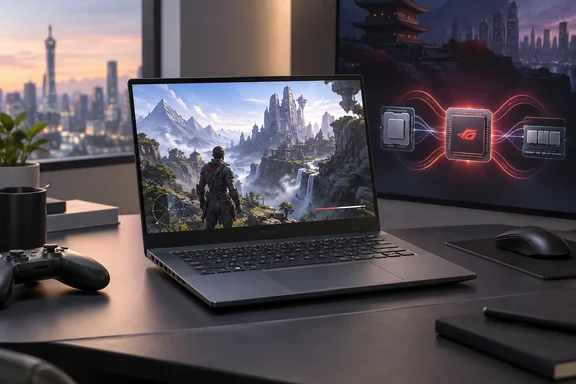
Asus Tianxuan Air 2026 Adds a Ryzen AI Max+ 388 Model in China
This is a new configuration of a laptop Asus already sells, not a new laptop line. IT Home describes it as a fresh configuration of the Tianxuan Air 2026 Ryzen AI Max edition. Asus's Chinese spec listing identifies that machine as model FA401EA with the Ryzen AI Max+ 388, and notes that its specifications may change. Technetbook called it a launch. Either way, the product on sale is a single SKU with the Ryzen AI Max+ 388, 32GB of memory and a 1TB PCIe 4.0 SSD.
The price comes with launch conditions. IT Home reports a 1,000-yuan limited-time discount during the first sales period, which brings the effective price to no more than 11,999 yuan. Buyers who post a product review can also get a 200-yuan e-gift card. Technetbook calls 11,999 yuan the starting price and converts it to about $1,680. That figure is only an exchange-rate conversion of a promotional Chinese price. It is not a US retail price, and no Western availability has been reported.
"Tianxuan" is the name Asus uses for its gaming-branded laptops in China. On this model, the gaming hardware is a large integrated GPU rather than a discrete graphics card, and that choice explains most of the machine's strengths and limits.
The Ryzen AI Max+ 388 Keeps the Full Radeon 8060S and Halves the Cores
AMD announced the chip at CES 2026. The 392 slots in as a 12-core, 24-thread part, while the 388 drops to 8 cores and 16 threads. AMD is keeping the same graphics configuration on both, with the full RDNA 3.5 iGPU at 40 compute units. The CPU side is eight Zen 5 cores with 16 threads. The base clock is 3,600MHz, and turbo can reach 5,000MHz. The 40MB of total cache is 8MB of L2 and 32MB of L3.
The 388 matters because of where AMD used to put that GPU. Previously, the full Radeon 8060S configuration was only available in the high-end Ryzen AI Max+ 395 model, which combines 16 cores and 32 threads with the 40 CU Radeon 8060S. Notebookcheck's spec database puts it another way: compared to the older AI MAX 385, the 388 is identical except for the faster iGPU. So the 388 pairs the 385's CPU with the 395's graphics. When the chip first appeared in benchmark leaks, VideoCardz and others called it a better fit for gaming devices, because it keeps the full 40-CU iGPU while cutting CPU cores.
Power limits depend on each laptop. Ryzen AI Max+ 388 is specified at 55 W TDP with configurable TDP from 45–120 W, built on a 4 nm process. That range covers everything a laptop maker could choose. Asus has not said what wattage the Tianxuan Air runs in each of its cooling modes, so the chip's 120W ceiling tells you nothing about how this 1.69cm-thick laptop will perform over a long session.
The NPU (the chip's dedicated AI accelerator) is the same across the family. The APU comes equipped with 8 Zen 5 CPU cores running at up to 5.0 GHz, the 40 CU RDNA 3+ Radeon 8060S graphics adapter and the 50 TOPS XDNA 2 neural engine. TOPS (trillions of operations per second) is a peak rating. It doesn't tell you how fast any given app will run, and it doesn't mean an app will use the NPU at all. Many local AI tools run on the GPU instead, and those tools depend on the memory pool covered in the next section.
No independent tests of this laptop have been published. The chip's early leak did include a synthetic CPU result: Notebookcheck reported that it scores 4,145 and 31,702 in PassMark's single and multi-core CPU benchmarks, respectively. The former is in line with other Strix Halo parts, while the latter is slightly lower than the Ryzen AI Max 385. Those numbers came from a pre-release chip in an unknown system. They don't predict how the Tianxuan Air will do in games.
32GB of LPDDR5X-8000 Is Soldered, Shared and Final
Strix Halo chips don't give the GPU its own memory. The laptop's 32GB of LPDDR5X-8000 is one shared pool, and IT Home reports that it can be split between system memory and video memory depending on what apps need. With a discrete GPU, graphics memory is fixed on the card. Here, the more memory the GPU takes, the less Windows and your apps have, and the reverse.
AMD's platform specs list 256-bit LPDDR5x at up to 8000 MT/s and a maximum of 128GB. That 128GB figure is what the chip supports. It doesn't mean Asus sells or allows 128GB in this laptop. Only the 32GB configuration has been reported. LPDDR5X of this type is soldered to the board, so the memory you buy is the memory you keep.
For gaming at the panel's native resolution, 32GB shared between Windows and the Radeon 8060S is a reasonable amount. For local large language models, where the model's size limits what fits in memory, 32GB is a real ceiling. That point is our own inference from the shared-memory design, not a tested result. Anyone buying Strix Halo mainly to run large models on-device should know that this SKU sits at the low end of the chip's memory range. Asus hasn't said how much memory the firmware reserves for graphics or whether you can change that in the BIOS or the AMD driver software.
Storage is the part you can upgrade. The laptop ships with a 1TB PCIe 4.0 SSD and has a second M.2 2280 slot for another drive. IT Home reports that the slot has a light-sensor power-cut feature. The name suggests it cuts power when the case is opened, but Asus hasn't explained how it works. No maximum size for the second drive has been published.
Glacier Cooling and a 1.48kg Chassis Put the 8060S in a 14-inch Body
The laptop has aluminum top and bottom covers in a color Asus calls Eclipse Gray. It weighs about 1.48kg and is about 1.69cm thick, and the hinge opens to 180 degrees. That's light for a machine with this GPU, and it explains the "Air" name.
Asus calls the cooling system Glacier. It uses two liquid-bearing fans with 97 blades each, 0.1mm pure copper fins and rear exhaust vents. Users can switch between Quiet, Performance and Enhanced modes. IT Home's report describes these modes as suited to office work, content creation and heavy loads. No wattage, noise or temperature figures have been published for any mode, so the real difference between Performance and Enhanced is unknown.
The display is a 14-inch 2.5K panel at 165Hz with 100% sRGB coverage. Brightness, response time and panel type haven't been disclosed. Power comes from a 73Wh battery with 100W USB Power Delivery charging, and no battery-life or charging-time figures are available.
Here are the ports as reported:
| Port | Count and specification |
|---|---|
| USB4 | One |
| USB-C | One, 10Gbps |
| USB-A | Two, 10Gbps |
| HDMI | One, HDMI 2.1 FRL |
| Card reader | Micro SD |
The chip handles USB4 itself. Notebookcheck notes the AI Max chip supports RAM as fast as LPDDR5x-8000 and is natively compatible with USB 4. Asus hasn't said which USB-C port charges the laptop or which ones carry a display signal. That matters if you plan to run one cable to a dock.
Windows Hello and Windows 11 Support Are the Windows-Specific Features
The top bezel holds a combined FHD and IR camera module that supports Windows Hello face sign-in. It's the one Windows feature the reporting ties directly to this laptop. For Windows users, that means facial login out of the box without an external camera.
AMD's product page lists 64-bit Windows 11, RHEL and Ubuntu as supported operating systems for the Ryzen AI Max+ 388. Asus hasn't published the Windows edition, preinstalled software or driver-support schedule for the China-market Tianxuan Air. Graphics driver updates will come through AMD's normal Radeon channel for the 8060S, but anything Asus-specific, such as firmware and the cooling-mode utility, depends on Asus's support for Chinese-market models.
What this means for you
If you're in mainland China and want strong integrated graphics in a 14-inch laptop under 1.5kg, this is the model to look at. Buyers elsewhere should treat it as an early example of what Ryzen AI Max+ 388 laptops will cost, not something they can buy locally. If you need more than 32GB for local AI work, or more than eight cores for heavy multithreaded jobs, a Ryzen AI Max+ 395-class machine with more memory fits better. The 388 keeps the GPU and drops the CPU cores and extra memory headroom.
- The Tianxuan Air 2026 Ryzen AI Max+ 388 configuration went on sale in China on September 23, 2026, with 32GB of memory, a 1TB PCIe 4.0 SSD and a launch price of no more than 11,999 yuan after a 1,000-yuan discount.
- The Ryzen AI Max+ 388 has the same 40-CU Radeon 8060S as the Ryzen AI Max+ 395, with 8 cores and 16 threads instead of 16 and 32.
- The 32GB of LPDDR5X-8000 is shared between system and GPU and can't be upgraded. The second M.2 2280 slot is the only upgrade path.
- Performance will depend on Asus's power limits in Quiet, Performance and Enhanced modes, and none of those limits have been published or tested independently.
- Windows Hello face sign-in through the FHD and IR camera is confirmed. AMD lists 64-bit Windows 11 as a supported OS for the chip.
- The roughly $1,680 conversion is based on a promotional Chinese price, so don't treat it as a US price.
AMD said at CES 2026 that the Ryzen AI Max+ 388 would bring the full Radeon 8060S to lower-priced machines, and this Tianxuan Air is one of the first retail laptops to do that. Whether Asus's 14-inch chassis can keep the 40-CU GPU running at its best is still unknown. That question will be answered by the first independent reviews measuring sustained power, noise and frame rates across the three cooling modes, and by whether Asus sells the FA401EA outside China.