

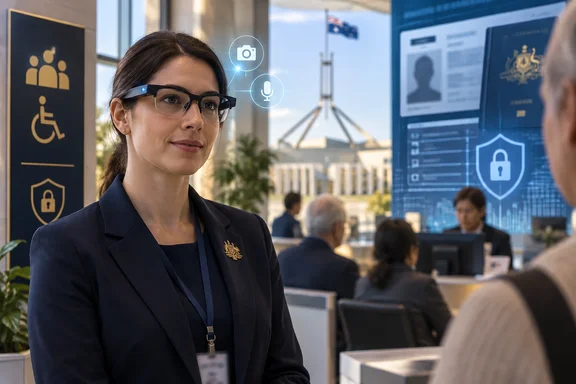
ABC News and Reuters both report that the review concerns federal public-service workplaces, following Gallagher’s warning that smart glasses create “legitimate privacy and security concerns” because they can record and capture information. The government has not announced a ban, published a draft policy, identified covered device models, or set a decision date.
For IT administrators, the immediate significance is not a new law. It is a signal that smart glasses are moving from a consumer-device and public-privacy debate into the same policy category as personal cameras, smartphones, removable storage and unmanaged recording hardware in sensitive workplaces.
Commonwealth workplaces, not every government building
The distinction is material. The proposed restrictions under review concern Commonwealth-run offices and services: federal departments, Centrelink service centres, Commonwealth Scientific and Industrial Research Organisation laboratories, and comparable Australian Public Service environments. They do not automatically extend to state government agencies, public hospitals, public schools, local councils, or privately operated contractors.
The Guardian reported that state-run schools and hospitals would remain responsible for their own rules. That is consistent with Australia’s federal structure: Canberra can set conditions for Commonwealth workplaces, but councils and state agencies generally retain authority over their own facilities and staff.
That means a ban, if one emerges, would not prevent a visitor from wearing Ray-Ban Meta glasses in every Australian government building. Nor would it amount to an import ban, a retail prohibition, or a blanket rule against using the devices in public. Attorney-General Michelle Rowland said on August 31 that the government was not then considering an import ban as part of its privacy-law consultation, although she did not rule out other future measures.
This is the first point lost in much of the “world-leading ban” framing. Australia may become an early national government to impose a consistent restriction across its federal public service, but there is no final policy yet and no evidence of a whole-of-government ban covering the country’s three tiers of government.
The security issue is unmanaged capture, not eyewear
Smart glasses present a familiar enterprise-security problem in a less familiar form factor. A device that looks like ordinary eyewear can combine a camera, microphones, network access, cloud-connected accounts, voice assistants and, in some products, AI-driven image or language functions. In a workplace handling identity documents, customer records, case files, research material or restricted government information, that is an unmanaged data-capture endpoint worn on an employee’s face.
Traditional office security controls have tended to focus on phones, laptops, USB storage and visitor cameras. Smart glasses complicate those controls because their recording capability is less visible to colleagues and members of the public. A rule prohibiting “recording devices” may already cover them in principle, but Gallagher’s request to the Public Service Commission suggests the government believes existing guidance is too inconsistent or too vague for an expanding product category.
The operational questions are more complicated than simply banning Ray-Ban Meta glasses by brand. A policy that names a single manufacturer will age badly as lower-cost competitors and devices with similar cameras arrive. A usable rule would need to define the prohibited capability: wearable devices able to capture, store, transmit or livestream audio, images or video in areas where that presents a privacy, security, safety or records-management risk.
That approach would also need to account for smartphones, smartwatches, body cameras, camera-equipped earbuds and other products that may perform overlapping functions. ABC News has reported that some basic smart glasses are available in Australia for as little as A$40, underscoring why a rule limited to premium AI glasses would miss much of the practical exposure.
Exemptions will determine whether the policy works
Gallagher has specifically asked for advice on exemptions. That is not a procedural footnote: it is likely to be the hardest part of any final rule.
Vision Australia and other advocates have argued that smart glasses can be important accessibility tools. Features such as live speech-to-text, scene descriptions, navigation support and hands-free assistance can make workplaces more usable for people who are blind, have low vision, are deaf or hard of hearing. The federal government has publicly acknowledged those uses while weighing the risks of covert recording.
A blanket ban without a disability-access accommodation process would invite a conflict between security policy and workplace inclusion. But an unrestricted exemption based only on an employee’s stated need would not satisfy agencies responsible for sensitive records or controlled spaces.
The practical model is likely to resemble existing device-access controls. An agency could permit approved assistive technology while setting conditions on where it can be used, whether recording functions must be disabled, how devices are registered, and when a person must switch to an agency-provided alternative. Secure facilities already apply varying restrictions to phones, cameras and wireless accessories; smart glasses can fit into that system, provided policies address their camera and microphone capabilities directly.
For Windows and enterprise IT teams, the critical distinction is between a device used as a managed assistive tool and one linked to a personal Meta, Google, Apple or other consumer account. The latter can create uncertainty over where captured material is stored, whether it is synced automatically, who can access it, and whether it may be used to train or improve a vendor’s services under consumer-account terms.
Australia is following targeted bans, not inventing a universal template
Australia would not be the first public body to restrict camera-equipped glasses. Reuters reported that courts in England and Wales have prohibited Meta smart glasses, while Oslo barred the devices in schools last month. Targeted Australian restrictions are already spreading: The Guardian reported that Brisbane, Yarra, Sydney, Blacktown and Canterbury-Bankstown councils have imposed limits in facilities such as pools, gyms, playgrounds, childcare centres and public spaces.
Those measures share a common trait: they regulate high-risk locations rather than attempting to outlaw the hardware itself. Pools and changing facilities carry obvious expectations of privacy. Courtrooms have confidentiality, evidentiary and witness-protection concerns. Government service centres can involve personal financial details, welfare claims, immigration matters and identity documents. Laboratories may hold proprietary research or controlled information.
The Commonwealth proposal would be notable because it could establish a single policy across a large national employer rather than leaving each office to set its own ad hoc rules. It would also create pressure on private employers to reassess whether their existing acceptable-use policies actually cover wearable cameras.
But Australia’s government has not yet shown how it will enforce a prohibition across public-facing sites. A rule for employees is straightforward: it can be incorporated into workplace conduct policies and disciplinary frameworks. A rule covering visitors, contractors and service-centre customers requires signage, staff training, incident handling and clear guidance on when someone may be asked to remove a device or leave a restricted area. None of those details have been announced.
What agencies and enterprise IT teams should do before a decision
Federal agencies do not need to wait for a final Australian Public Service policy to identify the gaps in their own controls. The prudent starting point is an inventory of existing rules for personal recording equipment and bring your own device use, especially in customer-facing offices, research environments, meeting rooms and secure zones.
A short assessment should establish whether current policies:
- Explicitly cover wearable cameras and microphones, rather than assuming “personal devices” is sufficiently clear.
- Distinguish between prohibited recording, permitted assistive technology and approved agency-owned equipment.
- Address personal cloud accounts, automatic synchronisation and AI services connected to wearable devices.
- Give reception, security and service-centre staff a consistent process for handling visitors wearing camera-equipped glasses.
- Identify locations where device restrictions already exist but signage and enforcement practices have not kept pace with new form factors.
The Australian government’s review is a warning that wearable cameras are becoming a governance issue before they become a mass-management problem. If the Public Service Commission recommends a prohibition, the most consequential result will not be a symbolic rebuke of Meta’s glasses. It will be a test of whether agencies can write technology-neutral rules that protect sensitive information without locking out workers who rely on wearable technology for accessibility.