

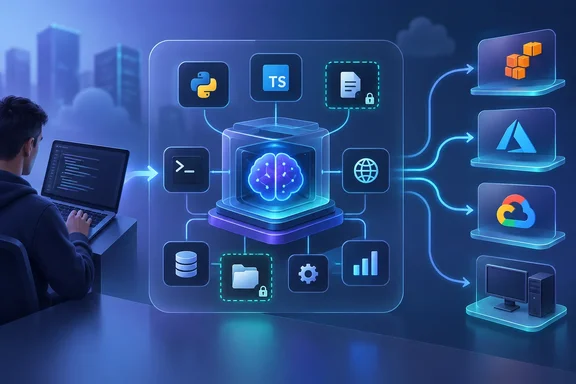
The practical appeal is a reusable foundation for an agent’s execution rather than rebuilding that foundation for each application. “Any cloud” is a portability claim, not proof of a turnkey deployment on every hosting service. The available evidence does not establish platform-specific deployment requirements or Windows installation support.
What the harness provides
An agent harness is the software surrounding an AI model that manages its work: supplying context, making tools available and controlling execution. The Strands Harness SDK’s repository describes that foundation as something developers can control end-to-end, with interchangeable backends. Those are project capabilities as documented by its maintainers, rather than independently measured production results.
According to SiliconANGLE, AWS’s ready-to-use Strands Harness includes file reading, writing and editing, shell access and web search. SiliconANGLE also reports support for external tools through Model Context Protocol servers, additional Agent Skills and a helper agent for delegated subtasks.
Together, those features could reduce the amount of infrastructure developers must assemble before an agent can perform useful work. A model can propose an action; the harness supplies the surrounding machinery that lets the application execute it and continue working with the result. That separation is important when evaluating the release: the harness’s capabilities and the selected model’s capabilities are different parts of the application.
Strands itself predates this announcement. AWS introduced the Strands Agents SDK in May 2025 as an open-source, model-driven approach to building agents, spanning local development and production deployment. The Harness announcement therefore concerns a new offering within an existing agent-development project, rather than the debut of Strands as a whole.
Cloud choice and model choice are separate decisions
SiliconANGLE reports that AWS lists Azure, Google Cloud, Modal and Cloudflare alongside AWS as potential environments for Strands Harness. It also reports model options from Anthropic, OpenAI, Amazon Bedrock and Google, plus locally hosted models through Ollama.
For an enterprise team, these represent two separate choices: where the agent application executes and where its model requests are processed. Running an agent locally does not, by itself, mean its prompts and tool results stay local if it calls a remote model. Likewise, deploying the application on Azure does not establish that its model processing takes place there.
The repository’s “any model, any cloud” positioning supports evaluating Strands as a portable development foundation. It does not establish native integrations with Azure identity, monitoring or deployment services, and those should not be assumed from the hosting claim alone.
Context management could change operating costs
According to SiliconANGLE, Strands Harness can move tool results into separate files and cache reused portions of requests. It also supports resuming conversations through session IDs.
These functions address different needs. Context management controls how much information the model receives during its work; session persistence preserves continuity between runs. Moving bulky results outside the immediate context can reduce repeated input, but its usefulness depends on whether the agent can retrieve the information it needs. Persistence also creates a storage and access-control consideration for teams handling sensitive conversations.
SiliconANGLE relays AWS benchmark claims of greater efficiency and lower costs than competing agents. Those are vendor-reported comparisons, not independently established savings. No independent benchmark reproduction is established by the available evidence, so the percentages should not serve as a budget forecast. A meaningful evaluation would compare completed tasks, answer quality, model usage and total cost under the same workload.
What developers should evaluate first
The built-in tools described by SiliconANGLE make permission boundaries an immediate deployment concern. An agent able to execute shell commands and edit files needs a deliberately restricted working environment; moving that agent to a cloud host does not remove the consequences of those permissions.
A useful pilot should answer three concrete questions:
- Can the agent complete the intended task with access limited to the files and tools it actually needs?
- Can session data and retained tool results be kept within the application’s required privacy and retention boundaries?
- Does the chosen backend provide the execution controls and operational visibility needed to investigate failed or incomplete runs?
SiliconANGLE also reports that AWS’s Strands CLI can export a prototype’s harness code as Python or TypeScript. If that workflow fits a team’s development process, it offers a practical route from experimenting with prompts and tools to reviewing application code. The decision to deploy should then rest on that code’s permissions, state handling and behavior in the intended environment—not on cloud portability alone.