

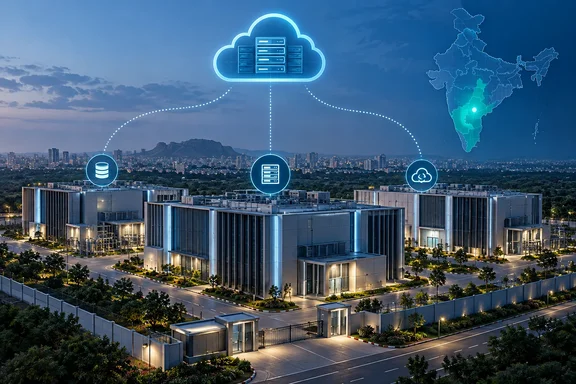
The region is Microsoft’s fourth in India, joining Central India in Pune, South India in Chennai, and West India in Mumbai. Microsoft says eligible Cloud services and workloads can run from Hyderabad. “Eligible” is doing useful work in that sentence: a live region does not mean every Azure service, AI feature, or configuration is available there yet.
A new choice for workloads—not an automatic migration
For an organization serving users in southern India, India South Central offers another place to consider hosting applications and processing data. Location can matter to performance and data-residency planning, but proximity alone cannot establish a particular latency improvement. Nor will an existing workload move to Hyderabad merely because the region has opened. Those decisions still require a service-by-service architecture review.
Microsoft says the region has three Availability Zones. These are separate locations within a region, intended to reduce the risk that a localized infrastructure failure takes down a properly designed application. The catch is architectural: putting one application instance in one zone does not make it zone-resilient, and using multiple zones does not protect against the loss of an entire region. Microsoft’s reliability guidance distinguishes zone-spanning designs from disaster recovery across regions.
HDFC Bank offers a concrete example rather than a universal blueprint. In Microsoft’s launch announcement, the bank described Hyderabad as a disaster-recovery complement to its Central India footprint. Whether another organization can follow a similar approach depends on its required services, recovery objectives, replication design, and data-location rules.
What Azure teams should check
Before choosing India South Central for a new application—or adding it to a recovery plan—administrators should work through four questions:
- Are the required services available? Check the region support for each Azure service, feature, and configuration in the workload. Microsoft says the region launched with a broad Azure portfolio, while additional Azure and AI capabilities are planned. Do not design around a future rollout as though it were already complete.
- Is resilience actually configured? Determine which components can span zones and which need a second-region recovery design. A three-zone region provides the opportunity for resilience; the application still needs to use it.
- Where will the workload’s data go? Review the location and governance requirements of the whole application, including any services it depends on. Microsoft presents the region as another data-residency and sovereignty option, not a blanket compliance certification for everything deployed there.
- What must be tested? Validate application performance and recovery behavior against the organization’s own targets. Neither a shorter distance on a map nor a regional launch announcement substitutes for those tests.
Microsoft says its India cloud capabilities are designed to help customers address applicable Indian data-protection and sector-specific expectations. It also explicitly says customers remain responsible for determining which requirements apply to their organizations and workloads. Choosing Hyderabad is therefore a useful control decision, not a legal-compliance shortcut.
The larger Telangana picture
The inauguration also reflects Telangana’s push to attract cloud and AI infrastructure. The New Indian Express reported roughly 300 MW of operational data-centre capacity in the state and another 2 GW under development. Sridhar Babu described a state goal of 5 GW by 2029 and around US$30 billion in investment. Those are statewide figures and ambitions—not capacity or investment figures for Microsoft’s new region alone.
Microsoft says the Hyderabad region uses effectively zero water for cooling. That qualification matters: it is not a claim that the entire site has no water footprint. The company is also positioning the region as a hub for Asia and the Global South, with more AI capabilities to arrive over time. For customers, though, the immediate story is less grandiose and more practical: India now has another live Microsoft cloud location, and the value of that option depends on what each workload needs—and what the region supports today.
References
- Microsoft Launches New South Central Cloud Region in Telangana - boldnewsonline.com boldnewsonline.com · 2026-09-25T00:00:00+00:00
- AI ambition into action: Microsoft brings AI-ready capabilities across its India cloud infrastructure, establishes India South Central region as a strategic hub for Asia and Global South - Source Asia news.microsoft.com
- Microsoft’s newest India datacenter region goes live to power the country’s AI economy and enable Frontier Firms - Source Asia news.microsoft.com