

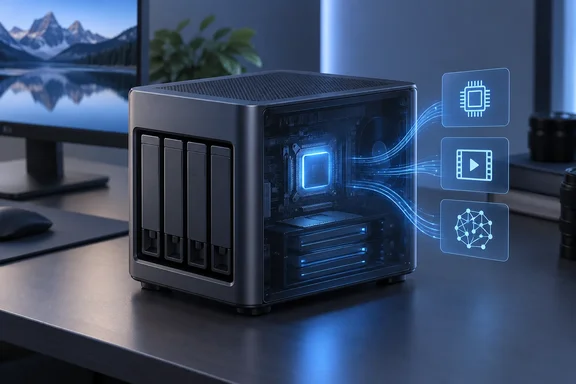
Beelink's Panther Lake ME Pro NAS: Two Chips, Three Chassis, No Spec Sheet
The Chinese outlet IT之家 reported the announcement first, on September 22. Notebookcheck and Guru3D followed. All three agree on the main facts. Processor choices include the Core Ultra X7 358H and Core Ultra 5 325, with the product scheduled to become available before the end of October 2026. IT之家 adds that Beelink presented the X7 358H as the model with more powerful GPU AI compute.
According to Notebookcheck, there will be three models. Two are ordinary two-bay and four-bay versions. The third is a compact system that Notebookcheck guesses could be an all-flash design, similar to Minisforum's recently launched S5. That's the outlet's reading of what Beelink showed on stage. Beelink hasn't confirmed what kind of storage the small unit uses or how its drives are arranged.
Beelink has been open about how much it hasn't said. Beelink has yet to share detailed specs of this Panther Lake ME Pro lineup, and Notebookcheck says the capacity ratings are unknown too. The outlet points to the existing range for comparison: typically, the 4-bay ME Pro systems are said to max out at 132TB, while the company markets most 2-bay systems with a rated capacity of 72TB. Those numbers describe current models. The Panther Lake units may or may not match them.
Only China-market timing has been reported. Notebookcheck notes that Beelink tends to bring most of its products outside the Chinese market, so a global release is possible. That's a pattern, though, not an announced date.
Intel's Spec Sheet Shows What the Core Ultra X7 358H Brings to a NAS
The X7 358H is the more interesting of the two chips, and Intel's ARK page covers it in detail. Intel lists it as a Core Ultra Series 3 mobile processor, formerly codenamed Panther Lake, launched in Q1 2026. It has 16 cores: four performance cores, eight efficient cores and four low-power efficient cores. It runs 16 threads with a maximum turbo of 4.8 GHz and 18 MB of Intel Smart Cache. The compute tile is built on Intel 18A. Phoronix's Linux review confirms the same layout, and notes that the Core Ultra X7 358H does maintain the same 18MB Smart Cache and 25 Watt base power rating as the 388H along with the 80 Watt Turbo Power.
For a NAS, the media and virtualization features matter more than peak clock speed. Intel lists these for the integrated Arc B390 GPU, which has 12 Xe cores:
- The GPU supports Intel Quick Sync Video with hardware encode and decode for H.264, H.265 (HEVC) and AV1.
- H.266 (VVC) is supported for decode only.
- The GPU is rated at 122 peak INT8 TOPS, and the separate NPU at 50 TOPS.
- The chip supports VT-x, VT-x with Extended Page Tables, and VT-d (directed I/O virtualization).
- Intel Standard Manageability is listed. Intel Active Management Technology (AMT) is not, so there's no vPro-style out-of-band management at the chip level.
Hardware AV1 and HEVC encoding is the headline feature for anyone who plans to run a media server and transcode streams on the box. VT-d is the chip-level feature that makes device passthrough possible for home-lab virtualization. These are processor capabilities, though. Whether Beelink's firmware exposes them, and whether its bundled software uses them, is still unknown.
Guru3D raises the most important performance caveat: the announcement does not include sustained power limits or cooling specifications, so buyers cannot yet determine whether the implementation delivers the same long-duration performance as larger Panther Lake systems. Intel's 25 W base and 80 W maximum turbo figures describe what the chip can do. How far Beelink pushes it in a small enclosure full of drives is a separate question. Intel also lists 15 W as the minimum assured power, so there's a lot of room between a quiet setup and a performance-focused one.
Intel's Memory Rule and the 12-Lane PCIe Budget Will Shape the ME Pro
Intel's fine print includes a detail that matters for the top model. Intel says Arc graphics branding is only available on H-series Core Ultra systems with at least 16 GB of system memory in a dual-channel configuration, and that OEM enablement is required. Other configurations are labeled plain "Intel Graphics." If Beelink sells a cheap single-channel or low-memory version of the X7 358H, it won't officially be an Arc B390 system. If you're buying the top model for GPU compute or transcoding, check the memory configuration first.
Intel lists a maximum of 96 GB of memory, LPDDR5X up to 9600 MT/s, and two memory channels. LPDDR5X is usually soldered, so memory choices in a Panther Lake NAS may be fixed at purchase. That's an inference from the memory type. Beelink hasn't said whether memory is soldered or socketed.
The PCIe allocation is the other limit. Intel lists 12 PCIe lanes in total: one PCIe 5.0 x4 group and two PCIe 4.0 x4 groups, which can be split into smaller links. Notebookcheck's processor database also lists four Thunderbolt 4 ports and Wi-Fi 7 in the platform controller. In a NAS, those 12 lanes have to be shared among M.2 SSD slots, SATA controllers for hard-drive bays and network controllers. How Beelink splits them will decide whether the four-bay model can run fast NVMe caching and high-speed Ethernet together. That's the most useful figure to look for when the full spec sheet comes out.
The Core Ultra 5 325 is less well documented. Notebookcheck describes it as a mid-range processor within the Panther Lake line, and it comes with the less capable 4-core Xe3 iGPU. A four-core Xe3 GPU against the X7's 12 cores is a big graphics gap. How the two models compare as file servers will depend on storage and networking details that haven't been published.
Tencent's Marvis and fnOS Make Software Part of the China Pitch
The coverage agrees on one more thing: in China, Beelink is selling the software as much as the hardware. Beelink is pairing the hardware with Tencent's Marvis personal AI agent and the storage-oriented fnOS platform. Per IT之家, Marvis offers file-content understanding, remote control across devices and a local AI processing mode. fnOS, from Beelink's partner Feiniu, handles file management, backup and sync, remote access, and browsing, organizing and sharing video on the device.
This explains the chip choice. A NAS that indexes and understands file contents on the box itself needs AI throughput that older Intel N-series chips don't have. The X7 358H's 12-core GPU and 50-TOPS NPU fit that job, and Beelink put the GPU forward as the X7 model's advantage. Intel lists OpenVINO, WindowsML, DirectML, ONNX Runtime and WebNN among the frameworks the silicon supports. No one has shown how well Marvis or fnOS actually uses the NPU or GPU on this hardware.
Tencent's Marvis and fnOS were announced for the Chinese launch. Nobody has said whether a global version would ship with the same software, a different NAS operating system, or none. Beelink sells the ME Pro as a mini PC as well as a NAS, so Windows buyers will want to know which OS comes preinstalled and whether drivers support a clean Windows 11 install. No outlet has reported either yet.
The Panther Lake ME Pro Joins a Crowded Family of AMD and Intel Models
ME Pro is a product family that Beelink has already filled with very different chips. Beelink's US product page lists a two-bay hybrid NAS mini PC with Intel N95 or N150 options. IT之家's archive shows more ME Pro variants: a Core 3 304 version in two-bay and four-bay forms, a Ryzen AI 9 HX 370 "ME Pro 370" starting at 3,999 yuan, a Ryzen AI 9 HX 470 version starting at 4,795 yuan, and a four-bay H255 model starting at 2,739 yuan. Notebookcheck describes the HX 470 model as a four-bay unit using AMD's Gorgon Halo chip.
There's also a hardware reason Beelink can offer so many chips in one chassis. In December 2025, Notebookcheck reported that this system, which can also double as a mini PC, comes with a drawer-style slot, which allows users to swap between AMD, Intel, and ARM-based motherboards. Panther Lake could plausibly arrive as another board option for that drawer. Beelink hasn't said so, though, and hasn't said whether current owners could upgrade to a Panther Lake board.
That leads to the practical comparison. The Panther Lake models go head-to-head with Beelink's own Ryzen AI 9 HX 370 and HX 470 versions, which cover the same high-end, AI-focused niche and already have published Chinese prices. Once prices and specs appear, the choice between them will come down to Intel's Quick Sync media engine and 18A efficiency versus whatever the AMD models offer in memory and I/O for the money. No independent tests of any Panther Lake ME Pro have been published.
What this means for you
If you need a NAS or home-lab box this month, buy from what's already on the shelf. The Panther Lake ME Pro is only an announcement with a planned end-of-October China launch. If Intel's hardware AV1/HEVC encoding and on-device AI appeal to you, wait for the spec sheet and first reviews before choosing between it and Beelink's AMD models. People planning a Windows 11 mini-PC setup should wait for confirmation of the bundled OS and driver support outside China.
- Beelink has confirmed two processors, the Core Ultra X7 358H and Core Ultra 5 325, and a launch in China before the end of October 2026. Pricing and global availability haven't been announced.
- The compact third model may be all-flash according to Notebookcheck, but Beelink hasn't confirmed its storage type.
- Intel says Arc B390 graphics on the X7 358H need at least 16 GB of dual-channel memory, so check the memory configuration before buying the top model.
- The chip's 12 PCIe lanes have to cover the drive bays, M.2 slots and networking, so read Beelink's lane and Ethernet details closely once they're published.
- Sustained power limits, cooling, noise and idle power are all unknown, so Intel's 25 W to 80 W figures don't tell you how the box will actually perform.
- The Tencent Marvis and fnOS software was announced for the Chinese launch, and Beelink hasn't said what software a global version would include.
Beelink is betting that a Panther Lake chip's GPU, NPU and media engine will make the ME Pro more than a mini PC with drive bays. It's backing that with a chip that has real transcoding and virtualization features on paper. The end-of-October launch should bring the spec sheet and Chinese pricing. Those will show whether the Core Ultra X7 358H model can compete with Beelink's existing Ryzen AI 9 HX 370 and HX 470 units, and whether the Core Ultra 5 325 version is priced as a sensible entry point.
References
- Beelink intros powerful Panther Lake-equipped ME Pro NAS lineup - Notebookcheck Notebookcheck · 2026-09-23T07:26:00+00:00
- Intel® Core™ Ultra X7 Processor 358H intel.com
- 零刻公布 "Panther Lake" 款 ME Pro NAS 迷你主机,支持多项 AI 应用 - IT之家 ithome.com