

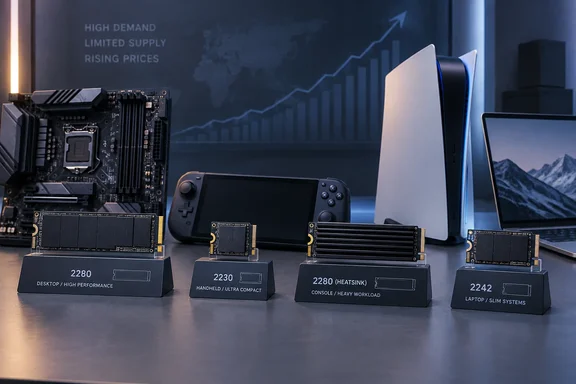
PCWorld's 2026 PCIe 4.0 SSD picks are sorted by slot and use case
Jon L. Jacobi, who has tested storage for PCWorld for more than two decades, chose the five picks from nearly three dozen PCIe 4.0 drives the outlet has reviewed. Only one slot is labeled "best overall." The other four each answer a specific hardware situation: a tight budget, a 2230 handheld, a console that can't use host-memory caching, and Lenovo's 2242 slots.
The guide explains why PCIe 4.0 is still the sensible target. It calls PCIe 4.0 the baseline storage interface on recent computers and says PCIe 5.0 is slowly taking over, but that the real-world gain is smaller than the spec suggests. In PCWorld's words, a lot of software "unfortunately includes Windows" among the programs that can't take full advantage. PCIe 5.0 drives also still cost a hefty premium.
PCWorld puts numbers on that argument. It estimates roughly 3.5GBps maximum from PCIe 3.0, 7.5GBps from PCIe 4.0, and just over 14GBps from PCIe 5.0 under ideal conditions. Those ideal conditions mean synthetic benchmarks or software that uses NVMe's multiple queues. The guide says ordinary single-queue Windows transfers stay under 4GBps on any generation, which is why its advice to Windows users is not to overbuy on speed.
Two compatibility notes from the guide are worth checking before you order. First, PCIe 4.0 needs an AMD Ryzen 3000-series or Intel 11th-gen Core processor (or newer) plus a PCIe 4.0 motherboard. A Gen4 drive works in an older slot but runs at that slot's speed. Second, not every M.2 slot is NVMe, because some older M.2 slots and drives are SATA. Anyone upgrading an older laptop needs to confirm which interface the slot uses.
WD Black SN7100 takes the top spot because the Lexar Play 2280 is hard to find
The overall winner won partly because the drive that edged it out couldn't be bought. PCWorld says the Lexar Play 2280 beat the 2TB SN7100 by an "extremely narrow margin" in its testing. When the guide was updated, though, only the SN7100 was still on sale. The guide's FAQ says the SN7100 is available in capacities up to 4TB.
The name is in transition. PCWorld says the drive is still sold as the WD Black SN7100 but will go forward as the SanDisk Optimus GX 7100, a consequence of Western Digital spinning off its flash business as SanDisk. One heading in the guide spells it "Optimux," but the brand is Optimus. Independent coverage confirms that the Optimus line is mostly renamed WD hardware: Dong Knows Tech notes that the Optimus GX 7100M is the only one in SANDISK's new Optimus family available in the compact 2230 design. As such, it's the first original Optimus drive, not simply a name change of any previous WD Blue or WD Black options. In practice, an SN7100 and a GX 7100 on the same shelf should be treated as the same product.
PCWorld lists these review-time prices: $60 for 500GB, $90 for 1TB, and $140 for 2TB. The drive carries a five-year warranty and a 600TBW rating per terabyte of capacity. Those prices are historical. PCWorld itself says the prices it researched for this update don't match the ones in its earlier reviews.
The budget pick shows how far prices have moved. PCWorld says the 2TB WD Blue SN5100, now renamed the SanDisk Optimus 5100, used to sell for $150 and now costs $285. The guide blames the AI boom directly. Dong Knows Tech independently warns buyers to be prepared for their current high pricing due to the memory shortage caused by AI.
| Drive | PCWorld award | Form factor | Price when reviewed |
|---|---|---|---|
| WD Black SN7100 / SanDisk Optimus GX 7100 | Best overall | M.2 2280 | 500GB $60, 1TB $90, 2TB $140 |
| WD Blue SN5100 / SanDisk Optimus 5100 | Best budget | M.2 2280, single-sided | 500GB $55, 1TB $80, 2TB $143, 4TB $300 |
| SanDisk Optimus GX 7100M | Best for Steam Deck | M.2 2230 | 1TB $230, 2TB $450 |
| Seagate Game Drive PS5 NVMe SSD | Best for PS5 | M.2 2280 with heatsink | 1TB $100, 2TB $150 |
| Corsair MP600 Micro | Best 2242 | M.2 2242 | 1TB $99.99 |
HMB versus DRAM decides the SN7100, SN5100 and PS5 picks
The most useful technical idea in the guide is the difference between HMB and DRAM drives. A host memory buffer (HMB) drive has no DRAM chip of its own. It borrows a slice of the host PC's system memory for its main cache. A DRAM drive has its own memory on the SSD.
PCWorld describes the trade-off this way. HMB designs can deliver slightly faster sequential transfers, while DRAM drives give "significantly better" random and 4K performance. Random performance is what makes the OS feel snappy, though PCWorld admits the difference can be very hard to see with the naked eye. For a typical Windows desktop, gaming rig, or laptop, that makes HMB drives the value choice. The guide goes as far as saying you lose nothing in sequential performance with HMB these days.
The budget WD Blue SN5100 is also an HMB design, with one more trade-off: it uses QLC NAND, which stores four bits per cell. PCWorld says it slows down during very long writes. Even so, it ranked third among all the HMB drives PCWorld has tested and led the outlet's 450GB single-file write test by a wide margin. It improves on its predecessor and PCWorld's former budget pick, the WD Blue SN5000, most clearly in sustained sequential throughput. Because the two drives were priced the same when PCWorld checked, the outlet recommends the newer one. PCWorld lists the SN5100's warranty as five years, capped at 600TBW per terabyte. Its single-sided layout (chips on one side of the board only) fits almost any 2280 slot, including thin laptops that can't take a double-sided drive.
The PS5 pick is where HMB stops being a choice. PCWorld says the PS5 doesn't support HMB, so a DRAM-less drive in the console has to fall back on its slower secondary caching. That's why the Seagate Game Drive, which has DRAM, is the console pick. It's also why PCWorld's list of other notable drives flags the Orico OS5: it's marketed for the PS5 but uses an HMB design the console doesn't support. A "PS5" label on the box doesn't settle the question.
SanDisk Optimus GX 7100M tops the 2230 field, at a steep premium
Handheld owners get the most notable result in the guide. PCWorld calls the Optimus GX 7100M the fastest 2230 SSD it has tested and also the fastest PCIe 4.0 SSD of any size it has tested. It is especially strong at 4K random performance, which PCWorld points out is unusual for an HMB drive. In its full review, the outlet adds that the drive doesn't slow down tragically during long writes. PCWorld describes the drive as a 2230 (22mm wide, 30mm long) form factor, PCIe 4.0/NVMe 2.0 SSD with a SanDisk in-house controller and TLC NAND.
Other outlets largely back up PCWorld's verdict. Tom's Hardware calls it as good as it gets for M.2 2230 with high performance and power efficiency. Tom's also frames it as a spiritual successor to the WD Black SN770M, a popular Steam Deck upgrade, built on hardware similar to the SN7100's. Dong Knows Tech tested the 2TB version and found it edging out the Crucial P310 rival in most cases. The Crucial P310 was PCWorld's previous Steam Deck pick. Dong Knows also reports that the GX 7100M shares the same hardware specs as the Optimus GX7100. The only difference between them is the physical size, with the M version being shorter.
One reviewer disagrees on the ranking. The SSD Review reports that the 2TB drive scored a Total Score of 3564 which placed it amongst the bottom third of SSDs tested to date in its overall scoring, which compares it against a wider field. That result doesn't cancel PCWorld's claim. Different test suites weight different workloads, and the win within the 2230 class holds up across outlets. It does mean "fastest PCIe 4.0 SSD" is PCWorld's finding on its own test bench, and not a universal ranking.
The downside is cost and capacity. PCWorld's review-time prices were $230 for 1TB and $450 for 2TB. The guide says that's about $20 more than a 1TB Crucial P310 and more than $100 more at 2TB. Tom's Hardware explains the capacity ceiling: 2230 drives are generally limited to a small range of capacities, and the 7100M comes only in 1TB and 2TB. Tom's adds that 4TB is possible today in the slightly longer 2242 size. Owners who want a 2230 upgrade and can wait for a sale have reason to: PCWorld expects prices below MSRP over time.
Seagate Game Drive and Corsair MP600 Micro cover the PS5 and 2242 slots
The Seagate Game Drive PS5 NVMe SSD is a DRAM-equipped 2280 drive with a low-profile heatsink. It comes in 1TB and 2TB versions, with no 4TB model. PCWorld's testing ranked it the second-fastest PCIe 4.0 SSD it has measured on random operations. Its endurance rating is the standout spec: 1,275TBW with a five-year warranty, which PCWorld calls more than double the industry norm. Despite the PS5 branding, the guide says it works in any device with a PCIe M.2 2280 slot. Availability is the catch: in March 2026, PCWorld found it still on sale but in short supply.
The Corsair MP600 Micro fills a gap in physical sizes. The 2242 form factor, 22mm wide by 42mm long, sits between the 2230 used in handhelds like the Steam Deck and the 2280 found in most desktops and laptops. PCWorld credits Lenovo with popularizing it in the Legion Go and ThinkPad portables. The MP600 Micro was the fastest 2242 drive PCWorld tested and compared well against many 2280 drives. The guide's main warning is about size: it is too long for 2230 slots. The review-time price was $99.99 for 1TB, but a retailer listing on PCWorld's page showed $426.39. Prices on this model clearly need checking before you buy.
PCWorld's benchmarks were run on a fresh Windows 11 test bench
PCWorld's rankings come from two test platforms. Older drives were tested on Windows 11 with an Intel Core i5-12400 and 64GB of DDR5. Newer drives were tested on Windows 11 24H2 with an Asus Z890-Creator WiFi board, a Core Ultra 5 225, and 128GB of DDR5. Drives were mounted in a HighPoint 7604A PCIe 5.0 adapter or an Asus ROG M.2 adapter. The outlet runs CrystalDiskMark 8, AS SSD 2, and ATTO 4. It then times 48GB and 450GB copies both with Windows Explorer drag-and-drop and with FastCopy, which it says can copy files two to three times faster than Explorer.
The caveats limit how far the numbers carry. Every test ran on a freshly formatted, TRIM'd drive, and PCWorld notes performance can drop as a drive fills up because less NAND is left for caching. Results apply only to the sample and capacity tested. Performance varies by capacity, and vendors sometimes swap components. A 500GB SN7100 won't necessarily match the 2TB unit behind the top pick.
For endurance, PCWorld describes TBW (terabytes written) as working like the mileage limit on a car warranty. It's the vendor's estimate of how much you can write before the drive runs out of spare cells, set partly by NAND type and partly by what the vendor is willing to risk on replacements. The guide says modern drives generally won't wear out under normal consumer use, and that QLC typically carries lower TBW ratings than TLC. PCWorld also notes that three-year warranties are common on bargain drives, while better models go up to five years.
What this means for you
Measure your slot before you look at a leaderboard. The physical size of your M.2 slot and whether your host supports HMB rule out more drives than any speed chart will. After that, choose between sequential value and random-I/O performance based on how you use the machine.
- A standard Windows desktop or laptop with a 2280 slot is well served by the WD Black SN7100/SanDisk Optimus GX 7100. The SN7100 and GX 7100 are the same drive under two names, so buy whichever is cheaper.
- Buyers on a budget can pick the WD Blue SN5100/SanDisk Optimus 5100. It slows down during very long writes because it uses QLC, but its single-sided design fits thin laptops.
- Steam Deck and other 2230 handheld owners get the fastest small drive in PCWorld's testing with the SanDisk Optimus GX 7100M, which Tom's Hardware and Dong Knows Tech also rate highly. Expect to pay a large premium over the Crucial P310, and note the 2TB maximum.
- PS5 owners should choose a drive with DRAM, such as the Seagate Game Drive, because the console can't use HMB caching and a "PS5" label alone doesn't guarantee a DRAM design.
- Lenovo Legion Go and ThinkPad owners with 2242 slots should look at the Corsair MP600 Micro, but it will not fit a 2230 slot.
- Treat every price in the guide as a snapshot. PCWorld reports sharp increases, such as the 2TB SN5100 going from $150 to $285, so check the current price for your exact capacity before you order.
PCIe 4.0 remains the practical storage tier for Windows machines in 2026. Windows' single-queue file copies can't use much of what PCIe 5.0 offers, and the premium for Gen5 has grown while AI demand squeezes NAND supply. Availability, more than speed, now shapes PCWorld's picks: the Lexar Play 2280 lost the top spot because it couldn't be bought, and the Seagate Game Drive is scarce. Until prices come down, the drive you can actually buy in your slot size is the one to get.
References
- Best PCIe 4.0 SSDs 2026: 5 top picks from experts PCWorld · 2025-02-07T22:14:19+00:00