

What GEO is, and why it exists
GEO covers the work of shaping web content, site access and a brand's wider web presence so that generative AI systems pull it into answers. The targets include ChatGPT, Perplexity, Microsoft Copilot and Google's AI Overviews and AI Mode. These respond in prose rather than a ranked list of links, so success means appearing in the answer, not holding a position on a results page.
The motivation is that a synthesized answer often settles the query without a click. A results page sends users to websites. An answer that cites a few sources may not.
Most answer engines follow the same broad pattern, known in AI research as retrieval-augmented generation (RAG):
- Access. The page has to be crawlable and eligible.
- Query rewriting. The model generates its own related searches. Google calls this "query fan-out" and gives an example. A query about fixing a weedy lawn might spawn searches for herbicides, chemical-free removal and prevention.
- Retrieval and synthesis. Pages are fetched and the model composes a response with links.
GEO, AEO (answer engine optimization) and "conversational SEO" are overlapping labels. Terminology and measurement are still inconsistent.
Where the term came from
The name comes from a paper posted to arXiv on November 16, 2023. Its authors are Pranjal Aggarwal, Vishvak Murahari, Tanmay Rajpurohit, Ashwin Kalyan, Karthik Narasimhan and Ameet Deshpande. The arXiv record shows it was accepted to KDD 2024, and it was presented in Barcelona that August.
The authors built GEO-bench, a benchmark of 10,000 queries. They reported that their methods could boost visibility in generative engine responses by up to 40%. Treat that as a result under laboratory conditions, not a promise for any real site. The paper itself notes that results vary by domain. As PPC Land points out, it used a five-source pipeline and GPT-3.5 with AI-written rewrites. It also did not measure effects on rankings.
The Microsoft angle: Bing's AI Performance dashboard
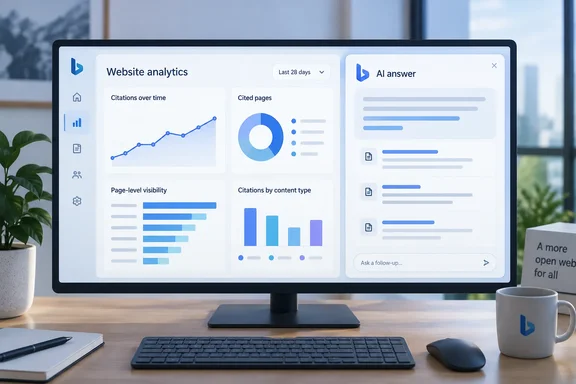
The most concrete Microsoft development is the AI Performance dashboard in Bing Webmaster Tools. Microsoft announced it on February 10, 2026, as a public preview. It shows how publisher content appears across Microsoft Copilot, AI-generated summaries in Bing, and select partner integrations. Microsoft itself describes the release as an early step toward GEO tooling in Bing Webmaster Tools.
The dashboard reports:
- Total citations. How often your site is shown as a source in AI answers during the selected period. It does not show placement within an answer.
- Average cited pages. The average daily number of unique pages from your site shown as sources. Microsoft says this does not indicate ranking, authority or the role of a page in any answer.
- Grounding queries. The key phrases the AI used to retrieve content. Microsoft says this is a sample of overall citation activity.
- Page-level citation activity. Citation counts per URL.
- Visibility trends. A timeline of citation activity.
Microsoft also says Bing respects content-owner preferences expressed through robots.txt and other supported controls.
Third-party write-ups add some details I could not confirm from Microsoft's own post. One says a June 2026 update added Citation Share, Intents, Topics and a Compare view. Another says the report blends all surfaces into one total, so you cannot split it by Copilot versus Bing summaries. Both come from SEO blogs. Check your own dashboard before relying on them.
What the numbers can and cannot tell you
A citation is a visibility signal. It is not a ranking, a session or a conversion. Microsoft's own caveats say as much. High citations next to flat referral traffic would not be a tracking bug.
The report also covers only Microsoft's ecosystem. It will not show how you fare in ChatGPT, Perplexity or Google. Because it reports only content Bing has crawled and indexed, patchy indexing means patchy citations.
Microsoft's suggested ways to use the data are to:
- Validate which pages are already being cited.
- Identify content that appears frequently across answers.
- Find indexed pages that are cited less often and improve their clarity, structure or completeness.
Its content advice is to deepen expertise, use clear headings, tables and FAQ sections, support claims with evidence, keep content fresh, and keep text, images and video consistent about the same entities. Treat these as Microsoft's recommendations, not proven ranking factors. Microsoft also points to IndexNow for notifying participating search engines when content is added, updated or removed. Local businesses are pointed to Bing Places for Business.
How the other platforms compare
Google. Google's guide to optimizing for generative AI features (last updated July 10, 2026) says SEO best practices still apply. Its generative features rely on core Search ranking and quality systems. To be eligible, a page must be indexed and eligible to appear in Search with a snippet. The guide tells site owners they can ignore several popular "hacks" for Google Search:
- llms.txt files and other special markup
- chunking content into tiny pieces
- rewriting content just for AI systems
- seeking inauthentic mentions
- overfocusing on structured data. It isn't required, though Google still recommends it for rich results.
Google's measurement answer is the Search Generative AI performance reports in Search Console. They were announced on June 3, 2026, for a subset of sites at first. They show impressions, pages, countries, devices (for Search) and dates for AI Overviews, AI Mode and Discover generative features. They give impressions, not a dedicated click metric.
OpenAI. For ChatGPT search, OpenAI's publisher FAQ says to make sure you aren't blocking OAI-SearchBot, updating robots.txt if needed. That keeps your content eligible for summaries and snippets. Publishers who allow the crawler can track referrals through the UTM parameter utm_source=chatgpt.com. Blocking GPTBot is a separate choice that governs training.
Note the caveat: Google's advice covers Google Search only. It does not prove other engines retrieve content the same way, and some practitioners argue they don't.
The evidence problem
Is GEO a real discipline, or SEO with a new acronym? The evidence cuts both ways.
The C-SEO Bench benchmark appeared at NeurIPS 2025 (Datasets and Benchmarks Track). Its authors are Haritz Puerto, Martin Gubri, Tommaso Green, Seong Joon Oh and Sangdoo Yun. It tested question-answering and product-recommendation tasks across three domains each. It also varied how many competitors adopted the tactics. The authors found that most conversational-SEO methods were largely ineffective and often hurt document ranking. Traditional SEO strategies that improve a source's ranking in the model's context worked significantly better. Gains also shrank as more actors adopted the tactics, which the authors described as a congested, zero-sum problem.
That doesn't prove all GEO work fails. It does undercut blanket claims that rewriting content reliably wins citations.
Incentives matter on both sides. Google sells search advertising and has reason to describe the shift as continuity. GEO tool vendors have the opposite incentive.
PPC Land's explainer also cites a long list of vendor and consultant statistics. Examples are query fan-out counts, brand inclusion rates, survey results and a listicle study. I did not independently verify those, so I'm not repeating them here as settled fact.
Regulation: UK publisher controls
On June 3, 2026, the UK Competition and Markets Authority imposed a conduct requirement on Google. The CMA says publishers will be able to opt out of their content powering AI features in Google Search, such as AI Overviews. Google must also attribute publisher content with clear links in AI-generated results. It must let publishers opt out of content use for AI-model fine-tuning. The CMA gave Google nine months to implement all changes. It expects important controls sooner. Google must also publish compliance reports every six months for the first year.
This is UK-specific. The CMA also notes that a strategic market status designation doesn't mean Google acted anti-competitively.
A practical checklist for site owners and IT teams
- Confirm access. Check that robots.txt, noindex and nosnippet directives aren't blocking the crawlers you want. That includes Bingbot, Googlebot and OAI-SearchBot.
- Verify your site in the first-party tools. Use Bing Webmaster Tools and Google Search Console. Read the AI reports as visibility indicators only.
- Keep content fresh. Consider IndexNow for faster update discovery across participating engines.
- Prioritize original, evidence-backed content. Google and Microsoft both stress depth, clarity and support for claims.
- Test against a baseline. Change one thing at a time and compare. Don't assume a vendor score or a single benchmark predicts business results.
- Be wary of shortcuts. Mass-produced self-promotional lists and AI-only pages are risky. PPC Land reports Google says its spam policies apply to generative AI responses. I did not verify that claim independently.
Bottom line
GEO is real as a measurement problem: Microsoft and Google now both give publishers first-party views of AI visibility. As a bag of proven tricks it is much weaker. The foundations are indexing, crawlability, unique content and honest measurement. The rest is still being tested, and the best research so far warns against assuming it works.
References
- Introducing AI Performance in Bing Webmaster Tools Public Preview |... blogs.bing.com
- Bing blogs.bing.com
- Explaining GEO - PPC Land PPC Land · 2026-10-05T17:56:51+00:00