

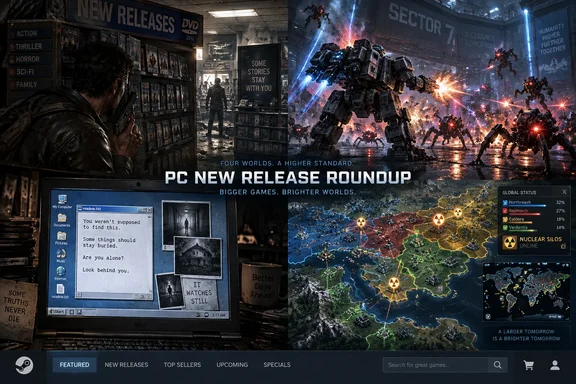
Engadget’s new-indie roundup correctly identifies the immediate appeal of each game, but the buying decisions are less alike than the shared “new on Steam” label suggests. The useful distinction is whether you are buying a finished experience, an early-access project, or the first installment of a larger release still scheduled to arrive in 2027.
For PC players, the practical takeaway is simple: RIG Riot and lily’s world XD are the least structurally complicated purchases; BLACKWOOD asks buyers to accept a rough Act One while waiting for its conclusion; and OpenFront deserves a closer look before anyone assumes the Steam edition replaces the free browser game.
BLACKWOOD’s first act is a $25 bet on two future chapters
BLACKWOOD: Act One launched on Steam for Windows on September 16, putting players in the role of Anton Blackwood, a DVD-store operator in 2012 who spends his nights as a contract killer. The premise is unusually specific: store-management and double-life mechanics sit beside third-person shooting, melee combat, weapon customization and Max Payne-style slow-motion dives.
AttritoM7 Productions says a purchase includes all three acts. Its Steam launch announcement supplies a more precise schedule than the broad 2027 window described in Engadget’s report: Act Two is planned for March 2027 and Act Three for September 2027. That means the current release is not a season pass for an undefined future product; it is a paid first chapter with two dated follow-ups, though those dates still depend on the small developer meeting its production plan.
The important caveat is quality, not the concept. Engadget reported problems with clunky hand-to-hand combat, erratic audio levels, poor vehicle handling and slow weapon pickups. Pure Dead Gaming, in a separate review, similarly described technical roughness, inconsistent enemy AI and stretches of side content that weaken the pace. Player reports on Steam also include complaints about unresponsive controls and DirectX 12 stability.
Those overlapping complaints make this more than a reviewer’s taste dispute. The game’s current problem is execution at the exact point its pitch depends on fluidity. A John Wick-inspired action game can survive limited production values; it has a much harder time surviving delays between running out of ammunition, grabbing a weapon and getting back into the fight.
AttritoM7 did issue a day-one patch and has said it will add autosaving and more side missions before Act Two. Autosaving is a meaningful improvement if the current sleep-based saving system forces players to preserve progress through a specific in-game routine. But it does not address the bigger issue: prospective buyers should treat Act One as an imperfect six-hour opening, not a polished substitute for the action games it references.
The $25 list price does include the remaining acts, which limits the financial risk compared with buying separate episodes later. Still, the sensible purchase decision depends on tolerance for launch-period jank. Players attracted primarily to the DVD-store premise and the promise of an ongoing story may find enough to like now. Players coming chiefly for precise gun-fu should wait for the next round of fixes and see whether the studio improves the basics before March.
RIG Riot’s first patch puts the CPU question front and center
Sage Boatman’s RIG Riot launched on Steam for Windows on September 14 as a single-player third-person mech-action roguelike. Its starting point is plainly stated: the developer wanted more of the high-speed mech combat associated with Armored Core VI: Fires of Rubicon, then designed a game built around repeatable raids, increasingly difficult enemy encounters, upgrade choices and thousands of permanent mech parts.
The distinction from FromSoftware’s game is not merely its smaller budget or indie presentation. RIG Riot applies a roguelike loop to mech building: a run produces weapons and temporary modifications, while permanent parts expand the garage between raids. For a Windows player who likes tuning builds as much as mastering a campaign, that gives it a clearer repeat-play structure than a conventional mission-driven mech game.
It also arrived with a technical warning that matters more than the launch comparisons. In a September 17 Steam update, Boatman said RIG Riot runs “almost entirely on the CPU,” explaining that moving more work to the GPU had hurt performance on integrated graphics systems. The developer said enemy-heavy Standard mode can put additional strain on CPUs and is considering a setting to control the number of enemies allowed to spawn.
That is a useful disclosure for PC buyers, because it reverses the usual assumption that lowering graphics settings will necessarily solve a performance problem. If frame-rate drops arise chiefly from CPU simulation and enemy counts, a strong graphics card does not guarantee a smooth experience. Players on older four-core processors, handheld PCs or integrated graphics should pay particular attention to early patches and the revised Steam system requirements rather than buying on the assumption that the game’s stylized visuals make it lightweight.
Boatman’s September 17 patch adjusted rendering settings for steadier frame rates, changed difficulty-mode names and fixed an issue in which enemies in the former Assault mode did not award upgrade progress on kill. The developer has also discussed investigating co-op, localization, game modes and Steam Workshop support, but those are possibilities rather than promised features. Console and GOG versions are similarly not commitments.
For now, RIG Riot looks like the most immediately replayable game in this group, but also the one where buyers should validate performance during Steam’s refund window. Its recent patch cadence is encouraging; it does not make CPU-bound bottlenecks disappear.
lily’s world XD uses the Windows desktop as its setting
Kwalee-published lily’s world XD arrived on Steam for Windows on September 17. Developed by SonderingEmily, it presents itself as a psychological-horror investigation set inside the laptop of Lily, a teenager living in 2004. Players read messages, examine photos, work through the contents of a personal computer and gradually discover that someone else may be watching the investigation.
The desktop-exploration format has obvious ancestors in screenlife horror such as Unfriended and Searching, as Engadget noted, but the game’s stated hook is more personal than a generic faux operating system. The developer used real teenage-era photos of herself and friends in the game, according to Engadget, lending the early-2000s material a less manufactured texture than the standard “retro internet” pastiche.
Steam’s listing confirms the game is a Windows release with a demo available, full English audio, Steam achievements and 4 GB of storage required. SteamDB recorded its release at 14:53 UTC on September 17, confirming that this is a live launch rather than a coming-soon listing that has been prematurely picked up by storefront trackers.
The most relevant thing to know before buying is that lily’s world XD is not an operating-system simulator in the administrative or technical sense. It is a narrative horror game using an imitation desktop as an interface. That may sound obvious, but it draws the line between an interactive mystery built around reading, observation and fourth-wall tricks, and a game intended to offer deep branching computer simulation.
At $12 before its launch discount, it is also the lowest-commitment entry in this set. The demo is the better test than trailer footage for anyone sensitive to psychological horror or uncertain whether the deliberately invasive “search someone’s laptop” format works for them.
OpenFront’s Steam version is an option, not the only way in
OpenFront reached Steam Early Access on September 17 after building an audience in browsers. It is a real-time multiplayer strategy game in which large numbers of players compete on shared maps, form temporary alliances, expand territory and deploy nuclear weapons. Its Steam listing describes hundreds of players and AI opponents in a single map-based conflict, while the developer’s code and release notes show a project still receiving frequent balance and anti-cheat updates.
The major clarification is commercial. Engadget says the web version drew more than 2.5 million monthly players, but OpenFront’s current Steam page says the browser version has driven 1 million monthly players. Meanwhile, the developer’s August Steam announcement referred to around 200,000 daily players, and its launch message cited more than 21 million players cumulatively. Those figures may refer to different periods or measurements, but they are not interchangeable. The 2.5 million monthly claim should not be treated as a current confirmed benchmark without a definition from OpenFront Inc.
What is confirmed is that the browser edition remains free. OpenFront’s Steam release announcement explicitly says the web game is not going away, and the developer’s public release notes identify the Steam client’s additions as achievements, exclusive cosmetics, audio changes, offline play and immediate trusted-account status. Steam users and browser users can also meet in the same cross-platform multiplayer environment.
That changes the value proposition considerably. The paid Steam version is not the only route to the multiplayer game, nor is it simply a performance patch for browser users. It is a client purchase for players who want Steam integration, offline options and the associated account benefits while helping fund further development.
Early Access also means unfinished work remains visible. OpenFront’s roadmap includes mobile applications, clan-system additions, maps, modes, performance and observability work, plus Steam Deck optimization. The title is playable now, but the developer is still improving the competitive infrastructure and addressing cheating and teaming through account-trust measures and player reporting.
For Windows users, OpenFront is the easiest one of these games to try before spending money: load the browser version, see whether the pace and multiplayer politics suit you, then decide whether Steam’s client-specific features justify the purchase.
References
- John Wick as a DVD store operator, a roguelike take on Armored Core and other new indie games worth checking out Engadget · 2026-09-19T11:30:00+00:00