

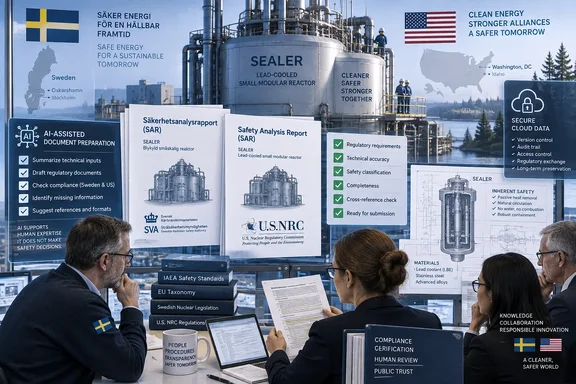
But the headline claim needs a firm boundary. This is an effort to speed Blykalla’s internal licensing work, not to shorten the independent safety review by a regulator. Blykalla says it aims to reduce a documentation exercise traditionally measured in years to months and cut time and resources by 90 percent. Neither Blykalla nor Microsoft has announced that the Swedish Radiation Safety Authority or the U.S. Nuclear Regulatory Commission has accepted an AI-accelerated review timetable.
That distinction is more than semantics for IT teams and data-center operators watching nuclear developers promise on-site, always-on power. AI may reduce repetitive document production and expose inconsistencies before a filing is submitted. It cannot replace the technical evidence, environmental assessments, public processes, security plans and regulator judgments that determine whether a reactor can actually be built and operated.
Microsoft’s role is document intelligence, not a licensing decision
Blykalla says it is applying Microsoft’s GenAI for Energy Permitting Solution Accelerator along with AI agents in its regulatory workflows. The announced use cases are drafting, reviewing and refining permitting documents against regulatory requirements, in both Swedish and English.
That makes the deployment closer to a specialized retrieval, analysis and workflow system than an AI system making safety decisions. A well-designed implementation could connect requirements to evidence, identify missing sections, trace revisions across large document sets and give engineers a faster route to the source material behind a claim. Those are useful tasks in a field where inconsistent terminology or an unsupported assumption can generate time-consuming regulator questions.
Microsoft has positioned its energy-permitting accelerator as a way to automate parts of document creation and compliance checking. Its usefulness will depend heavily on Blykalla’s implementation: which reactor-design records it can access, how it handles Swedish and U.S. regulatory terminology, whether output is traceable to controlled source documents, and who signs off on generated text.
The public announcement leaves those operational questions unanswered. There is no disclosure of the Azure services involved, the models used, the boundaries on sensitive engineering data, retention controls, evaluation results, or a process for detecting a plausible but incorrect generated statement. Those omissions matter more here than they would in an ordinary enterprise knowledge-base deployment. Nuclear licensing submissions must be defensible years after filing, including through design changes, requests for additional information and public scrutiny.
Energinyheter, a Swedish energy-industry publication, reported that material produced through the workflow will still require review by nuclear specialists, lawyers and other responsible staff before it reaches an authority. That is the right control, and it should be treated as the minimum rather than a reassurance that the AI itself has solved the verification problem.
Blykalla’s “months” claim applies to paperwork
Blykalla’s chief AI executive, Jon Christensen, framed the target as taking “licensing documentation” from years to months. The company’s wording is narrower than a promise that a reactor will receive a construction or operating license in months, although promotional headlines around AI permitting can easily blur the two.
The U.S. NRC’s published process shows why. Pre-application work can include technical reports, white papers, topical reports and readiness assessments. A formal reactor application then requires the regulator to evaluate safety and environmental information under a selected licensing pathway. For a commercial plant, the process can also involve reviews of emergency planning, security, operational limits, construction inspections and public hearings.
Blykalla’s U.S. project remains early. In June, the company announced that it had initiated formal pre-application engagement with the NRC for SEALER. That is a significant preparatory milestone, but it is not a license application and it does not itself authorize construction or operation.
The NRC’s public list of active advanced-reactor pre-application activities, last updated August 27, does not name Blykalla among the listed liquid-metal-cooled reactor developers. That does not disprove Blykalla’s reported engagement; the company could be conducting early interactions that have not yet appeared in the agency’s public project list. It does mean that the public record currently provides no NRC project page, published engagement plan or review schedule against which Blykalla’s AI-driven efficiency claims can be measured.
The agency itself is pursuing AI-assisted productivity. The NRC says it is piloting an internal generative-AI tool for an enrichment-facility application and using Microsoft Copilot Chat to research precedents and compare licensing documents. Its stated use is staff efficiency, not delegation of safety findings to AI. That parallel may make future exchanges between applicants and regulators more document-native, but both sides still need human experts able to verify the underlying engineering argument.
Sweden adds a separate set of approvals
Blykalla is also pursuing Swedish reactor parks, where the company has recently advanced projects at Norrsundet in Gävle Municipality and at Untra in Tierp Municipality. Its Microsoft announcement initially referred broadly to applications for two advanced reactor parks in Sweden; the company’s current release identifies the Norrsundet project as a six-reactor, 330 MWe proposal.
The Swedish work is not simply a translation exercise. Blykalla’s own project materials say a park would need decisions or approvals involving the Swedish Radiation Safety Authority, the Land and Environment Court, the Swedish government and local government. An AI system can help organize submissions across those tracks, but it cannot consolidate them into a single checkbox or make local, environmental and national approvals happen in parallel by default.
For Blykalla, the more immediate benefit may be consistency. The company is trying to commercialize a lead-cooled fast-reactor design based on proprietary aluminum-alloyed steel intended to address the corrosion challenge posed by liquid lead. That is technically distinctive from the light-water reactors that dominate existing commercial licensing experience. A controlled evidence system could make it easier to reuse substantiated design information while preserving the exact context, version and jurisdiction under which a claim was made.
That reuse has limits. A statement that is appropriate to one country’s technical framework, environmental law or terminology may not satisfy another’s requirements. The bilingual Swedish-English workflow needs review that catches more than mistranslation; it needs to prevent a document from importing the wrong regulatory assumption.
What Microsoft gains from the nuclear use case
For Microsoft, the partnership is a high-profile test of Azure’s role in a fast-growing energy market shaped by data-center demand. Blykalla explicitly pitches SEALER as a compact reactor suitable for co-location with industrial facilities and AI data centers. Microsoft’s energy ambitions and its own need for reliable low-carbon electricity make the association commercially logical, even though the announcement does not disclose a power-purchase agreement, an equity investment, reactor order or commitment to operate SEALER units.
That missing detail is important. This is a technology-workflow collaboration, not evidence that Microsoft has selected Blykalla to power a specific data center. Readers should not infer a new electricity supply deal from a permitting-tool deployment.
There is also a practical enterprise IT lesson in the announcement. Regulated industries will increasingly ask whether AI can turn long approval cycles into short ones. The more honest answer is that AI can improve the quality and speed of the submission process when its sources, controls and human review are rigorous. It cannot safely remove the independent review steps that exist precisely because a well-written document is not the same thing as a well-supported safety case.
The measure of success will be fewer regulator questions
Blykalla has chosen a sensible place to apply AI: the painstaking preparation of regulatory documentation. If the system reduces contradictory statements, finds missing evidence early and makes each assertion traceable to a controlled engineering record, it could reduce rework and requests for clarification on both sides of the Atlantic.
The company has not yet published the benchmarks needed to demonstrate that result. It has provided no baseline document-production cycle, no quality metric, no error rate, no description of human-approval gates and no date for a formal U.S. application. Its 90 percent reduction target should therefore be read as an ambition rather than a demonstrated outcome.
The first concrete proof point will not be an AI demo. It will be whether Blykalla submits a complete, internally consistent licensing package that moves through Swedish authorities and the NRC with fewer avoidable questions—and whether the company can show that its AI workflow improved the record without weakening the human accountability behind it.
References
- Blykalla and Microsoft Collaborate to Advance AI-driven Nuclear Licensing for its Lead-Cooled Advanced Nuclear Reactor 01net · 2026-09-15T15:00:00+00:00