

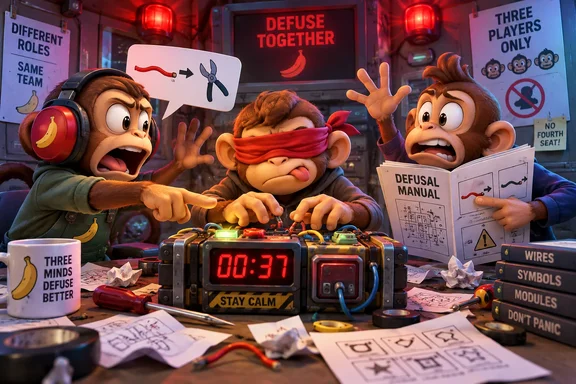
PC Gamer’s account of the game’s escalating, panicked bomb-defusal sessions captures the intended experience: failure is usually a communication breakdown before it is a puzzle-solving failure. But its opening description also contains a material error for prospective players. It says players can bring “three friends,” implying a four-player team. Steam’s official listing is explicit: BOMBANANA! requires exactly three players. There is no fourth operational role.
That distinction matters for a co-op game whose central gimmick is that every role is necessary and every player begins without a complete picture. The September 10 v1.0.2 update makes the game more accessible to solo purchasers, but it does not add four-player support, bots, or a way to fill an incomplete duo with an AI teammate.
Three Monkeys, One Information Bottleneck
The underlying structure is closer to a physical party-game puzzle than a conventional online co-op game. The blind monkey is the only player who can interact with the bomb, meaning the person pressing switches, handling modules, and making the final defusal choices has incomplete visual information. The deaf monkey can inspect the bomb and communicate verbally, but cannot hear confirmation, correction, or questions from the rest of the team. The mute monkey has the manual—the source of the actual solution rules—but must communicate through body language, pointing, or other non-verbal actions.
PC Gamer compares the setup to Team 3, the cooperative construction game inspired by the three wise monkeys. The better-known PC comparison, though, is Keep Talking and Nobody Explodes, which also turns defusal into an exercise in translating a visual problem through a manual under time pressure. BOMBANANA!’s contribution is to remove the comfort that Keep Talking generally affords: no single participant can simply read aloud, ask a clarifying question, and act on the answer.
Instead, BOMBANANA! creates a chain of interpretation. The seeing-and-speaking player has to describe the bomb accurately. The manual-holder has to recognize the relevant module and convey an instruction without speech. The blind operator must then interpret that signal and perform the right action. Every transfer is an opportunity for ambiguity.
That makes the game’s monkey theme more than a joke pasted over a conventional puzzle system. Gesture, posture, emotes, and frantic movement are part of the input method. The result is structured chaos, but it is structured enough that teams can improve rather than merely hope for better luck on the next explosion.
The Full Release Is Larger Than the Demo Premise
Steam lists BOMBANANA! as a full release rather than an early-access project, with a 30-level campaign, an Endless mode with procedurally generated waves, and customizable sessions where players can alter elements such as timer pressure, hazards, mistakes allowed, and module selection. The official store page also describes multiple bomb environments and interruptions including power outages and obstructive events.
Those options are significant because the core role design has a natural limitation: once a regular trio learns a small set of puzzle modules and develops shared shorthand, the initial confusion can turn into routine procedure. More modules and environmental disruptions are how the game preserves its central tension without changing the three-role formula.
PC Gamer’s hands-on report points to that progression. Early levels teach participants how to relay individual details—such as a switch color and whether it should be up or down—while later levels layer in more puzzles, distractions, and a gauge that can trigger an immediate blast if it is not managed. The frustration is intentional, but the useful part is that players are not merely racing a timer. They are managing a communication protocol under pressure.
For Windows players planning a session, this means the first few failures are not a sign that the group has reached the game’s skill ceiling. They are part of establishing a vocabulary. Teams that settle on consistent terms for positions, colors, gestures, confirmation signals, and when not to interrupt should improve quickly. Teams that treat every round as a fresh shouting match will likely experience the game as a series of explosions punctuated by finger-pointing.
Matchmaking Fixes the Purchase Problem, Not the Design Constraint
BOMBANANA!’s September 10 v1.0.2 patch added matchmaking intended to help solo players find and join other players. The update also adjusted level-difficulty balance, fixed controller UI that did not appear correctly for controller users, added a lobby-code visibility control, and made changes to sound and voice-chat systems.
The matchmaking addition is the most consequential of those changes because an exactly-three-player online game has a harsher group-formation problem than games built for a flexible range of two to four players. A player with one friend cannot simply begin a private match. A group of four cannot all join the same team. Before the patch, anyone without two ready teammates faced a basic access problem rather than a gameplay challenge.
The new system lowers that barrier, but it introduces another reality: BOMBANANA!’s funniest moments depend on improvised trust, and its hardest moments depend on shared shorthand. Random matchmaking can supply bodies for the three roles, but it cannot instantly create the social rhythm that makes indirect communication efficient.
That does not make public matchmaking pointless. It may be the best way for a solo buyer to learn the roles, understand the game’s gestures, and find regular partners. It also makes the $7.99 game more practical for players who saw clips or read coverage but do not have a standing trio ready to buy in together. Still, anyone purchasing specifically for a planned group should count heads before checking out: the intended unit is three, not “up to four.”
The Popularity Claim Needs a Narrower Reading
Steam currently shows BOMBANANA! with an “Overwhelmingly Positive” user-review label, with roughly 96 percent positive reviews from more than 2,400 accounts. Notebookcheck separately described the title as a new Steam hit shortly after launch, also citing its 96 percent positive reception. That is meaningful early evidence that the premise is connecting with players rather than only with trailer audiences.
But “taking over the internet,” the framing used by PC Gamer, is more marketing-sized language than a measurable conclusion. The available record establishes an enthusiastic early Steam response, not a verified player-count milestone, sales figure, or broad cross-platform cultural event. TARK’s launch material said the game had passed one million wishlists before release, but that is a publisher claim and not the same thing as confirmed ownership or concurrent-player data.
The more defensible conclusion is that BOMBANANA! has converted a clean, easily understood hook into positive early reception: three players, three impaired information channels, one bomb, and no spare seat. That clarity has helped it stand out in a crowded co-op category where many games market “chaos” without giving players a reason to communicate differently.
What a Windows PC Group Should Expect
BOMBANANA! is available through Steam for Windows and macOS. Its store listing describes online co-op, Steam achievements, and Family Sharing support, while the latest patch specifically references controller UI and voice-chat adjustments. Those are encouraging signs for a low-friction party game, though the communication premise means a working microphone setup remains more important than in most casual online titles.
The game’s accessibility is more complicated than its colorful presentation suggests. The roles intentionally restrict sight, hearing, or speech as game mechanics, but those mechanics are not substitutes for real-world accessibility features. Steam and the developer’s material identify colorblind options, while the patch notes acknowledge audio and controller-interface work; neither source provides a complete accessibility breakdown for players with sensory, speech, or motor disabilities. Prospective buyers who need specific accommodations should not assume that a game themed around sensory limitations necessarily supports them.
For everyone else, the immediate practical advice is simpler: form a group of exactly three, test voice chat before a timed round, and agree on a few basic directional and confirmation signals before starting the campaign. The first bomb may still explode. The next one should at least explode for a reason the whole team understands.