

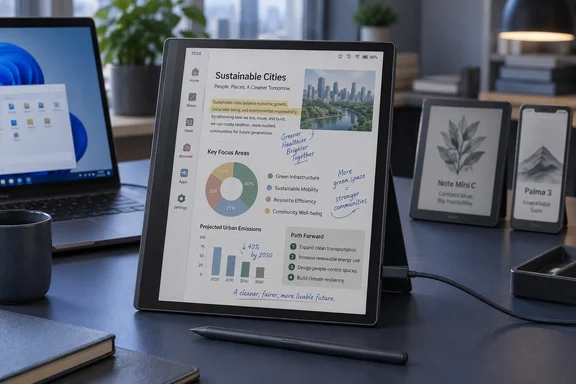
The distinction is more than a launch-day technicality. As MakeUseOf framed the trio as fresh Kindle competition, and Android Authority, WIRED, and 9to5Google independently confirmed the three-device announcement, BOOX’s actual product pages show a split rollout: the 10.3-inch Note Air6 C is on sale, while the 8.52-inch Note Mini C and phone-shaped Palma 3 are announcements with prices attached. That leaves prospective buyers comparing a real product against two promised ones.
For Windows users who treat an eReader as a document-and-notes companion rather than a closed book appliance, the Note Air6 C is the consequential release. It runs Android 16 with Google Play access, reads Office and PDF formats natively through BOOX’s NeoReader software, supports microSD expansion, and ships with a stylus. The headline-grabbing claim that the entire trio finally challenges Kindle, however, gets ahead of the hardware that is actually available—and overlooks that Amazon already sells the Kindle Scribe Colorsoft for color writing and reading.
The Note Air6 C is the launch product that matters today
The Note Air6 C is BOOX’s updated 10.3-inch color digital notebook, built around an E Ink Kaleido 3 panel. It renders monochrome content at 300 ppi and color content at 150 ppi, the same basic compromise seen across this class of color ePaper: sharp text, but muted color intended for highlights, charts, marked-up documents, covers, and comics rather than tablet-grade imagery.
BOOX says its updated octa-core processor and Super Refresh technology make the Note Air6 C 40 percent faster than the Note Air5 C in tasks such as opening large documents and turning pages. That is a vendor benchmark, not an independently measured result, and it should be treated accordingly. But the claimed target—less lag while moving through large scanned PDFs, split-screen notes, and Android applications—is the right one for an ePaper notebook.
The underlying hardware makes the intended use clear: 6GB of RAM, 64GB of internal storage, a microSD slot, Wi-Fi and Bluetooth 6.0, dual speakers, a microphone, a fingerprint reader, and a 3,700mAh battery. BOOX also advertises support for PDF, DOC, DOCX, PPT, PPTX, EPUB, CBR, CBZ, HTML, image formats, and audio files.
That file support is where the device has a clearer role beside a Windows PC. A Kindle remains primarily a reading endpoint for Amazon purchases and documents sent into Amazon’s service. The Note Air6 C is aimed at people who receive a PowerPoint deck, download a PDF from SharePoint or a browser, annotate it, and want to put the resulting file back into their broader workflow. BOOX’s Android build also permits third-party apps, including cloud-storage clients and reading applications, instead of requiring one store or one document pipeline.
The hardware’s $579.99 starting price is high for an eReader but less surprising for a color handwriting tablet. Amazon’s Kindle Scribe Colorsoft occupies a similar premium territory and gives Amazon users a more tightly integrated color-note experience. The BOOX argument is not lower cost; it is software choice and file flexibility.
The pen is included—despite the submitted report saying otherwise
One detail in the original account does not survive a check of BOOX’s own product listing: the Note Air6 C’s Pen3 stylus is included in the standard box. BOOX lists the tablet, Pen3, USB-C cable, tray tool, quick-start material, and warranty card as the included bundle.
The magnetic keyboard cover is separate. BOOX’s store lists that accessory at $109.99, and its product page describes it as a snap-on, pogo-pin keyboard for longer writing sessions. Its magnetic case is also an extra purchase.
That correction matters for buyers comparing the Note Air6 C with a Kindle Scribe or a reMarkable. A digital notebook becomes materially more expensive when its pen is optional, while a bundled pen makes the sticker price a more honest starting point. The Note Air6 C still requires an additional outlay for keyboard-style work, but it does not require one merely to take handwritten notes.
BOOX also says several headline software features depend on its latest firmware. Those include Dual Notes, which supports two notes or documents in split screen, as well as tools such as Talk Insights transcription and AI-assisted summarization. The company’s own fine print says Talk Insights needs an internet connection and is limited to selected regions and languages. Organizations should therefore avoid treating the AI features as an offline transcription solution or assuming every staff member will receive the same capabilities.
There is another support consideration that should matter to IT-conscious buyers. BOOX promises firmware updates for “more than three years” after launch, but does not commit on this product page to a specific Android-version upgrade schedule or a security-patch calendar. Amazon publicly lists security-support end dates for supported Kindle models, including December 31, 2030 for the Kindle Scribe Colorsoft. BOOX’s more general promise may be adequate for a personal reading device, but it is less specific for anyone considering access to workplace email, cloud drives, or sensitive documents through Android apps.
The Note Mini C is a smaller notebook, not a budget edition
The upcoming Note Mini C condenses much of the Note Air6 C formula into an 8.52-inch color ePaper device. BOOX lists the same 6GB of RAM, 64GB of storage, microSD expansion, Android 16, an octa-core processor, BSR refresh technology, a color Kaleido 3 display, dual-tone front light, fingerprint reader, speakers, and microphone.
Its lower 3,150mAh battery and roughly 300-gram weight are the trade-offs for portability. The Mini C has the same 300 ppi black-and-white and 150 ppi color pixel density as the larger model, which means the smaller screen is not a lower-resolution compromise; it is an A5-adjacent work surface for readers who find a 10.3-inch slate too cumbersome.
The unusual part is the pricing. BOOX currently lists the Note Mini C from $549.99, while both WIRED and 9to5Google reported a roughly $580 price at announcement. That may reflect regional pricing or an early store promotion, but BOOX has not supplied a clear release date or a clean explanation for the discrepancy. The important purchasing fact is simpler: the Mini C is not yet shipping, so the advertised price is not a completed retail offer.
Unlike the Note Air6 C, the Mini C uses BOOX’s InkSight active stylus system. BOOX lists an InkSight pen in the standard bundle, again undercutting any suggestion that a buyer will need to separately purchase a basic handwriting tool. It does not support the magnetic keyboard cover, making this more of a handwritten annotation and reading device than an ePaper laptop substitute.
For users whose work is built around review copies, technical PDFs, academic literature, tickets, diagrams, and OneNote-like handwritten capture, the Mini C could be the more compelling of the two Notes. But until it is available for purchase and independent testing, its advantages remain projected rather than demonstrated.
Palma 3 is the Kindle competitor in form factor, but not yet in availability
The Palma 3 is the BOOX device that most directly overlaps with the traditional Kindle use case. It is a 6.13-inch monochrome, phone-shaped reader with a 300 ppi display, front light, page-turn volume buttons, 128GB of storage, microSD expansion, a fingerprint sensor, Android 16, and a 3,950mAh battery. BOOX has replaced the prior plastic-focused design with an aluminum frame and fiberglass rear panel, according to Android Authority and WIRED.
It is still not a phone. The Palma 3 has Wi-Fi and Bluetooth, no listed cellular modem, and a 16-megapixel rear camera intended for document capture rather than photography. Its appeal is a pocketable Android reading device that can run Kindle, Kobo, Libby, Pocket-style reading services, browsers, and other Android software without offering the interruptions of a conventional OLED handset.
There is a second correction to make here. The submitted report says the Palma 3 works with BOOX’s InkSense Plus stylus. BOOX’s official Palma 3 specification sheet lists only capacitive touch, and its standard box contains no stylus. Neither WIRED nor Android Authority reports stylus support for the Palma 3. Until BOOX publishes an explicit compatibility statement, buyers should assume it is not a handwriting device.
BOOX’s own Palma 3 page also illustrates why launch pricing needs caution. The site shows “From $319.99,” while other portions of BOOX’s store and reporting from WIRED, Android Authority, and 9to5Google place the expected U.S. price at $339.99. With the device still marked “Available Soon,” no buyer should assume either figure is final until checkout opens.
Kindle faces a different kind of pressure
The new BOOX devices do not make Kindle obsolete, and Amazon is no longer absent from color ePaper or stylus note-taking. The current Kindle Scribe Colorsoft is an 11-inch color writing device, while the standard Kindle family continues to offer simpler, lower-cost reading hardware and deeply integrated Amazon book purchasing, sync, and support.
What BOOX offers is a different operating model. On a Kindle, Amazon controls the device experience tightly: that produces a more predictable appliance, fewer configuration decisions, and a direct path into a large book store. On BOOX hardware, Android 16 enables competing bookstores, library applications, cloud tools, office-adjacent apps, and locally managed files—but also introduces the maintenance and app-compatibility concerns of an Android device running on an inherently slower ePaper display.
The practical decision is therefore straightforward. Readers who primarily buy Kindle books, want the least troubleshooting, and do not need third-party Android software still have strong reasons to choose a Kindle. Readers who need to mark up PDFs, manage files from a Windows PC, consult several book stores or library services, and use a stylus for real note-taking have a more credible alternative in the Note Air6 C today.
The Note Mini C and Palma 3 may broaden that choice once BOOX publishes release dates and starts shipping them. Until then, this is one retail launch and two promising product previews—not a three-device disruption of Kindle.
Update: Notebookcheck reports that BOOX has launched the Note Mini C (September 16, 2026)
Notebookcheck now reports that BOOX has launched the 8.52-inch Note Mini C, describing it as an iPad mini-sized color ePaper tablet with Android 16, a Kaleido 3 display, 6GB of RAM, 64GB of expandable storage, and pen support.
That report signals movement beyond BOOX’s earlier “Available Soon” positioning, but it does not establish a U.S. shipping date, retail availability by region, or a finalized checkout price. Buyers should therefore treat the Mini C as newly launched in BOOX’s rollout rather than assume it is immediately obtainable everywhere.
For Windows users, the practical appeal remains its smaller format: Android app access and microSD storage could make it a more portable option for PDF review, Office documents, cloud files, reading apps, and handwritten annotations than the larger Note Air6 C. Independent testing is still needed to assess refresh performance, handwriting latency, battery life, and how well its Android software behaves on the smaller color E Ink screen.
References
- Boox launches Note Mini C: iPad Mini-sized e-reader with Android 16 and Kaleido 3 color E Ink display Notebookcheck · 2026-09-16T22:10:00+00:00
- Onyx BOOX's three new ePaper tablets finally give Kindle real competition MakeUseOf · 2026-09-16T15:51:16+00:00