

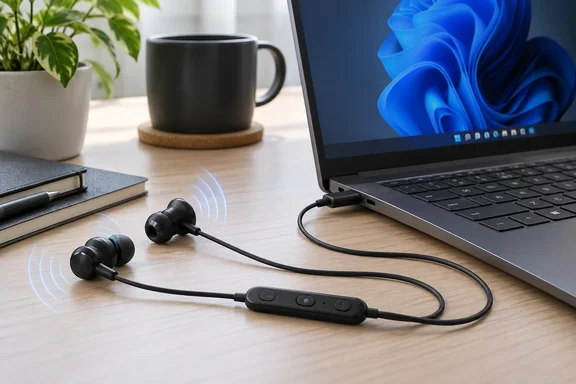
The product is called the Bose Noise Cancelling Wired Earbuds. They cost $99, need no Bluetooth or charging, and include Bose's QuietControl noise cancellation. Bose says they start shipping on October 15. Preorders are open now as a My Bose exclusive at Bose.com and Best Buy, in Black, White Smoke and a limited-edition Dewdrop Mint. One retail detail doesn't match: HotHardware reports that Best Buy won't open its preorders until October 1, even though the product is already listed. If you want a pair on launch day, Bose's own store looks like the safer bet for now.
What Bose actually announced
The pitch is simple: you get most of what premium wireless buds do, without pairing or a battery. According to Bose's launch materials, the earbuds plug straight into compatible USB-C phones, tablets and computers. You don't need to pair them or install an app, and because they run on power from the connected device, there's no internal battery to charge, even for noise cancellation.
The main specs:
- Noise control: The inline controls switch between Quiet, Aware and ANC-Off modes. Quiet turns on noise cancellation, and Aware lets outside sound in.
- Remote and mic: The remote has physical buttons for volume, playback, calls and cycling through the noise cancellation modes. The microphone sits on the back of the remote, which Bose says helps it pick up your voice while cutting down unwanted noise.
- Cable: HotHardware reports that it's a 4.2-foot (51-inch or 130 cm) cable. That's long enough to reach a laptop on a desk or a phone in your pocket.
- Fit: Bose says the eartips and stability bands can be combined nine different ways. Its product page lists three eartip sizes and two sizes of stability wings, plus a carry case in the box.
- Durability: The earbuds are rated IPX4. How-To Geek calls them "gym-ready," which is fine for sweat and light splashes. Bose's own page warns against heavy water exposure and says not to submerge them. They're gym buds, not swim buds.
How-To Geek says the noise cancellation is the same technology used in Bose's QuietComfort earbuds and headphones. Bose's own materials call it QuietControl and don't claim identical hardware or performance to any particular wireless model, so treat "same ANC" as a reasonable reading rather than a proven fact. Bose's comparison chart also lists no CustomTune, Immersive Audio, Bluetooth multipoint, voice control or app support for this model.
Section summary: $99, USB-C, powered by your device, three noise-control modes, a physical remote and an IPX4 rating. Shipping starts October 15.
The PC angle: this is a USB audio device
Here's why Windows users should care. These earbuds plug into USB-C, so your PC sees them as a USB audio device, not a simple analog headset. Bose's press materials include a spec that the product page leaves out: the earbuds use USB Audio Class 2 (UAC2), accept source audio at any sample rate and bit depth, and always play back at 24-bit/48 kHz.
That confirms the resolution claim How-To Geek made, and it has a practical upshot. From general industry knowledge (not Bose documentation): Windows 10 has included a built-in USB Audio 2.0 class driver since version 1703, and Windows 11 has it too. So a UAC2 device should work on a current Windows PC without a vendor driver, which fits Bose's "no app needed" promise. Bose hasn't published a Windows compatibility list, so for now this is an expectation, not a tested result.
Bose's product page says the earbuds work with most modern smartphones, tablets and computers that have a USB-C port, including many Android devices, newer iPhones with USB-C, and laptops. Note the word "most." Two cautions:
- Adapters. Bose says non-USB adapters won't work, because the earbuds need USB power to run, including for ANC. Don't expect a cheap USB-C-to-3.5mm dongle to rescue your old desktop tower.
- Power draw. Noise cancellation runs on your laptop's battery. Bose doesn't say how much power the earbuds use, so the effect on battery life is unknown. On a PC it's probably minor, but it isn't zero.
Getting them working on Windows 11
This is standard USB audio setup on Windows. Nothing here comes from Bose:
- Plug the earbuds into a USB-C port that supports data. Some charging-only ports on docks and monitors don't.
- Go to Settings > System > Sound and check that the Bose earbuds are selected under both Output and Input.
- In Teams, Zoom, Discord or your game, pick the earbuds in the app's own audio settings. Many apps keep their own device choice and ignore the Windows default.
- If they don't show up, try another port, preferably one built into the machine rather than a hub, before you blame the earbuds.
Section summary: These are UAC2 USB audio devices with a fixed 24-bit/48 kHz output. Current Windows builds should handle them with the built-in driver, but they need a USB-C port that carries data, and adapters are out.
About "lossless" and "low latency"
Bose says the earbuds support lossless audio listening through its SoundDesign digital signal processing. That's accurate in a narrow sense. A lossless file travels over the cable without Bluetooth compression. But because the output is fixed at 24-bit/48 kHz, a 44.1 kHz CD-quality track or a 96 kHz hi-res file gets resampled somewhere along the way, either by Windows or by the earbuds' own signal processing. That's our analysis of Bose's published spec. For most people it doesn't matter. Audiophiles who care about bit-perfect playback should know it happens.
On latency, Bose says the wired connection keeps sound in sync for videos, games and content creation. That's believable, since a wired USB link skips the buffering that Bluetooth codecs add. Still, Bose hasn't published a latency figure, and your app, audio stack and game engine add their own delay. "Better than Bluetooth" is a safe expectation. "Zero lag" is not.
Is the comeback real?
Wired earbuds really are having a moment, though the numbers need a source. WIRED reports that wired headphone sales rose 10% in the second half of 2025 and 20% at the start of 2026, the first increase in five years, and says young people are driving it. WIRED also calls this Bose's first new wired headphone since 2015. Bose president Raza Haider told WIRED the product went from idea to finished design in about eight or nine months.
Bose is framing it the same way. Haider said in the launch announcement that "Wired earbuds are experiencing a cultural renaissance." How-To Geek goes further and calls wired buds a rebellion against tech for tech's sake, in the same spirit as the iPod revival. That's a fair cultural read, but it's a thesis, not data. Some people choosing simpler gadgets doesn't mean the whole market is leaving wireless.
WIRED also got a late-stage prototype for four days, which is an early impression, not a full review. Its reviewer found the sound quality and ANC clearly better than cheap wired buds like Apple's EarPods. The complaints were practical ones: the remote is heavy enough to pull on the cable and tug the buds in your ears, and the thick cable still tangles in the pouch. Some things about wires haven't changed.
Who should buy them
Good fit if you:
- Take a lot of calls or play games on a USB-C laptop and are tired of Bluetooth dropouts, pairing trouble and dead batteries
- Want ANC for the office or a commute without another device to charge
- Share or lend earbuds and don't want to deal with pairing (though a USB mic on shared hardware is its own hygiene question)
Look elsewhere if you:
- Use older PCs or desks with USB-A only, since Bose says non-USB adapters won't work
- Rely on multipoint switching between phone and laptop, an app EQ, or voice assistants, none of which this model has
- Need proper water resistance, since IPX4 isn't waterproof
A hundred dollars isn't cheap for wired earbuds. It is a lot cheaper than Bose's flagship wireless buds, and the ANC is the main thing that sets these apart from the $20 bargain options. Whether that's worth it depends on how much you've come to dislike charging cases.
Bottom line: These aren't just nostalgia. They're a UAC2 USB-C headset with real noise cancellation, and for laptop users that can make more sense than Bluetooth. Just go in knowing they need a USB-C port that carries audio, output is fixed at 48 kHz, there's no published latency figure, and you'll be untangling the cable again.
References
- Wired earbuds are back, and Bose's new noise-cancelling pair shows they're not a gimmick How-To Geek · 2026-09-28T17:03:16+00:00
- Look Ma, Wires! Bose Brings Active Noise Cancelling To $99 USB-C Earbuds hothardware.com
- Shop Noise Cancelling Wired Earbuds | Bose bose.com