

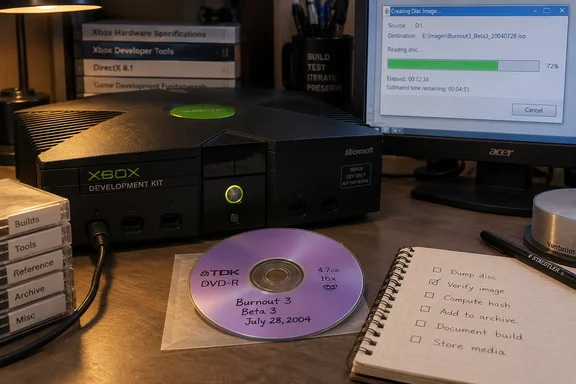
To set expectations early: this isn't a lost prototype full of cut tracks and forgotten cars. It's a snapshot taken a few days or weeks before the game shipped, depending on which date you trust. It's still worth a look for anyone who follows Xbox history, development-kit media or the practical side of dumping discs on a PC.
How the disc was found
Hackaday reports that finding retail console games on auction sites is routine, but a disc like this one is not. MattKC ended up with a copy of the Beta 3 release of Burnout 3 for the original Xbox, a beta that was only ever meant for internal use. He then compared it with the retail release and set about preserving the beta.
TechEBlog adds more detail about where it came from. It says MattKC spotted the undocumented original Xbox copy on eBay this summer and paid a steep price to have it shipped from Australia. These details come from MattKC's own account in his video. Archive metadata doesn't confirm them.
According to TechEBlog, the label reads:
- July 28, 2004
- "Beta 3"
- "Confidential material: return to mastering lab"
The outlet also reports that a name on the label, blurred in the video for privacy, belonged to a product manager at EA Australia. That fits the period when Electronic Arts bought Criterion. But TechEBlog itself admits that how the disc left that office and landed on a public auction remains a guess. Nobody has documented how it got out, and this article won't guess either.
Section summary: An internal Burnout 3 Xbox beta from July 2004 was bought at auction and preserved. The shipping and label details come from MattKC's video, and how the disc left EA is unknown.
What the archives record
Two preservation records back up the core story:
| Detail | Hidden Palace | Internet Archive |
|---|---|---|
| Build date | July 28, 2004 | 2004/07/28 (in title) |
| Build name | Beta 3 B3X3007P | "Xbox Beta 3" |
| Media | DVD-R | ISO image, ~3.7 GB item |
| Region | — | Late beta PAL build |
| Dumped/released by | MattKC | Uploaded by itsmattkc |
| Date recorded | Dump and release both September 16, 2026 | Added August 28, 2026 |
Hidden Palace calls it a review prototype. It says the build is dated one day before the final NTSC build, which it lists as July 29, 2004.
The dates don't agree
The records conflict in two places:
- When the dump appeared: Hidden Palace gives September 16, 2026, but the Internet Archive upload is stamped August 28, 2026. The two dates may mark different stages of publishing, but neither source explains the gap.
- How close to release it was: The Internet Archive description says the build was compiled roughly five days before the retail PAL build. Hackaday says the beta was dated just six days before release. Hidden Palace, however, lists the EU final build as August 13, 2004, which is 16 days after July 28. The game itself went on sale on September 8, 2004 in the US and September 10 in Europe.
The dates you can rely on are July 28, 2004 for this prototype, July 29 for the final US build and August 13 for the final EU build. The five- and six-day figures probably reflect different ways of counting. Either way, this is a very late build.
Section summary: Both archives agree on the build date and who dumped it. They disagree on when the dump was published and on how close to release the build was.
Dumping it on a PC was the easy part
This is where the story matters most for PC users. Retail original Xbox discs are awkward to read on a computer. As Hackaday explains, retail Xbox games show up as a DVD Video disc if you put them into a PC, which can complicate reading them.
The xemu project's documentation explains why: an Xbox game disc has two partitions. The first is a video partition that a PC or DVD player can read, usually containing a short clip telling you to put the disc in an Xbox. The second holds the actual game data. Getting at that second partition normally needs a special reflashed DVD drive or a modded console.
This disc was different. Because it was a burned beta disc for an Xbox devkit, it was easy to read and dump with a regular DVD drive and some common tools for ripping Xbox ISOs.
TechEBlog describes it as a purple-tinted consumer DVD-R that had been used for a development kit. Reading it in a normal drive with DiscImageCreator produced a clean 3.7 GB image in just a few minutes. According to TechEBlog, MattKC then unpacked the data with XDVDMulleter and, after some trouble, got the build to boot in the xemu emulator. The outlet also says the disc had no program database (PDB) file. Those workflow details come from the video and aren't confirmed elsewhere.
Why the dumping and conversion steps are separate
xemu's documentation gives useful background for anyone trying this:
- xemu needs images in XISO format. These often use a
.isoextension but are not standard ISO images. - A full "redump" image of a retail disc contains both partitions and is usually around 7 GB. xemu can't use that format directly. You have to extract the game partition first, with tools such as xdvdfs or
dd. - xemu says it doesn't endorse piracy, and that the only legal way to get these files is to dump them from physical media you own.
The 3.7 GB size of this image fits a disc with no video partition, which is what you'd expect from a devkit DVD-R. That's an inference, though, not something MattKC has documented.
xemu's compatibility list rates the retail game as "Playable" with minor issues. That rating covers the retail release, not this beta, so it doesn't guarantee the prototype will behave the same way on your machine.
Section summary: Devkit DVD-Rs skip the protection that makes retail Xbox discs hard to read on a PC. The dump was simple, but getting the build to boot in xemu still took extra steps.
What's different from the retail game
Not much, which is unsurprising for a build this late. Hackaday and the Internet Archive listing agree that the main difference is localization: the retail release adds fixes for languages other than English.
TechEBlog goes into more detail, again based on MattKC's findings:
- Criterion built this copy as a debug binary for a development console, not a retail-signed XBE for a store disc.
- English gameplay looks almost identical to the final game.
- Switching languages brings up a few strings that are too long for the UI. The retail version simply shortened them.
- References to a generic online server were replaced with an EA server in later files.
- TechEBlog says Crash mode contains the most significant code change MattKC found. The snippet available here cuts off before describing it, so it isn't covered in this article.
Section summary: It's essentially the retail game with rougher non-English text, a debug build and some server-name changes. A curiosity, not a lost version of the game.
Why a nearly identical build still matters
Why bother preserving a disc that's almost the same as retail? Because game development history is mostly made of builds like this. Dramatic early prototypes get the headlines, but late betas show how a game was actually finished: the last pass on translations, swapping placeholder server references for real ones, and the gap between debug and retail-signed executables. For anyone interested in how original Xbox software was built and certified, those are real details.
Hackaday lightly jokes that once the dump was done it was just a matter of comparing it with the retail PAL release. That's true, but it's only simple because the disc survived and someone paid to rescue it. MattKC's history with the series helps too: his forum hosts a place to discuss reverse engineering and modding Burnout 3: Takedown, and the Burnout 3 community has already documented rendering flags and other quirks.
Some caveats:
- Downloads and legality: The Internet Archive offers ISO and torrent downloads. That doesn't make downloading copyrighted game code automatically legal, and xemu's own guidance points users to dumping discs they own.
- Provenance: A disc marked "return to mastering lab" was, by definition, not supposed to leave. Preservationists and rights holders often disagree about material like this, and both sides have a reasonable case.
- Scale: Anyone hoping for hidden tracks will be disappointed. The main finding is some overly long translated strings.
If you've been following WindowsForum threads on emulating original Xbox games, making XISO images or preserving old PC and console media, this is a good real-world example of all three.
Bottom line: A July 28, 2004 "Beta 3" build of Burnout 3: Takedown has been dumped and archived. It's very close to retail, but it documents how the game was finished and shows why devkit discs are much easier to read on a PC than retail ones. Beyond what's recorded in the archives, the details come from MattKC's own account, and the published dates still don't line up.
References
- Rare Burnout 3 Xbox ‘Beta 3’ Disc From July 2004 Finally Gets Dumped - TechEBlog - TechEBlog - · 2026-09-25T20:32:56+00:00
- Burnout 3: Takedown - Xbox Beta 3 - 2004/07/28 : Free Download, Borrow, and Streaming : Internet Archive archive.org
- Burnout 3: Takedown (Jul 28, 2004 prototype) - Hidden Palace hiddenpalace.org