

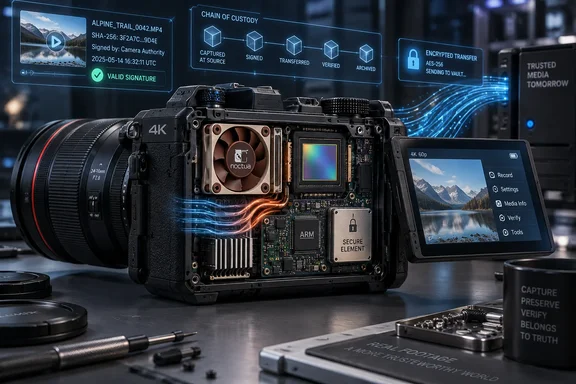
PC Gamer first highlighted the unusual partnership on September 18, while Noctua’s own case study confirms that it supplied the 40 mm, 5 V PWM-controlled fan for CAIM1’s current prototype. Noctua says the camera is intended to capture 4K video at 60 frames per second while generating cryptographic proof locally, a workload that produces enough heat that passive cooling could lead to processor throttling and dropped frames.
But the headline claim needs careful reading. CAIM1 may be able to generate evidence that a particular device captured and signed a particular file; that is useful provenance. It does not, on the information released so far, prove that every event depicted was genuine, that the person using the camera was physically present throughout the recording, or that the footage was never staged before capture.
CAIM1’s promise is provenance, not a truth machine
Caim, the project behind CAIM1—short for Counter Artificial Intelligence Machine 1—describes the device as a camera that can attest the “human origin” of photos and video at the moment of capture. Its published design calls for a Micro Four Thirds sensor, 4K recording, a 4.3-inch touchscreen, and interchangeable lenses through an E-mount arrangement, with an option for Micro Four Thirds mounting. It is a bring your own lens camera, not a conventional all-in-one consumer shooter.
The basic workflow Caim describes is technically recognizable: capture media, generate a hardware-secured cryptographic proof, anchor proof data on decentralized storage, then let another party verify it. The camera is also supposed to print a physical receipt containing an access code associated with the proof.
That architecture could establish a valuable chain of custody. A verifier could potentially determine whether the media file corresponds to a signed capture claim from a particular camera, whether the file has been modified in ways the system tracks, and whether the relevant proof record still matches. For journalists, insurance investigators, field technicians, compliance teams, and creators whose work is routinely copied or challenged, those are meaningful properties.
They are narrower properties than “real” or “human-made.” A cryptographic signature can show that a protected capture pipeline produced a file. It cannot independently determine whether someone pointed the camera at a real event, a screen displaying generated content, a miniature set, a replayed video, or a carefully staged scene. Authentication begins at the device; truth still requires context, corroboration, and judgment.
Caim’s site repeatedly presents the product as a solution to the collapse of trust in online imagery, but it does not yet publish a detailed threat model explaining precisely what CAIM1 is meant to defeat. There is no public description of how the camera handles compromised firmware, a stolen device, sensor-input spoofing, exported clips that are re-encoded by a social network, or a user deliberately recording synthetic material from another display. Those omissions matter more than the marketing language because they define whether the device can be trusted outside a controlled demonstration.
A secure element can protect keys, but it cannot validate a scene
Caim says CAIM1 will integrate Tropic Square’s TROPIC01 secure element. Tropic Square describes TROPIC01 as an open-architecture, RISC-V-based hardware security component intended to protect cryptographic keys and provide hardware-rooted security functions. That makes it a credible building block for signing capture records without leaving sensitive keys exposed to the main camera software.
A secure element is especially relevant to a device making provenance claims. If a signing key can be copied from ordinary storage, an attacker might create apparently authentic records from an unauthorized system. Putting key material and sensitive cryptographic operations behind dedicated hardware raises the cost of that attack and can support device identity, firmware-integrity checks, and tamper-resistant signing workflows.
Still, CAIM has not released the information required to assess the entire trust chain. The company has not identified the specific decentralized network used for anchoring; its public partner section still contains placeholder labels rather than naming a blockchain provider. It has also not published a verifier, a public developer specification, sample signed media, an independent security audit, or a reproducible explanation of what information enters each signed record.
That leaves a large gap between using a secure element and providing an interoperable, independently trusted media-authentication system. Readers should treat the cryptographic approach as promising hardware design work, not as a finished verification service. Noctua’s case study explicitly calls CAIM1 a prototype and says the target for the first batch is Q1 2027.
CAIM1 has not shown compatibility with the mainstream provenance standard
The wider industry already has a prominent open specification for media provenance: C2PA, the Coalition for Content Provenance and Authenticity standard commonly described through the “Content Credentials” label. C2PA defines signed assertions that can record capture-device information, edit actions, and other provenance details in a format designed for verifiers to inspect.
CAIM’s public material uses its own terms—hardware attestation, immutable decentralized infrastructure, proof receipts, wallet access codes—but does not state that it produces C2PA-compatible Content Credentials. That missing claim is significant for Windows users and IT departments. A signed image that can only be checked through a project-specific website or wallet system is far less useful than one that can be verified by multiple tools, platforms, asset-management systems, and publishing workflows.
The distinction also affects preservation. C2PA is built around a signed, inspectable provenance record tied to an asset and its edit history. CAIM appears to emphasize an external proof record anchored elsewhere. Both approaches can be technically legitimate, but they answer different operational questions: whether a file carries portable provenance versus whether a service can retrieve a record about it later.
Before anyone treats CAIM1 as a tool for evidence collection or newsroom use, Caim should answer several practical questions:
- Will the original image or video verify offline, or will validation require a connection to a particular chain, wallet, or web service?
- Will the camera retain a verifiable relationship to edited derivatives, transcodes, clips exported through Windows editing software, and files uploaded to platforms that strip metadata?
- Will Caim publish the signing format, trust roots, revocation process, firmware-update policy, and an independent review of the complete capture-to-verification path?
- Will CAIM1 support C2PA, or provide a documented bridge to it, so a proof is useful outside the project’s own tools?
Without answers, a “proof” receipt may remain less durable than the camera’s pitch suggests.
Noctua’s fan solves a real engineering constraint
The Noctua component is more than visual branding. The NF-A4x10 5V PWM is a 40 × 40 × 10 mm fan designed for low-voltage devices and controlled through pulse-width modulation, allowing firmware to vary its speed with thermal demand. Noctua lists the 5 V model as unsuitable for direct PC use; it is intended for compact 5 V applications where a standard 12 V PC fan would be the wrong electrical fit.
According to Noctua, CAIM1’s designers chose the native 5 V fan because a 12 V alternative would have required a boost converter. That additional circuitry would take board space, reduce battery efficiency, and introduce switching noise that could be undesirable around a sensitive image sensor. Noctua says the CAIM1 board was redesigned to make room for the fan.
The cooling layout is also unusually consequential for a camera. Noctua describes one airflow path that passes over a sensor heatsink, through the fan, across CPU heatsinks, and out of the side of the housing. The fan is placed behind the image sensor and isolated with anti-vibration mounts. If those choices work as intended, they address the central practical conflict in CAIM1’s design: capture hardware, local cryptographic processing, audio recording, optics, and battery operation all compete for a limited thermal and physical budget.
A fan does not validate an image, of course. It does make the camera’s claimed workload more plausible. A device that must calculate cryptographic proof during 4K60 recording cannot simply ignore heat, and thermal throttling that causes missed frames would directly undermine its intended use as an evidentiary capture device.
The first public test should be verification, not a product demo
CAIM1’s current materials show a concept with a real hardware-security component, a considered cooling design, and a clear target: establish media provenance at capture rather than attempting to detect AI imagery after the fact. The Noctua integration adds an independently confirmed piece of that prototype story, while Tropic Square’s TROPIC01 provides a recognizable foundation for protecting device-held keys.
The unresolved issue is whether CAIM can turn those components into proof that survives normal computing. Windows users will copy files, transcode them, edit them, back them up, synchronize them, and send them through services that may discard metadata or change formats. A camera that can sign a pristine original but loses its verification trail at the first ordinary export will have limited value outside specialist workflows.
Caim’s stated Q1 2027 first-batch target gives it time to show the part that matters: public sample files, independently reproducible verification, documented failure cases, and compatibility with the systems in which authenticated media actually circulates.