

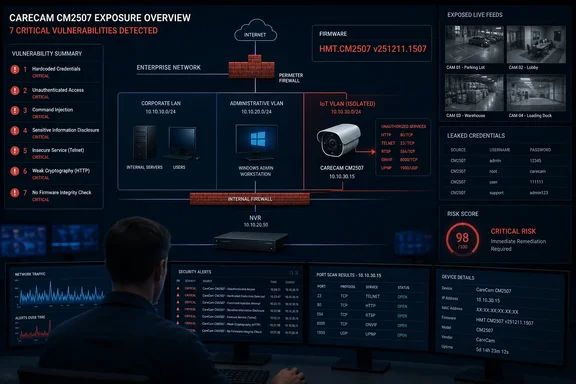
The September 15 advisory, designated ICSA-26-258-08, assigns a CVSS v3 score of 7.5 to the affected product. CISA says it is unaware of public exploitation specifically targeting these flaws, but the advisory describes a collection of weaknesses that could turn a networked camera from a surveillance endpoint into both a privacy exposure and a foothold inside a segmented environment.
Researcher Ben Law reported the issues to CISA. As of publication, no independent outlet appears to have reported additional technical details or a vendor fix timetable, which is unsurprising given that CISA released the advisory only hours ago. That leaves defenders with a confirmed affected firmware identifier and a serious impact statement, but without the exploitation prerequisites that would normally determine how quickly an organization must physically replace, isolate, or update a device.
Seven CVEs, but no patch version
The advisory lists these CVEs against CareCam CM2507 firmware v251211.1507:
- CVE-2026-88259
- CVE-2026-84398
- CVE-2026-84400
- CVE-2026-81305
- CVE-2026-85478
- CVE-2026-85497
- CVE-2026-81321
CISA classifies the underlying issues under several dangerous categories: missing authentication for a critical function, an empty password in a configuration file, functionality controlled from an untrusted control sphere, weak password hashing, and cleartext storage of sensitive information. Those labels describe weaknesses at different points in the device lifecycle—access control, configuration handling, service exposure, and credential storage—rather than seven variations of one bug.
The advisory’s key omission is equally important: it does not identify a fixed firmware release, a downloadable update, a workaround specific to the CM2507, or the conditions needed to exploit each CVE. Administrators should not infer that firmware versions other than v251211.1507 are safe. CISA identifies that version as affected; it does not make a safety claim for earlier, later, or differently branded firmware builds.
This is a common but operationally awkward position with low-cost and white-label-connected devices. The model name printed on a housing, listed in an inventory tool, or surfaced through a mobile app may not be enough to identify the vulnerable firmware. Teams need to collect the device’s actual firmware string from its administration interface, management platform, or acquisition records and compare it directly with HMT.CM2507 Firmware v251211.1507.
Why camera flaws can become a network problem
CISA’s impact language goes well beyond an attacker viewing a camera feed. Access to live video and device information is the obvious surveillance risk, particularly where cameras monitor entrances, offices, production floors, stockrooms, or customer-facing spaces. But unauthorized services and arbitrary code execution would potentially give an intruder a persistent system under their control on the local network.
A camera should not be assumed harmless merely because it is deployed for physical security rather than IT operations. Devices of this kind commonly maintain outbound connections to a cloud service, communicate with a network video recorder, use local discovery protocols, and retain credentials for wireless networks, management accounts, or associated services. If stored credentials can be recovered—as CISA warns here—the incident can extend beyond one camera even if the original flaw is limited to the device.
The combination of a missing-authentication condition and an empty password stored in configuration should be treated as especially concerning in environments where cameras are reachable from employee networks, guest Wi-Fi, a building-management VLAN, or the public internet. The advisory does not say these vulnerabilities are remotely exploitable without authentication, so defenders should not overstate that conclusion. It does establish enough risk to justify removing the device from unnecessary network paths while the vendor’s remediation status is clarified.
Windows administrators may encounter the practical effects indirectly: through a Windows-based VMS server, a Hyper-V-hosted recording appliance, a Windows workstation used for camera administration, or credentials reused between camera software and other systems. The camera itself is the affected endpoint, not Windows. The defensible response is to protect Windows-connected management and recording systems from the camera network, rather than waiting for a Microsoft update that will not arrive.
Inventory and isolation should happen before a vendor answer
CISA’s published guidance is broad but appropriate: minimize network exposure, keep control-system and remote devices off the public internet, place them behind firewalls, isolate them from business networks, and use properly maintained VPN access where remote administration is necessary. In the CM2507 case, the lack of a published fixed firmware makes those compensating controls the primary mitigation for now.
Administrators should start with the systems most likely to hold a usable inventory: DHCP leases, switch MAC-address tables, wireless-controller records, network video recorder device lists, procurement data, facilities-management documentation, and cloud-camera account records. Search for CareCam and CM2507, but also investigate cameras whose model fields are blank or generic. An OEM firmware name such as HMT.CM2507 can be more reliable than branding when products are resold or managed through third-party apps.
The immediate containment work should include the following:
- Remove direct inbound internet exposure to camera web interfaces, RTSP feeds, remote-management ports, and UPnP-created port mappings.
- Place identified cameras on a dedicated IoT or surveillance VLAN with tightly restricted routes to video recorders and the management workstation.
- Block camera access to general user subnets, domain controllers, file servers, endpoint-management infrastructure, and administrative jump hosts.
- Review camera, NVR, cloud-service, and Wi-Fi credentials for reuse, then rotate any credentials shared with other systems.
- Preserve configuration exports, firmware files, and relevant logs before factory resets or firmware changes, because they may be necessary for incident review.
- Monitor for unexpected outbound connections, newly exposed services, configuration changes, or camera accounts created outside normal change control.
Network isolation will not repair weak credential storage or an authentication flaw in the device, but it limits who can reach the vulnerable interfaces and what a compromised camera can reach afterward. It also gives facilities and security teams a way to keep essential video coverage in service while reducing exposure.
The missing remediation is the central operational fact
CISA identifies CareCam as headquartered in China and says the product is deployed worldwide in the commercial-facilities sector. That classification should not be read as evidence that every CM2507 is installed in a critical environment. It does underline why the issue belongs on an enterprise security team’s queue rather than being dismissed as a consumer-camera defect.
The practical severity will vary sharply by deployment. A camera behind a firewall on an isolated VLAN, administered only from a hardened workstation, presents a different exposure from one accessible through a forwarded port, attached to flat office Wi-Fi, or managed with credentials reused by an NVR or Windows application. The advisory does not supply deployment counts, affected serial ranges, exploit code, attack vectors, or a vendor response, so organizations should make prioritization decisions from their own exposure data rather than from the 7.5 score alone.
CareCam CM2507 owners should contact their supplier or CareCam for a firmware advisory that explicitly names the corrected version, provides integrity information for the update file, and explains how existing configurations and credentials are handled. Until that record exists, the safe administrative position is straightforward: do not treat an unverified firmware update or an unlisted version as a fix, and do not leave the affected build exposed while waiting for one.
References
- CareCam CM2507 CISA · 2026-09-15T12:00:00+00:00