

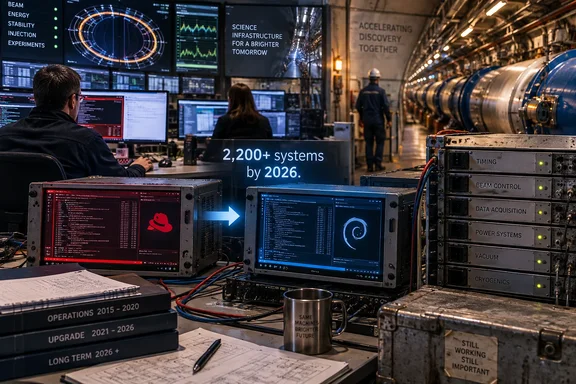
It’s FOSS first highlighted the current Debian 13 deployment target after CERN engineers Federico Vaga and Nikos Tsipinakis presented it at MiniDebConf Winterthur. The practical issue is not subscription cost or a generic preference for community Linux. CERN’s front-end controls run long-lived industrial computers connected to specialist electronics, and newer RHEL processor baselines would make much of that still-working hardware ineligible for the platform.
That is a meaningful warning for enterprise IT, industrial systems teams, and anyone maintaining a mixed-age PC fleet: an operating system’s CPU support policy can turn into a capital-equipment replacement program long before hardware actually fails.
CERN is changing one control layer, not its entire Linux estate
The 2,200-plus Debian systems are accelerator front-end computers: the machines that interface with equipment, run real-time applications, and sit near the physical infrastructure that operates beams and instruments. CERN’s own Linux documentation continues to list RHEL 8, RHEL 9, and RHEL 10 as supported platforms, while AlmaLinux remains part of its supported environment. It also describes Debian as a limited-support option rather than a general replacement for desktops, data-center servers, or all scientific computing.
CERN’s earlier technical paper, presented at the 2023 ICALEPCS controls conference, makes the division explicit. The organization selected RHEL 9 for high-availability servers and control-room consoles, while deciding that embedded front-end systems required a different operating-system strategy. Debian was the answer for that lower layer because the hardware could not move forward on the Red Hat timetable without substantial replacement work.
So the headline number should not be read as “CERN dumps Red Hat.” It is evidence that a major RHEL institution has decided a single-distribution strategy no longer fits every workload. That is a more consequential development than a wholesale migration claim, because it shows the boundaries of enterprise Linux standardization in environments with 10- to 15-year hardware lives.
CERN’s current RHEL guidance reinforces the point. Its RHEL site license has an end date in 2029, before the scheduled start of Run 4, and CERN cautions against using RHEL in cases where a system cannot be completely reinstalled and migrated before that deadline. Even inside an organization that continues to run RHEL extensively, lifecycle planning is now being treated as a workload-specific engineering problem.
The CPU baseline made RHEL a hardware decision
CERN’s 2023 paper identifies the immediate trigger: Red Hat’s move to the x86-64-v2 microarchitecture baseline in RHEL 9 and x86-64-v3 in RHEL 10. Those labels describe minimum instruction-set levels for AMD and Intel 64-bit systems. A computer can be physically functional, have adequate memory, and still fail to qualify if its processor lacks required instructions.
For a conventional server refresh, that may be manageable. For accelerator controls, the computer is often coupled to older PCI cards, custom interfaces, drivers, timing hardware, and validation procedures. Replacing the host can mean redesigning electronics, recertifying software behavior, recabling racks, and finding maintenance windows in a facility that cannot casually be taken offline.
CERN said the processor deprecation affected roughly 65 percent of the embedded processors in its operational front-end tier. Its paper describes the affected machines and associated devices as old but perfectly functional. The organization did not argue that Red Hat was wrong to raise its baseline; it concluded that the replacement cost and operational disruption were unreasonable for this portion of its estate.
Independent reports based on the 2026 MiniDebConf presentation put the alternative path into sharper financial terms. CERN’s risk analysis reportedly estimated about CHF 5.4 million in cost to remain on the Red Hat path for those front ends, including hardware-board redesign, staffing, rack work, recabling, and commissioning effort. That figure is a planning estimate, not a demonstrated Debian saving, but it explains why a distribution choice became a board-level lifecycle question.
The lesson for Windows and Linux administrators is direct. CPU compatibility requirements deserve the same inventory discipline as firmware dependencies, driver signing, TPM requirements, and application support matrices. A policy change that seems modest in a release note can strand a surprising number of specialized systems.
CentOS Stream changed CERN’s planning assumptions
The Debian decision also grows out of a longer break in the Red Hat ecosystem. In December 2020, the CentOS Project shifted its focus from CentOS Linux—the downstream rebuild that organizations treated as a free, RHEL-compatible production platform—to CentOS Stream, the development branch that tracks ahead of RHEL releases. CentOS Linux 8 then reached end of life at the end of 2021 rather than receiving the longer support period many users had expected.
CERN’s controls team said the shorter CentOS Stream lifecycle did not align with its accelerator schedule. Its prior major move to CentOS 7 took two years of validation and migration work before settling into seven years of stable production. That is the cadence of industrial infrastructure: software changes are planned around scheduled shutdowns, hardware access, and safety-critical validation, not around an annual distribution release.
Yet CERN did not respond by rejecting Red Hat’s enterprise offering. Its 2023 paper says RHEL 8 and RHEL 9 had much better alignment with the organization’s long planning horizon than CentOS Stream. The controls team evaluated RHEL 9, rebuilt missing packages where needed, and selected it for the server and console portions of the accelerator stack.
That distinction gets lost in broad “Red Hat decline” narratives. CentOS Stream’s change narrowed the free, downstream RHEL model that had been useful to institutions with extensive production fleets. But RHEL’s longer support commitment remained useful enough that CERN retained it for workloads whose hardware and operational characteristics fit the platform.
Red Hat’s 2023 decision to stop publishing exact RHEL source releases through the old public CentOS Git repository added a second rupture. Public RHEL-related source access moved to CentOS Stream, while customer and partner portals remained the route for RHEL sources. AlmaLinux responded by changing its stated goal from a one-for-one RHEL rebuild to application binary interface compatibility: software and kernel modules that run on RHEL should run on AlmaLinux, but the project no longer promises to reproduce every RHEL binary exactly.
That change matters to organizations that once saw CentOS, and later its rebuild successors, as interchangeable fallback paths. The replacements remain viable, but they operate under a different relationship to Red Hat’s releases than the old CentOS Linux model did.
Debian solves CERN’s compatibility problem, not every support problem
Debian 13 gives CERN a way to support older x86-64 machines that fall below RHEL’s newer processor floor. But Debian is not a drop-in replacement for RHEL in the controls environment, and CERN has not presented it that way.
The organization has had to make its configuration and deployment processes distribution-aware. Its controls team has spent years reducing dependence on a single Linux family through automation, inventory integration, package pipelines, and tools that support multiple operating systems. That prior work is the real reason CERN can take this route without attempting a reckless, all-at-once migration.
CERN’s own technical material also makes clear that the operating system is only one component of the front-end platform. It must deliver a suitable kernel, custom drivers, real-time behavior, device access, network booting, application deployment, monitoring, and recovery procedures. Debian lowers the forced hardware-refresh pressure; it does not erase the engineering burden of maintaining a specialized distribution layer.
This is where the broader enterprise lesson becomes more useful than a Debian-versus-RHEL scorecard. The important capability is exit readiness: knowing which workloads can move, which hardware cannot move, what is coupled to the operating system, and how configuration management behaves once a fleet is no longer uniform.
A company that has built every image, package workflow, compliance process, and support escalation path around one vendor will find that changing distribution is expensive even when licensing is free. CERN spent years making the control environment less dependent on a single OS family before exercising that option.
Red Hat’s position is narrower, not collapsing
RHEL is not disappearing from CERN, and the current evidence does not establish a general flight from Red Hat among enterprise customers. CERN itself continues to provide RHEL repositories, recommends RHEL 9 for many users, and lists RHEL 10 support through May 2035. AlmaLinux also remains available across parts of its environment.
What has changed is the assumption that “enterprise Linux” automatically means one Red Hat-centered stack from servers through embedded control systems. CentOS Linux made that assumption unusually convenient: paid RHEL where formal vendor support was essential, with a downstream-compatible free platform elsewhere. CentOS Stream and the later source-distribution changes removed much of that simplicity.
The alternatives are now more differentiated. AlmaLinux and Rocky Linux aim to preserve RHEL application compatibility. Ubuntu Pro offers extended support around Ubuntu LTS. SUSE and Oracle Linux remain commercial choices. Debian offers a community-governed option with a very different release and support model. None is a universal successor to the old CentOS arrangement, because the workload, hardware age, regulatory position, and vendor-support requirements decide the answer.
CERN’s Debian migration will be judged during the accelerator’s Long Shutdown 3 work and later recommissioning, not by the announcement itself. By the end of 2026, the organization expects more than 2,200 front-end systems to be on Debian 13. If those systems operate reliably through the maintenance and restart cycle, CERN will have demonstrated something more useful than a symbolic win for Debian: long-lived industrial fleets can keep control of their hardware-refresh schedule when their automation, packaging, and validation practices are designed to survive an operating-system change.