

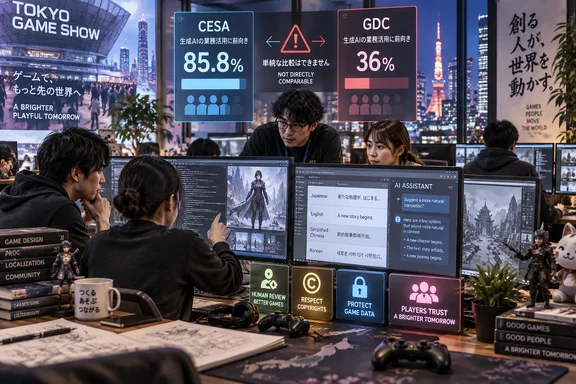
The more defensible conclusion is still significant: generative AI has become routine in the Japanese commercial game-development sample surveyed by CESA, while GDC’s broader industry sample shows that adoption remains selective and increasingly unpopular among the people who make games. For PC players and the Windows-based development shops behind many of their games, the practical issue is no longer whether AI tools are entering the workflow. It is whether studios can confine them to work where speed gains do not introduce IP, quality-control, security, or player-trust problems.
CESA published its CESA Game Industry Report 2026 Preview Edition on September 17, alongside Tokyo Game Show 2026. Automaton first highlighted the findings, while CESA’s own release confirms that 63.0% of the 1,349 respondents said they use generative AI daily and another 22.8% use it occasionally.
CESA’s 85.8% figure is real, but it is not a like-for-like year-over-year jump
The most repeated version of the story says Japanese AI use surged from 51% in 2025 to 85.8% in 2026. Numerically, that looks like a dramatic 34.8-point increase. Methodologically, it is not a clean before-and-after comparison.
The 2025 CESA finding came from a survey of member companies: 54 responding businesses reported whether their organizations used AI or generative AI in game development. Automaton’s reporting on that earlier survey described company-level use, including image and video creation, story and text generation, programming support, and work on proprietary game engines.
CESA’s new 85.8% statistic comes from a different survey, Game Developers’ Employment and Career Formation 2026. It is an internet survey of 1,349 respondents, aimed primarily at commercial-game workers across roles including producers, directors, engineers, artists, technical artists, sound creators, game designers, QA staff, testers, debuggers, and management. It also includes some educators and students.
That difference matters. A company can formally adopt a tool while only a minority of its staff use it. Conversely, individual workers can use a chatbot for research, translation, code explanation, or draft emails even if their employer has not deployed an approved generative-AI system across production. CESA itself says this is the first time it has surveyed generative-AI use in this developer-career study.
So the 85.8% result is a strong signal that generative tools are widespread among the respondents. It is not yet proof of a 2025-to-2026 adoption surge of that exact size. CESA’s complete report is not due until December, and the 30-page preview does not publish the cross-tabs needed to show which job disciplines, studio sizes, employers, or tool categories are driving the number.
The missing detail is consequential. A technical artist generating production-ready art assets, an engineer using an LLM to explain an API, and a producer using AI to summarize meeting notes all count as users under a broad workplace-use question. They create very different risks for a game’s codebase, art pipeline, licensing posture, and eventual Steam disclosure.
Japan’s 100% online-game statistic has an even narrower meaning
A separate July report from the Japan Online Game Association, or JOGA, found that all surveyed Japanese online-game companies used generative AI. That result has been widely cited as evidence that Japan’s games industry has reached total AI adoption.
It has a much narrower scope. JOGA’s study covers the online-game segment, where live-service operations generate constant demand for localization, customer support, player-behavior analysis, content planning, moderation, marketing, and operational forecasting. Those are areas where companies can deploy language models and predictive systems without necessarily putting generated art, dialogue, voices, or code directly in a retail game.
Automaton reported that the JOGA result covered online-game companies and identified player-preference analysis and user-behavior prediction as leading uses. Other coverage of the report listed Gemini, Claude, and GitHub Copilot among commonly used tools. JOGA has not publicly disclosed a respondent count in the material available around the headline, which makes “100%” impossible to evaluate as a measure of the entire Japanese development workforce.
The number is still useful. It shows that AI-assisted operations are no longer exceptional in a high-data, live-service-oriented part of the market. It does not show that every Japanese studio is generating player-facing assets, replacing artists, or shipping AI-written narrative. Those are separate claims, and neither JOGA’s headline nor CESA’s preview supports them.
CESA’s own corporate responses suggest the same distinction. Among the 48 member companies answering its 2026 survey, the most frequently expected benefit was efficiency and productivity improvement, cited by 38 companies. Shorter development cycles followed with 30 responses, then reduced development and operational costs with 29. Multilingual support and faster global expansion drew 24 responses; new expression and ideas drew 22.
These are management expectations, not audited outcomes. CESA has not supplied evidence that AI use has already reduced budgets, shortened schedules, or improved shipped games. The report therefore records an industry’s intended business case, rather than proving a return on investment.
GDC’s survey shows use and distrust can grow at the same time
The GDC Festival of Gaming’s 2026 State of the Game Industry report provides the other half of the picture. Based on responses from more than 2,300 game-industry professionals, it found that 36% use generative-AI tools as part of their job. But GDC’s most revealing result is not the adoption figure: 52% of respondents said generative AI is having a negative effect on the game industry, up from 30% in 2025 and 18% in 2024.
The report is also more specific about what “use” means. Large language models were the most common tools, with ChatGPT used by 74% of AI-using respondents, Google Gemini by 37%, and Microsoft Copilot by 22%. Research and brainstorming were the leading uses at 81%, while routine tasks such as email drafting and code assistance each registered 47%. Prototyping was cited by 35%.
Player-facing use was far lower. Game Developer’s reporting on the GDC survey put asset generation at 19%, procedural generation at 10%, and player-facing features at 5%. This is the central context often lost in arguments over adoption rates: a developer who uses Copilot to understand a legacy C++ subsystem or draft a test case is not necessarily supporting AI-generated character art, dialogue, voices, or game design.
GDC also found sharp differences by employer and discipline. Thirty percent of respondents working at game studios said they use generative AI at work, compared with 58% at publishers, support organizations, and marketing or PR teams. Upper management reported higher use than rank-and-file workers, while visual and technical artists, game designers and narrative staff, and programmers expressed the strongest negative views of AI’s industry impact.
That pattern helps explain why adoption statistics and attitudes can point in opposite directions. Many developers use tools that save time on documentation, search, ideation, translation, scripting, or debugging while objecting to the use of opaque models in art production, voice work, hiring decisions, or staff reductions. “Uses AI” is not a coherent position on how AI should be used.
Human review is a policy, not proof of control
CESA says Japanese member companies most commonly rely on human confirmation, correction, and supervision. It also reports widespread use of approved-tool restrictions and practices intended to prevent raw AI output from being used unchanged. Those are sensible controls, particularly for studios handling unreleased code, character designs, licensed material, voice recordings, and player data.
But “human in the loop” is a governance label, not a guarantee. Reviewers need to know whether a model can retain prompts, whether source code or production assets are sent to a third party, who owns or licenses the output, how provenance is documented, and when generated material crosses from internal assistance into a shipped game. A final human approval step cannot reconstruct an asset’s training-data history or undo exposure of confidential content entered into an unapproved public service.
The CESA preview identifies copyright and intellectual-property concerns as the leading challenge to adoption. That acknowledgement is more valuable than a vague claim that AI will simply make development faster. Studios face a practical split between low-risk internal assistance—research, coding support, formatting, QA triage, localization drafts—and higher-risk material intended for players, such as art, dialogue, music, voices, and marketing images.
For Windows game-development teams, the immediate operational response should be equally concrete. Approved AI tools need separate rules for public cloud services, enterprise services with contractual data protections, and local models. Code and asset repositories should be treated as confidential unless a tool’s retention and training terms have been reviewed. Generated output should be traceable in the same way teams track third-party libraries, outsourced assets, and middleware.
CESA’s December full report may clarify how Japanese studios divide generative AI among programming, art, design, operations, and player-facing production. Until then, the numbers show broad workplace exposure, not a verdict on quality or a reliable national league table. The real test for studios will be whether the tools remain assistants inside accountable pipelines—or become a shortcut that costs more in rework, rights disputes, and player confidence than it saves in development time.