

Kakao Games and Quasar Zone Tie Chrono Odyssey's System Requirements to Measured Frame Rates
The agreement divides the work into two parts. Inven Global reports that when Kakao Games categorizes in-game graphics options in greater detail, Quasar Zone will apply its proprietary hardware testing program, Game Ready, to diagnose compatibility and performance across various PC specifications. Chrono Studio develops the game, and Kakao Games publishes it. The first step is to break the graphics menu into finer settings. Quasar Zone then measures what each setting costs on real hardware.
The main promise is about what the published spec sheet will look like. Kakao Games and Quasar Zone plan to refine Chrono Odyssey's official minimum and recommended system requirements using the test data. They also plan to go further than a standard two-column hardware list. Inven Global says they will establish clear performance benchmarks corresponding to specific settings—such as resolution, detailed graphics options, and target frame rates—based on real performance data across diverse PC hardware.
This would be a real improvement for buyers. A typical "recommended" line names a CPU and a GPU but often leaves out the resolution, preset and frame rate it assumes. Quasar Zone's own announcement says the goal is to let players judge which resolution and target frame rate their hardware can reach before they buy the game. It presents clearly stated criteria as a way to prevent the refund requests and launch-week complaints that vague requirements often cause.
Other outlets have confirmed the deal. Gamemeca reports that Kakao Games will refine the in-game graphic options, while QuasarZone will use the proprietary hardware test program GameReady to check game compatibility and performance across diverse PC specifications. The reports disagree on the date. Gamemeca's English text says Kakao Games announced on August 22. Inven Global says the announcement came "on the 22nd," and Quasar Zone's post is dated September 22 and says the MOU was signed in September 2026. Gamemeca's "August" is most likely a translation slip.
Quasar Zone's Game Ready Tests Target Chrono Odyssey's Heaviest Battles
The most useful technical details come from Quasar Zone. Its announcement says it will run the game directly on test systems with varied specifications and measure how steady the frame rate stays and how much of the system's resources the game uses. It will also build composite test scenarios that simulate large-scale in-game battles, so results reflect the conditions players actually face. Noisy Pixel reports the same plan: testing will measure factors including frame-rate stability and hardware resource usage across different performance tiers. QuasarZone also plans to create testing scenarios based on large-scale in-game battles to evaluate how the game performs under heavier conditions players may encounter during regular play.
Testing big fights is a sound choice for an MMORPG. A benchmark run through an empty field says little about a raid or a crowded world event, where many characters and effects appear on screen at once. Chrono Studio has already added infrastructure for crowded areas. Its May 2026 developer notes described a multi-channel server system meant to manage player density during large-scale world events. Stress tests on the client side are a logical next step.
Chrono Studio's own description of the testing is broader. In the game's official Developer's Notes #6, the studio says it's testing Chrono Odyssey on various hardware configurations to identify potential performance bottlenecks and other issues that could impact the gameplay experience. Our testing covers frame rate stability, rendering performance, and other factors that can affect how the game runs on different PC specifications. The details about resource measurement and simulated battles come from Quasar Zone's announcement. The developer's note does not repeat them.
Quasar Zone has done this kind of work before. Its site lists earlier hardware compatibility and optimization MOUs with Korean studio Nimble Neuron in July and with Line Games for Ember and Blade in May. It says it brings PC spec data and benchmarking experience gathered through Game Ready to the Chrono Odyssey project. No results from those earlier partnerships are included in the reporting on this deal, so there is no track record here to judge.
Closed Beta Frame Drops Explain Why Chrono Studio Brought In Outside Benchmarkers
The developer has been open about the reason for the deal. Chrono Studio wrote that performance and stability were among the most common concerns raised during the Closed Beta Test, particularly around frame drops and crashes. We also saw cases where the game struggled to run smoothly even on higher-end PCs. The note was posted to the game's Steam news page and its official site on September 21, and it names Quasar Zone as a partner. That confirms the deal from the developer's side, separately from the publisher's announcement.
Reviewers saw the same thing. Writing for MMORPG.com after the June 2025 closed beta weekend, a reviewer reported that even on high-end rigs, frame rates tend to oscillate significantly. That is one writer's experience on their own system. It is not a controlled benchmark, but it matches the studio's own account.
The Quasar Zone deal adds to optimization work that was already underway. In Developer's Notes #3, posted in December 2025, Chrono Studio said it had removed unnecessary rendering passes and redundant calculations, which cut shader calls per frame by about 40 percent. It also said cleaning up unused materials, textures and resource references lowered average memory use by about 20 percent. Changes to environment streaming logic reduced swings in GPU usage during long sessions. These figures are the studio's own internal measurements. The new partnership is the first time an outside party will check the game across many hardware configurations.
Chrono Studio says its internal optimization continues alongside the Quasar Zone testing. It also says separate work is underway on character movement and animation, input responsiveness, controls and UI/UX. Those projects are not part of the hardware testing deal, so any improvements there should not be credited to the MOU.
Handheld Gaming PCs and Entry-Level Desktops Get Their Own Chrono Odyssey Benchmarks
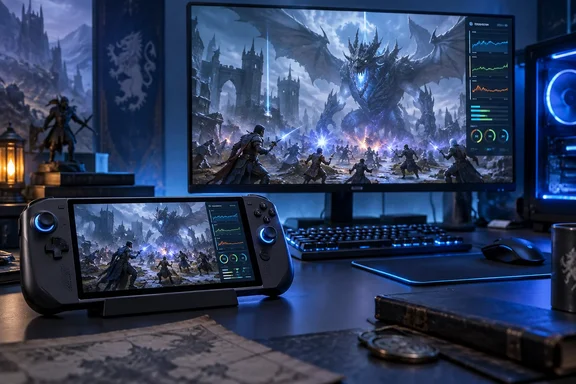
The part of the plan most relevant to Windows gamers covers the low end of the market. Inven Global reports the partners plan to support broad hardware compatibility by establishing performance benchmarks for entry-level mainstream PCs as well as handheld gaming PCs (UMPCs), which have recently been gaining attention. In Korean coverage, UMPC ("ultra-mobile PC") is the common term for handheld gaming PCs. Quasar Zone presents dedicated criteria for these devices as a way to make it easier for new players to get started.
For a big Unreal Engine 5 open-world game, this matters. Handheld gaming PCs have limited power budgets, and many run on integrated graphics. A standard desktop requirements list does not tell their owners much. Setting-specific targets tested on real handhelds would tell them far more.
None of the partners has said which handhelds or entry-level parts will be tested. They also have not named a resolution tier or frame-rate target for any hardware class. Anyone deciding whether a particular handheld or budget graphics card will run Chrono Odyssey still has nothing official to go on.
PC is only one of the game's platforms. Noisy Pixel notes that Chrono Odyssey is currently in development for PlayStation 5, Xbox Series, and PC. The MOU covers PC hardware only. It says nothing about console performance targets.
What this means for you
If you're deciding whether to buy hardware for Chrono Odyssey, wait for the revised requirements. Neither Kakao Games nor Quasar Zone has published a CPU, GPU, RAM amount, storage figure, resolution tier or frame-rate target. The announcement has no release date and no date for the new spec sheet either. Kakao Games says more detailed hardware targets should give PC players a clearer idea of expected performance before purchasing the game. Until that list is published, any spec list circulating for the game is outdated or unofficial.
Handheld owners should watch this more closely than most. Handhelds are the one hardware category the partners have promised to test specifically. When the numbers arrive, check that they are tied to a stated resolution, graphics preset and frame rate. Those details are what make them more useful than a standard requirements list.
- Kakao Games and Quasar Zone signed an MOU to test Chrono Odyssey across varied PC setups and rewrite its official minimum and recommended requirements from the measured results.
- Quasar Zone will use its Game Ready test program to measure frame-rate stability and resource use, including simulated large-scale battles.
- The planned requirements will link resolution, graphics settings and target frame rates to specific hardware tiers, with separate benchmarks for entry-level PCs and handheld gaming PCs.
- Chrono Studio says frame drops and crashes were among the most common complaints in the closed beta, and that the game sometimes struggled even on higher-end PCs.
- No benchmark results, named hardware, frame-rate targets or release date have been announced, so the deal does not yet guarantee that any particular PC or handheld will run the game well.
- The MOU covers PC only. Chrono Odyssey is also in development for PlayStation 5 and Xbox Series consoles.
The deal commits Chrono Odyssey to something PC gamers have long wanted from big releases: requirements based on measured results at stated settings, with separate figures for handhelds and budget machines. Chrono Studio has already acknowledged the performance problems in public. The next official milestone is the revised minimum and recommended specification. When it appears, it should show whether the promised setting-by-setting benchmarks made it into the version players actually use to make buying decisions.
References
- Kakao Games signs MOU with Quasar Zone for Chrono Odyssey PC optimization - invenglobal.com invenglobal.com · 2026-09-22T01:30:14+00:00
- 퀘이사존, 카카오게임즈와 하드웨어 호환성 및 최적화 업무협약 MOU 체결 > 게임 뉴스 | 퀘이사존 QUASARZONE quasarzone.com
- Steam Community :: Chrono Odyssey steamcommunity.com