

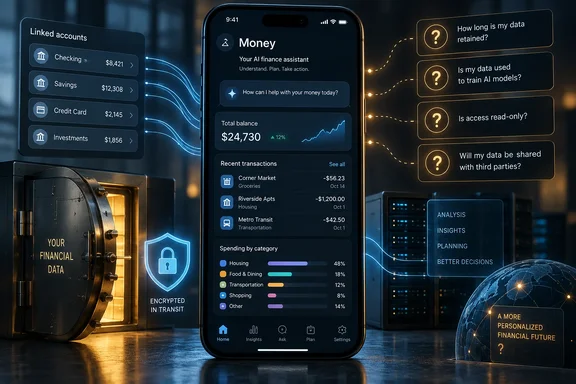
BleepingComputer first reported the feature after TestingCatalog posted images of an unannounced “Money” area in the Claude app. RuntimeWire separately reviewed the same TestingCatalog material and described an onboarding screen that says users can link bank accounts and ask Claude about “spending, plans, and more.” Anthropic has not announced Claude Money, published product documentation, or confirmed that the test will become a public release.
That means this is credible evidence of an in-development interface, not yet a financial product users can evaluate or deploy. The gap is important. A sidebar label and a “Get started” button establish that Anthropic is exploring account-linked personal finance; they do not establish supported banks, connection technology, subscription eligibility, countries, data access permissions, deletion procedures, or transaction controls.
The screenshots show a product category, not its safeguards
The reported iOS interface places Money alongside Claude features such as Chats, Code, Artifacts, Dispatch, and Cowork. The wording suggests Claude Money would be designed to interpret account activity rather than merely host uploaded statements: linked accounts would give the model a current view of balances, transactions, recurring charges, and the patterns that emerge from them.
That is a materially different privacy proposition from asking a chatbot how to create a budget. A connected account history can reveal employers, income timing, medical spending, debt payments, religious or political donations, travel, household relationships, subscriptions, and a user’s likely financial stress. An assistant does not need account numbers to derive highly sensitive information from transaction descriptions and merchant names.
Neither BleepingComputer nor RuntimeWire found a stated account-linking provider in the test. There is also no public indication that Claude Money would be read-only. For comparison, the established ChatGPT Finances product explicitly says it cannot move money, pay bills, change account settings, trade securities, open accounts, or file taxes. Claude Money has made none of those commitments because Anthropic has made no announcement at all.
Readers should therefore resist treating an account connection as routine merely because it resembles a budgeting app. The security boundary depends on the eventual authorization screen and partner: whether the bank connection uses token-based authorization, which account fields are shared, how often data refreshes, whether the service can retrieve investment or liability records, and how revocation works at both Anthropic and the connector.
Anthropic’s current consumer privacy terms create a specific concern
Anthropic’s existing consumer privacy policy does provide a meaningful—but incomplete—framework for assessing the test. The company says users of Claude Free, Pro, and Max can choose whether chats and coding sessions may be used to improve future models. It also says conversations flagged for safety review, explicit feedback, or voluntary testing programs can be used or analyzed under separate conditions.
Anthropic further says that if a consumer permits model-improvement use, new or resumed chats and coding sessions may be retained for up to five years. Users who do not permit that use remain under the company’s 30-day retention policy for those categories. Anthropic says it de-links data from a user identifier before using it for model improvement and applies filtering or obfuscation processes to sensitive information.
Those disclosures are not a Claude Money policy. They do not say whether linked financial records would be classified as account data, chat content, a tool response, or some separate category. They do not say whether an account summary generated inside a conversation follows the chat-training choice, whether raw transactions are ever accessible to human reviewers, or whether deleting a conversation also removes the associated synchronized financial data.
The distinction needs to be resolved before a public launch. A consumer who has opted into Claude model improvement might reasonably assume that choice covers prompts such as “find subscriptions I should cancel.” But it is unclear whether that setting would cover the transaction data used to answer the request, the assistant’s derived financial profile, or both. Conversely, a user who opts out still needs clear answers on storage, security monitoring, and vendor access.
Anthropic’s current privacy materials even encourage users not to use its products to process personal data, while its consumer terms now let users elect to share chats for improvement. A bank-linking feature would force the company to move from general privacy guidance to precise product controls. “We filter sensitive data” is not an adequate substitute for a declaration of what the financial feature collects, where it resides, and when it is destroyed.
ChatGPT Finances provides the comparison—and exposes the missing details
OpenAI’s ChatGPT Finances is the obvious model for what Claude Money could become. OpenAI launched its product in May 2026 as a U.S. preview for Pro subscribers, then expanded access to eligible Plus and Pro users in the United States across web, iOS, and Android. It connects through Plaid, which OpenAI says supports more than 12,000 banks, card issuers, brokerages, and other financial institutions.
ChatGPT Finances offers a dashboard for categorized spending, balances, bills, subscriptions, net worth, portfolio holdings, and upcoming payments. It can also answer questions involving savings goals, debt repayment, and spending trends. Its public documentation gives users several concrete operating facts: they select which institutions and accounts to connect; the product syncs account data automatically; and disconnecting an account triggers deletion of synced financial data from OpenAI’s systems within 30 days, with the corresponding ChatGPT connection deleted from Plaid within the same period.
The training disclosure is more nuanced than the claim that finance data categorically never trains AI models. OpenAI’s own help documentation says conversations using Finances follow the user’s general ChatGPT model-training settings. That does not prove that raw account data is directly used in training, but it does mean users should not accept blanket descriptions of an AI finance product as outside the model-improvement system without reading the actual controls.
Anthropic has yet to offer an equivalent disclosure for Claude Money. Until it does, there is no basis to assume it will use Plaid, match OpenAI’s 30-day deletion practice, offer the same institution coverage, limit the feature to the United States, or block payments and trades. Similar-looking sidebar entries are not comparable safeguards.
Anthropic already has financial-data ambitions beyond consumer banking
The test is not emerging in isolation. In February, Intuit and Anthropic announced a multiyear partnership intended to bring TurboTax, Credit Karma, QuickBooks, and Mailchimp tools into Claude environments through Model Context Protocol integrations. Intuit said consumers would be able to connect data to Claude for tasks including tax-refund estimates and high-interest-debt guidance, while businesses could build tailored agents on Intuit’s platform.
Anthropic also announced financial-services agent templates in May for professional work such as pitchbook preparation, financial modeling, ledger reconciliation, month-end closing, financial-statement review, and know-your-customer screening. Those products target businesses and are designed around organizational permissions, managed credentials, audit logs, and human approval flows.
The proposed Claude Money interface would move the company into a more personal and less controlled setting. Enterprise deployments can set access rules, designate approvers, and retain audit evidence. A consumer linking a household checking account from an iPhone needs the product itself to make its boundaries intelligible before the first transaction is synchronized.
For IT administrators, security teams, and employees who use Claude on managed devices, the issue will extend beyond individual curiosity. A public account-linking feature could create a new path for sensitive personal financial data into a service that may already be approved for writing, coding, or research. Existing acceptable-use rules often treat consumer AI assistants as low-risk productivity tools; they may not address bank-data aggregation, personal financial memory, or account-connected prompts.
Do not connect anything until Anthropic answers the operational questions
If Claude Money surfaces more broadly, users should look past the onboarding language and confirm the following before linking an account:
- The final product should identify the bank-data connector, the specific account types it can access, and whether access is read-only.
- Anthropic should state whether raw financial records, generated account summaries, and finance-related conversations are covered by the consumer model-training setting.
- The feature should provide a clear retention schedule, a one-step disconnect option, and confirmation of deletion from Anthropic and any data-aggregation partner.
- It should disclose which countries, plans, and financial institutions are supported rather than leaving users to discover limits after authorizing a connection.
- Organizations should decide whether managed Claude accounts and corporate devices may be used to connect any personal financial service.
Claude Money may turn out to be a limited read-only dashboard, an Intuit-backed assistant, or a broader personal-finance product. The existing evidence does not settle that. What it does show is that Anthropic is testing a direct route to the most sensitive continuous data many consumers possess—and the company has not yet published the privacy and security terms needed to judge whether that route is safe to use.
References
- Anthropic wants Claude to analyze your bank account and financial data BleepingComputer · 2026-09-16T20:35:48-04:00