

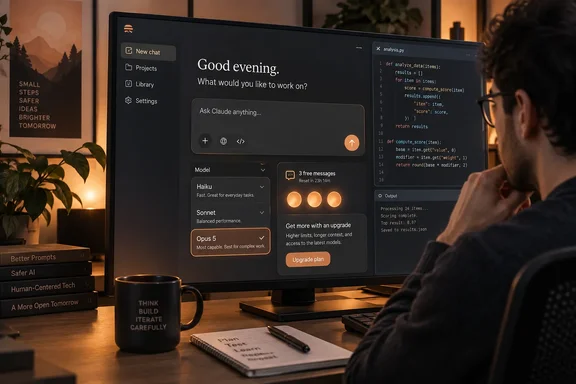
The important detail is the limit mechanism. Notebookcheck reports that affected accounts see “3 free” beside Opus 5 and a prompt to use the model without upgrading. Each Opus prompt consumes one of those messages, and the quota reportedly does not return with Claude’s normal five-hour free-plan reset. Once all three are gone, the account is again directed to upgrade.
That separates the apparent offer from the ordinary free-tier usage cap. Anthropic’s support documentation says free Claude accounts operate with a session-based limit that resets every five hours, while actual message capacity can vary based on demand, prompt length, the active model, attachments, tools, and conversation context. A counter that disappears permanently after three Opus 5 turns is therefore a separate product control, not an unusually small five-hour allocation.
Anthropic’s published access policy has not changed
Anthropic launched Claude Opus 5 on July 24, 2026, positioning it as its premium model for difficult software engineering, agentic workflows, and professional knowledge work. Its current product page explicitly lists Claude access for Pro, Max, Team, and Enterprise users, alongside API availability and access through Amazon Bedrock, Google Vertex AI, and Microsoft Foundry.
That public wording is still significant. It means a free account that sees the three-message banner has not necessarily gained a new plan feature, even if the UI makes Opus 5 selectable. Anthropic can expose an account-level trial while preserving Opus as a paid-plan capability in its published product matrix.
No Anthropic release note, support article, or pricing-page update found on September 16 describes a three-message Opus 5 trial for free users. The company’s Max-plan documentation does say that it occasionally runs limited-time promotions, but it provides no standing promotion, enrollment route, eligibility criteria, or Opus-specific free trial. The absence of that documentation is the story’s main limitation: there is evidence that the offer is appearing, but no authoritative explanation of who receives it or how long it will remain available.
Three prompts are enough for a benchmark, not a workflow
For a developer, three messages can be useful if treated as a deliberately planned evaluation rather than a conversational trial. Opus 5 supports higher-effort reasoning settings and is marketed for complex coding and long-running work; Anthropic says higher effort uses more tokens and can exhaust plan limits sooner. Free recipients should assume that each of the three turns is expensive and scarce.
A sensible way to use the offer is to compare one sharply defined task against the model normally available in the same account. A developer might provide a compact bug report, relevant source files, exact acceptance criteria, and a request for a patch plan or root-cause analysis. Another good use is reviewing a small but nontrivial pull request with instructions to identify regressions, missing tests, and risky assumptions.
It is a poor fit for an open-ended attempt to have Claude build a feature over many back-and-forth turns. Three prompts disappear quickly when the first answer triggers clarifications, the second produces code, and the third is spent correcting an incomplete implementation. Long context, iterative debugging, tool use, and files can also make a model comparison less clean because they consume the free account’s broader session capacity.
Anthropic’s own usage guidance recommends consolidating related requirements into one well-structured message, particularly for coding tasks. That advice becomes unusually practical here: if the trial is real and one-time, spend the first prompt on a complete brief rather than a warm-up request. Save the remaining two turns for a revision and a verification pass.
The UI distinction is more useful than guessing eligibility
Users who do not see Opus 5 in the model selector should not expect a hidden setting, a Windows desktop-app toggle, or a prompt trick to activate it. Notebookcheck found no visible enrollment method, and Anthropic has published none. The offer appears to be applied on Anthropic’s side, likely by account cohort, rather than unlocked by client version or platform.
This also means reinstalling Claude Desktop, clearing browser data, or switching between the web app and mobile app is unlikely to create access. Claude’s model availability is primarily tied to the account and plan, while the company’s support material says users select from the models available to them in the model picker. If “Opus 5” is absent or marked for upgrade, the account has not been included in the observed trial.
The same caution applies to shared workplace use. Team and Enterprise administrators manage access to models and features at the workspace level, so a company account may not behave like a personal free account. The three-message reports concern individual free accounts, not an enterprise licensing change or a Microsoft Foundry pricing concession.
The trial is also a conversion test
Anthropic has made Opus 5 a premium boundary for a reason. The company advertises it for production-ready code, complex agents, and large document workflows, while its paid subscriptions range from Pro at $20 per month to Max plans at $100 and $200 per month. Letting selected free users test that capability briefly can show the model’s output quality before the familiar upgrade prompt returns.
But this is a weak path for measuring sustained value. A three-turn sample may demonstrate a better first-pass plan, code review, or reasoning trace, yet it cannot establish the operating cost of an ongoing workflow, the practical rate limits on a paid plan, or whether the model remains reliable over a full implementation cycle. Those are the questions that matter to a developer deciding between a Claude subscription, direct API billing, or model access through a cloud platform.
The sharper finding is that Anthropic appears to be testing the sales boundary without revising the free plan’s published terms. Free users who receive the offer should use it as a short evaluation credit and document the result before it is gone. Everyone else should regard Opus 5 as paid-only until Anthropic changes its own plan documentation or makes a formal announcement.