

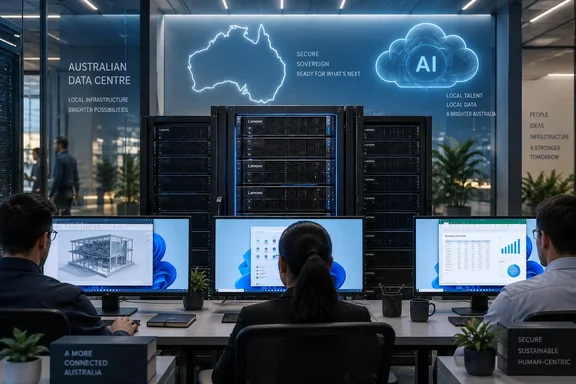
What CMTG actually did
CMTG was founded in 1998. It sells data storage, application hosting, private cloud and ongoing IT support to small and mid-sized Australian businesses, and its managed cloud runs virtual machines, backups and virtual desktop infrastructure (VDI). The old environment used Lenovo servers with VMware and Citrix virtualization, and the company says that hardware was near the end of its service life.
Lenovo's own case study lists what was bought:
- Hardware: Lenovo ThinkSystem SR675 V3 servers, AMD EPYC 9475F processors
- Services: Lenovo Global Financial Services, Lenovo Premier Support for Data Centers
- Software: Lenovo XClarity Pro, Citrix Virtual Apps and Desktops, VMware vSphere
For migration, Lenovo says that using Lenovo XClarity Pro infrastructure management software, the CMTG team streamlined and automated deployment and migration workflows, enabling the company to complete the switchover overnight without impacting customers.
CMTG also didn't pay for the hardware upfront. It financed the kit through Lenovo Global Financial Services. Lenovo describes this as aligning cost with revenue through a flexible and sustainable financial model. Neither company has published the total cost, the financing terms or the contract length.
Section summary: The refresh swapped out Lenovo servers nearing end of life for newer Lenovo servers on AMD EPYC. CMTG kept VMware vSphere and Citrix, managed the migration with XClarity Pro and financed the hardware instead of buying it outright.
The Azure Virtual Desktop factor
This is the part most relevant to Windows admins. CMTG named competition from services such as Microsoft Azure Virtual Desktop as one reason for the refresh. That's the real pressure on small regional hosting firms: Microsoft sells a hyperscale desktop-as-a-service product that's tightly tied into Windows 11 multi-session and Microsoft 365. A local provider running Citrix on VMware has to compete on speed, price, support or data locality.
CMTG managing director Carl Filpo said the company wants to stay ahead by using the newest, most powerful chips so customers get a secure, fast and reliable place to run their workloads. In other words, CMTG is trying to win on performance and local presence rather than on scale.
The performance claims, and how to read them
CMTG says the new platform lets it offer virtual desktops at lower cost with better performance. Its specific claims:
| Claim | What CMTG reported | Caveat |
|---|---|---|
| Windows 11 VDI frame rate | 60 fps in Citrix Windows 11 VDI benchmarks, which CMTG describes as Citrix's upper limit | No test method, resolution or application published |
| SQL Server reports | Up to three times faster | No query, dataset or baseline published |
| Single customer report | "Several minutes" down to "a few seconds" | One anecdote |
| Infrastructure footprint | Extra capacity could let CMTG run the cloud on fewer resources | Stated as a possibility |
Filpo's summary of the switch was blunt: "Moving to Lenovo ThinkSystem SR675 V3 servers powered by AMD EPYC processors is night and day as far as performance is concerned, both for us and our customers." He said the morning after the cutover, customers called to ask what had changed, and one said a particular report "has gone from taking several minutes to a few seconds."
Here's the reality check. When hardware nearing end of life is replaced by current-generation parts, big gains are expected. A jump from minutes to seconds in a SQL Server report may reflect faster cores, more cache, faster memory and storage, less contention on a newly built cluster, or all of those together. The case study doesn't separate them. Treat these as figures CMTG and Lenovo report about CMTG's own environment, not results you can expect to reproduce.
The 60 fps figure also needs context. CMTG itself says 60 fps is the ceiling of the Citrix platform. So the test shows the servers weren't the bottleneck in that configuration. It doesn't show how far past that limit the hardware could go, or how it behaves when many users log in at once.
Section summary: The reported gains are large but come from vendor material, with no published method. They make a useful example, not a benchmark.
Why this server, and why AMD?
CMTG says it looked at several hardware and processor options and chose this pairing mainly for graphics-heavy work. Lenovo's case study says the servers offer a strong price/performance ratio, especially for graphics-intensive workloads. The idea is that CAD customers on CMTG's VDI benefit from the processors' high clock speeds, so they can run demanding applications on endpoints that couldn't handle them locally.
The server choice is interesting. Lenovo's product guide calls the SR675 V3 a versatile GPU-rich 3U rack server that supports up to eight double-wide and single-wide GPUs including the new NVIDIA H200 and L40S Tensor Core GPUs, or the NVIDIA HGX H200 4-GPU offering with NVLink. It also notes that it is based on the AMD EPYC 9004 Series processors (formerly codenamed "Genoa", "Genoa-X" and "Bergamo") and on the new 5th Gen AMD EPYC 9005 Series processors (formerly codenamed "Turin"). Lenovo's technical specifications list Microsoft Windows Server and VMware ESXi among the supported operating systems.
One important caution: neither the case study nor the news report says whether CMTG installed any GPUs. The server can take GPUs, but nobody has said CMTG's servers have them. The CAD improvement is explicitly credited to CPU clock speed, not graphics cards.
As for AMD, CMTG says it considered several processor vendors and that a reference from Citrix tipped the decision. Filpo said Citrix uses AMD to run its own platform. That's CMTG's account of a conversation with a partner, not an independent head-to-head comparison.
The AI angle: groundwork, not a product
CMTG describes the refresh as the foundation for future AI services. The goal is an Australia-based environment for customers who would rather keep AI workloads in the country. Lenovo describes it the same way, saying the deployment is laying the groundwork for AI solutions—improving customer retention and growth.
No AI product, model, launch date or customer has been announced. Keeping data on local hardware also doesn't by itself make a service compliant with Australian privacy or sovereignty rules. That depends on contracts, operations and who holds administrative access. Still, for SMBs that are nervous about sending sensitive data to overseas AI endpoints, a local provider with capacity to spare is a reasonable pitch.
Not exactly breaking news
The timing is worth knowing. AMD published its own CMTG case study, titled CMTG Modernizes Private Cloud Advanced by AMD and Lenovo, around late July 2026, and Lenovo carries the story on several regional sites. The late-September news coverage repeats a customer story both vendors were already promoting. That doesn't make it untrue, but this is marketing that has been confirmed as real, not independent reporting.
What Windows and VDI admins can take from it
Even allowing for vendor enthusiasm, a few practical lessons hold up (these are general industry observations, not findings from the case study):
- Don't let VDI hardware age out. Windows 11 is more demanding than earlier desktop builds. Hosts near end of life are often where virtual desktops start to feel sluggish.
- High clock speeds matter for per-user experience. Single-threaded parts of CAD and reporting work respond to clock speed, not just core count. That's why a frequency-focused processor made CMTG's list.
- Know your protocol limits. If your display protocol caps frame rates, faster hardware won't lift that cap. It can only make sure the host isn't what's holding things back.
- Test against your own workloads. "Up to 3x faster SQL reports" is a claim about CMTG's environment. Run your own worst queries on candidate hardware before you believe anyone's numbers, including these.
- Leasing is a real option. Financing arrangements like CMTG's spread the cost over time, which helps smaller providers keep up with hyperscalers' refresh cycles.
- Buy some room for AI. Choosing a server that can take GPUs gives you a way to add AI later without another full refresh. Just keep in mind that buying that capacity is not the same as having AI services running.
Bottom line: CMTG's refresh shows how a regional service provider responds to Azure Virtual Desktop: new hardware, a Citrix-on-VMware stack it already knows, financing, and a pitch built on AI hosted in Australia. The reported gains are impressive but vendor-sourced. Take the approach seriously and treat the numbers with caution.
References
- Aussie tech firm taps Lenovo, AMD for private cloud overhaul - newsbytes.ph newsbytes.ph · 2026-09-30T05:36:10+00:00
- CMTG Meeting the next generation of customer demands Technology | Australia lenovo.com
- Meeting the next generation of customer demands | Lenovo AU lenovo.com