

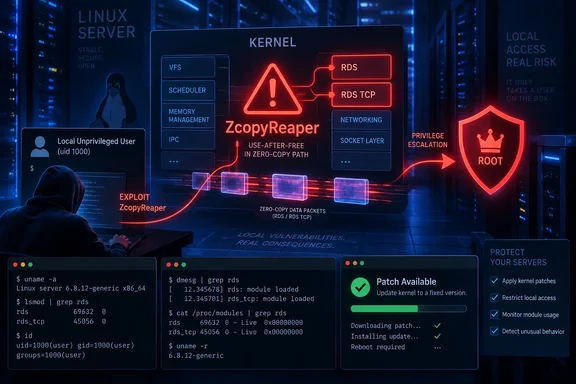
MSSP Alert’s September 18 report, based on a Smarter MSP advisory, correctly flags the availability of public proof-of-concept code and the potential for a low-privileged local account to obtain root. But the advisory leaves out the operational detail that determines whether a server needs emergency containment: the exploit depends on the RDS zero-copy send path, not merely on running an old Linux kernel.
NebuSec, which disclosed and named the exploit in an oss-security posting, says it demonstrated privilege escalation on openSUSE with kernel 6.4.0-150600.23.100. The group says no Linux capabilities or user namespaces are required, and that disabling unprivileged user namespaces does not mitigate the issue. That removes a common hardening fallback, but it does not make every Linux host exploitable by default.
RDS configuration determines the immediate exposure
The vulnerable code is in the RDS zero-copy send cleanup path. RDS is a Linux kernel networking protocol, not a component used by every ordinary web server, desktop, container host, or virtual machine. NebuSec identifies four minimum kernel configuration conditions needed to reach the vulnerable path:
CONFIG_INETandCONFIG_AIOmust be enabled.CONFIG_RDSandCONFIG_RDS_TCPmust be enabled, either built into the kernel or supplied as modules.- Where RDS is modular, both
rds.koandrds_tcp.komust be loaded or available for automatic loading.
This makes checking only lsmod insufficient. An unloaded RDS module is not necessarily unavailable: a process may trigger automatic module loading if the relevant module is installed and module autoloading is permitted. Administrators should check the running kernel configuration, whether the RDS modules are installed, and whether their distribution has already backported the fix.
The important practical distinction is between kernel version exposure and reachable attack surface. A server running an older branch with no RDS support is not in the same risk position as a multi-user system where RDS is available to arbitrary local accounts. Conversely, a host with RDS built into the kernel cannot reduce exposure by simply unloading a module.
The defect is a cleanup error after zero-copy setup fails
The upstream fix describes a specific lifetime-management problem rather than a generic RDS memory bug. During a zero-copy send, the kernel can pin user pages before attaching the outgoing message to a sending socket. If the operation fails during that interval, the cleanup path previously used the socket association to decide whether it was handling a zero-copy message.
That assumption was wrong. An unqueued message may not yet have a socket association even though it owns zero-copy-related state. The cleanup code could therefore treat pinned user pages as ordinary payload pages and release them incorrectly.
The patch changes the discriminator used by rds_message_purge(): it preserves the zero-copy notifier early and bases cleanup on whether that notifier exists, rather than inferring zero-copy ownership from the message’s socket association. The normal completion path remains for queued messages; the early-failure path separately drops pinned-page accounting and frees the notifier before releasing payload pages.
That detail matters for defenders because this is not a remotely reachable network-service bug in the usual sense. An attacker needs the ability to run code locally under an unprivileged account, create and operate the required RDS socket path, and trigger the faulty cleanup sequence. The resulting memory corruption can be turned into local privilege escalation, which is serious on shared servers, bastion hosts, CI runners, university systems, managed desktops, and virtual-machine hosts where lower-trust users or workloads already have execution.
“Critical” is not the score assigned to CVE-2026-43502
Smarter MSP calls ZcopyReaper “critical,” a useful signal of urgency for managed-service customers, but the CVE’s published CVSS 3.1 score is 7.8, classified as High. The vector is local attack, low complexity, low privileges required, no user interaction, and high impact to confidentiality, integrity, and availability once exploitation succeeds.
That score aligns with the technical record. Root compromise is the worst possible result on an individual affected machine, and public proof-of-concept code lowers the barrier for local attackers. Yet the local attack vector and RDS dependency are meaningful constraints that a severity headline can obscure.
No reviewed disclosure reports confirmed exploitation in the wild as of September 20, 2026. The public record establishes that exploit code exists and that researchers demonstrated an escalation on a specified openSUSE kernel. It does not establish broad opportunistic exploitation, a wormable condition, or unauthenticated remote compromise.
Administrators should not interpret the absence of reported in-the-wild attacks as a reason to defer patching. Local privilege-escalation flaws often become valuable after an attacker gains an initial foothold through a stolen credential, compromised application account, malicious package, vulnerable web service, or a tenant workload.
Fixed upstream versions are already available
The flaw was introduced in Linux 4.17, according to NebuSec’s disclosure, and the researchers identify upstream commit 44b550d88b26 as the fix. They say the first mainline release containing that fix was Linux 7.1-rc3.
For stable branches, the Hong Kong government’s GovCERT advisory lists these first fixed kernel versions:
| Vulnerable branch | First version outside the listed affected range |
|---|---|
| 4.17 through 5.10 | 5.10.258 |
| 5.11 through 5.15 | 5.15.209 |
| 5.16 through 6.1 | 6.1.175 |
| 6.2 through 6.6 | 6.6.140 |
| 6.7 through 6.12 | 6.12.88 |
| 6.13 through 6.18 | 6.18.30 |
| 6.19 through 7.0 | 7.0.7 |
Those upstream numbers are useful for initial triage, but they are not the final authority for enterprise fleets. Red Hat, SUSE, Canonical, Debian, cloud-image vendors, appliance manufacturers, and managed Kubernetes platforms commonly backport security patches while retaining a distribution-specific kernel version string. A host that appears to run an older upstream base may already contain the fix; a host that merely resembles a listed version may carry vendor changes that alter its status.
The correct verification point is the distributor’s security advisory and kernel changelog for CVE-2026-43502, followed by confirmation that the updated kernel has actually been booted. Installing a package without rebooting into the new kernel leaves the running system exposed.
Patch first; disable RDS where it is unnecessary
For systems with RDS present, patching to a vendor-confirmed fixed kernel is the durable response. Teams should inventory kernels by their full package release—not only the output of uname -r—and prioritize machines where untrusted users, developers, CI jobs, customer workloads, or application services can execute local code.
Where RDS is not a documented requirement, blacklisting both rds and rds_tcp is a sensible temporary reduction of attack surface. The change should be made through the distribution’s module-blacklist mechanism and included in the initramfs where required; otherwise a reboot or early boot process can still expose the modules. Administrators should validate the result after restart and watch for dependent software that expects RDS.
A short response plan should include the following:
- Identify systems running a vulnerable vendor kernel and establish whether RDS is built in, installed as a module, or absent.
- Apply the vendor’s kernel update for CVE-2026-43502 and reboot or otherwise move workloads onto the patched kernel.
- Disable or blacklist
rdsandrds_tcpon systems that have no operational use for RDS, especially while maintenance windows are pending. - Treat an unloaded module as an incomplete control unless it is blacklisted or removed, because the disclosed prerequisites include automatic module loading.
- Review local-code execution paths on affected servers, including shared SSH access, scheduled automation, CI agents, container build workers, and service accounts that can invoke arbitrary binaries.
ZcopyReaper deserves prompt action because the exploit is public and its endpoint is root. The immediate job is not to assume that every Linux machine running a kernel from the last eight years is equally vulnerable; it is to determine whether RDS is reachable, confirm the distribution’s patch status, and ensure the fixed kernel is the one actually running.
References
- Critical Linux kernel vulnerability ZcopyReaper allows privilege escalation - MSSP Alert MSSP Alert · 2026-09-18T15:27:56+00:00