

The official CISA record identifies the flaw as a VMware vCenter vulnerability that allows a threat actor with network access to execute arbitrary code. Broadcom rates it 9.8 out of 10 and lists no workaround. Its advisory, VMSA-2026-0006.2, provides fixed releases for current vCenter branches, but it also makes clear that vCenter 7.0 customers need an extended-support contract and must contact Broadcom Support for a fix.
BleepingComputer reported Tuesday that CISA had updated its ransomware status for the flaw over the weekend. The agency’s current public KEV feed confirms the ransomware designation, but the individual entry is dated August 18 and does not publish a per-field change log. In other words, the ransomware classification is official; the precise timing of the alleged weekend change cannot be independently established from CISA’s public record.
The Ransomware Flag Is Important, but It Does Not Name a Gang
CISA’s “Known” ransomware designation means the agency has enough evidence to connect exploitation of CVE-2026-59310 to ransomware activity. It does not identify a ransomware group, victims, a malware family, or the number of affected organizations. That absence is consequential: defenders should not wait for an attribution label before escalating their response.
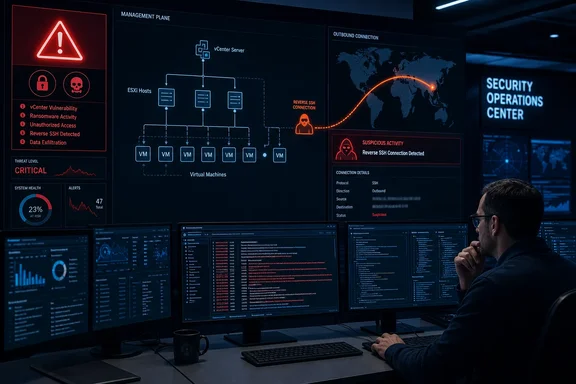
The available public research does add useful detail. German incident-response firm QUIRSO said it found a campaign exploiting CVE-2026-59310 against web-accessible vCenter servers, then using the open-source reverse_ssh framework for persistent outbound command-and-control access. QUIRSO reported 361 affected IP addresses across 47 countries, while explicitly warning that IP addresses are not the same thing as victim organizations; shared hosting, cloud platforms, and NAT can distort that count.
QUIRSO’s account of the intrusion chain is more serious than a scan-and-exploit event. The firm described cron-based persistence, creation of an SSO administrator account, credential access, ESXi discovery, and deployment of Babuk-derived ransomware. SecurityWeek and SC Media independently reported the same broad campaign findings from QUIRSO’s research, including the use of reverse SSH after initial compromise.
CISA’s ransomware field therefore tracks with a reported hands-on-keyboard campaign, rather than merely reflecting the general fact that ransomware crews like virtualization infrastructure. But CISA has not disclosed whether it is referring to QUIRSO’s observed activity, separate cases, or multiple operations. The public record also does not establish whether ransomware was deployed across the whole set of 361 IP addresses, or only in the incident that led QUIRSO to investigate.
The Patch Window Closed Weeks Ago
Broadcom published fixes on July 29. QUIRSO said it first observed compromised systems contacting attacker infrastructure on August 3, five days after disclosure; SecurityWeek reported that more than 340 affected IPs had appeared by August 5. That timeline places the initial exploitation surge in early August, not this week.
That distinction matters for operations teams reading the CISA update as a new warning. This is no longer simply a case of applying an emergency patch before public exploitation begins. Organizations with an exposed, unpatched vCenter appliance during that period have a historical exposure problem. Applying the fixed version prevents a repeat compromise through this flaw, but it will not remove an attacker’s added account, scheduled task, remote-access implant, stolen credential, or foothold elsewhere in the environment.
Broadcom’s affected-product matrix specifies the available vCenter remediation paths:
- VMware vCenter 8.0 must move to either 8.0 U3k or 8.0 U2f, according to Broadcom’s response matrix.
- VMware Cloud Foundation and VMware vSphere Foundation 9.1 must move to 9.1.0.0300, while version 9.0 requires 9.0.2.0100.
- VMware Cloud Foundation 5.x requires the documented asynchronous patch path to vCenter 8.0 U3k.
- VMware vCenter 7.0 requires customers with an extended-support contract to contact Broadcom Support; Broadcom lists no workaround for the vulnerability.
The advisory’s patch names matter because VMSA-2026-0006 covers several flaws across VMware products, including a separate ESX VMXNET3 virtual-machine escape issue, CVE-2026-47876. CVE-2026-59310 is the vCenter Syslog server flaw. Patching an ESXi host alone does not establish that the vulnerable vCenter Server Appliance has been remediated.
Why vCenter Is a High-Value Ransomware Entry Point
A vCenter compromise has a very different operational impact from compromise of an ordinary Windows or Linux application server. vCenter is a management-plane system: it holds authority over virtualization hosts, VM inventory, storage operations, permissions, snapshots, lifecycle tasks, and often integration points used by backup, monitoring, and identity systems.
That does not mean every vCenter compromise produces immediate control of every workload. Environments vary in privilege design, linked-mode configuration, host access, segmentation, backup architecture, and identity integration. It does mean an attacker who achieves code execution on the management appliance has gained a position from which to enumerate the virtual estate and target the systems that make recovery difficult.
This is why ransomware operators keep building tools that target virtual environments. Encrypting or disabling a small set of virtualization hosts can interrupt many workloads at once. If the same operator can reach vCenter, create or alter privileged accounts, and interfere with snapshots or backups, an organization can lose both production capacity and the systems it expected to use for restoration.
For Windows administrators, the practical concern reaches beyond the appliance itself. A vCenter Server Appliance may be Linux-based, but it commonly manages Windows Server domain controllers, file servers, line-of-business applications, SQL Server instances, and VDI workloads. Windows teams should verify which systems sit behind the affected vCenter instance and whether their backup and recovery workflows rely on that management plane.
Hunt Before Declaring the Environment Clean
CISA’s KEV entry says forensic triage is required for CVE-2026-59310. That is a stronger operational signal than the familiar instruction to patch according to vendor guidance. An organization that identifies an exposed appliance running an affected version should preserve evidence and begin its incident-response process before making broad changes that might destroy useful artifacts.
The publicly reported activity offers a focused starting point. Teams should review vCenter Server Appliance authentication and SSO activity for unexpected administrator accounts, particularly accounts created around the known exploitation period beginning August 3. They should examine cron configuration and other persistence mechanisms for unauthorized commands, inspect the appliance for unexplained reverse_ssh binaries or services, and look for unusual outbound encrypted connections from vCenter to unfamiliar internet hosts.
Because reverse_ssh is an open-source tool with legitimate uses, a filename or binary match alone is not proof of compromise. Correlate it with unauthorized installation, unexpected execution, new privileged identities, suspicious outbound sessions, or changes in vCenter and ESXi configuration. QUIRSO released generic detection material for the tool, but the firm also cautioned that detection needs validation in context.
Administrators should also review ESXi host access, recent virtual-machine inventory changes, snapshot operations, datastore activity, and backup-console logs. The goal is to determine whether the vCenter appliance was a short-lived execution target or a staging point for wider administrative control. If suspicious activity is found, rotate credentials that could have been exposed through the appliance and assess whether vCenter’s identity integrations or stored secrets create additional recovery work.
Exposure Reduction Is Still Worth Doing
Patching remains the first action for systems that are still vulnerable. Broadcom provides no workaround, so temporary defenses should be treated as exposure reduction rather than remediation. Restrict access to vCenter management interfaces to dedicated administration networks, remove direct internet exposure, enforce administrative access controls, and confirm that firewall policy permits only expected management sources.
The reported campaign concentrated on web-accessible vCenter systems. That does not establish that private-only deployments are safe: an attacker with a foothold on an internal network may still obtain the necessary network access. It does, however, make public exposure an immediate priority for asset discovery. Security teams should not assume an appliance is internal merely because its management IP is private; reverse proxies, port forwarding, VPN exceptions, cloud security groups, and legacy firewall rules frequently create exposure that the virtualization team does not see.
CVE-2026-59310 has been patchable since July 29, and CISA’s current catalog says it has known ransomware use. The correct response on September 15 is to verify the exact vCenter build, install Broadcom’s fixed release, remove unnecessary exposure, and investigate appliances that remained vulnerable after the early-August exploitation wave.