

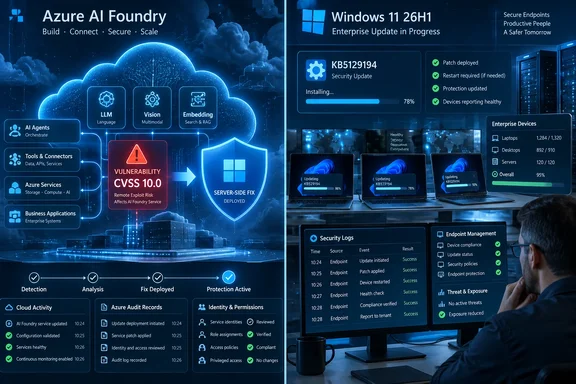
The Hacker News first detailed the Azure AI Foundry issue on September 18, reporting that Microsoft described CVE-2026-85889 as missing authentication for a critical function. Microsoft’s advisory says an unauthenticated attacker could elevate privileges over a network. The advisory credits researcher Rémy Marot with the report, and neither Microsoft nor the independent reports reviewed has identified in-the-wild exploitation before the fix.
SecurityWeek reports that the CVE was among 18 vulnerabilities Microsoft addressed across Azure services and Copilot-branded products. The significant dividing line is deployment: Microsoft says the cloud fixes were implemented server-side, whereas the two Windows vulnerabilities included in the same disclosure period are remediated only when the applicable Windows update reaches the endpoint.
CVE-2026-85889 Is the Standout Cloud Finding
A 10.0 score is rare enough to demand attention, particularly when the attack path is network-accessible, requires no authentication, and leads to privilege elevation. The published CVSS vector for CVE-2026-85889 describes a low-complexity remote attack with no user interaction and a changed security scope. Those properties explain the maximum score; they do not, by themselves, establish that an attacker could take over every Azure AI Foundry tenant or Microsoft cloud account.
Microsoft has not publicly described the affected function, exposed endpoint, affected regions, tenant configurations, or the privileges an attacker could obtain after a successful exploit. That omission limits what defenders can independently test. It also means that the right conclusion is narrower than some of the more dramatic headlines: a serious flaw existed in a managed Microsoft service, Microsoft says it has been mitigated, and customers should treat the remediation as complete only after confirming their operational environment has not shown suspicious activity.
Azure AI Foundry, which Microsoft also calls Microsoft Foundry, is used to build, deploy, and manage generative-AI applications and agents. Organizations using it should review service activity around the period before the September 17 disclosure, concentrating on privileged identities, newly created or changed connections, project access assignments, deployed endpoints, model deployments, and unusual use of automation credentials.
Because the public record does not specify the vulnerable workflow, it would be premature to prescribe a single log query or assume that a particular prompt, model, or agent configuration was exposed. The practical response is to preserve relevant audit data before routine retention windows remove it, then investigate anomalies involving privilege changes and service-to-service authentication.
Microsoft’s Server-Side Fix Does Not Eliminate Customer Responsibilities
SecurityWeek’s tally of 18 Azure and Copilot issues covers a broad mix of services: Azure Arc, Azure AI Foundry, Azure Logic Apps, Azure Billing, Azure Cosmos DB, Azure Container Registry, Microsoft Fabric, Microsoft Dataverse, Microsoft 365 Copilot, and several Copilot and Azure Machine Learning information-disclosure issues. Azure Portal also received a spoofing fix.
Microsoft says customers need not install patches for those cloud vulnerabilities. That statement is important, but it should not be read as a declaration that there is nothing for a customer to do. A server-side fix closes the vulnerable Microsoft-operated code path; it does not revoke over-broad tenant permissions, rotate secrets exposed through an unrelated incident, or distinguish legitimate from suspicious changes that occurred before remediation.
The disclosures include several other severe privilege-escalation cases. The Hacker News identified CVE-2026-85885, a 9.9-rated command-injection vulnerability in Microsoft 365 Copilot; CVE-2026-85878, a 9.9-rated improper-authorization flaw in Azure Database for PostgreSQL; and CVE-2026-87701, a 9.6-rated Azure Cosmos DB issue involving improper neutralization. Microsoft’s server-side remediation means those cases do not create a customer patch queue, but they should sharpen review of the privileged integrations around those services.
For administrators, the sensible distinction is between patch management and exposure management. There is no Azure AI Foundry hotfix to package in Intune, WSUS, or an image pipeline. There may still be a need to verify the security posture of projects that connect Foundry workloads to Azure subscriptions, Azure Key Vault, databases, Microsoft 365 data, or custom tools.
A short post-remediation review should include:
- Confirm that Azure activity logs, Foundry project audit records, and relevant Microsoft 365 audit data are retained for the period before September 17.
- Review recent role-assignment changes, new service principals, altered managed identities, and newly created API connections in subscriptions supporting AI workloads.
- Check whether Copilot plugins, Logic Apps workflows, container registries, and data connectors have permissions broader than their present business purpose.
- Preserve alerts and raw logs before making routine cleanup changes, since the public advisories provide no published indicators of compromise for these vulnerabilities.
KB5129194 Is a Separate Windows Remediation Track
The source material correctly calls out a separate pair of Windows elevation-of-privilege vulnerabilities: CVE-2026-62721 in the Windows User-Mode Power Service and CVE-2026-85921 in Windows Secure Kernel Mode. The former can allow a local attacker with authorized access to gain SYSTEM privileges; the latter is a double-free vulnerability that can allow a local attacker to reach Virtual Trust Level 1 privileges.
Both are included in KB5129194, the out-of-band cumulative update released on September 14 for Windows 11 version 26H1. The resulting OS build is 28000.2956. Microsoft’s support documentation explicitly lists both CVEs in that package.
The important correction is that KB5129194 is not inherently a manual-only update. Microsoft says it is available through Windows Update, Windows Update for Business, Windows Server Update Services, and the Microsoft Update Catalog. On consumer devices and managed endpoints whose update policies permit it, Windows Update can download and install it automatically. Enterprises that defer out-of-band releases, require approval in WSUS, or gate deployment through phased rings will still need an administrator to approve and deploy it.
That difference matters because cloud-side mitigation and endpoint update distribution are often collapsed into one vague “Microsoft patched it” narrative. They are separate administrative problems. The Azure and Copilot fixes were applied by Microsoft to the services; KB5129194 must reach the Windows 11 26H1 machines an organization operates.
Microsoft rates exploitation of CVE-2026-85921 as less likely. That is a useful prioritization signal, not a reason to leave devices unpatched. Both Windows flaws require local access, which puts them in a different risk category from CVE-2026-85889’s unauthenticated network path. Local privilege escalation is still highly relevant after phishing, malware execution, compromised developer workstations, or a foothold on a shared endpoint.
The Out-of-Band Update Carries More Than CVE Fixes
KB5129194 is also notable because it repairs problems introduced or observed after the September Windows security update. Microsoft says it addresses Remote Desktop Services instability that could produce failed RDP connections and sign-ins, unresponsive servers during Remote Desktop configuration, and hangs in associated tools including Microsoft Management Console, RDS Licensing Diagnoser, File Explorer, and the Windows Update page.
The update also resolves a Hyper-V-related issue affecting host-folder sharing with Linux virtual machines that use the Plan 9 protocol. It fixes a narrower USB Audio Class 1.0 failure involving multichannel features such as eight-channel and 3D audio modes.
Administrators should not assume the update is consequence-free. Microsoft continues to list a known issue in which some Credential Guard-protected machine accounts can lose their secure channel with an on-premises Active Directory domain after the September 8 security update or later releases. Microsoft attributes that problem to Machine Identity Isolation settings being honored in environments that are not using Windows Server 2025 domain controllers at the required domain functional level.
That known issue does not negate the security value of KB5129194, but it does make staged deployment and validation prudent for organizations with Credential Guard and Machine Identity Isolation policies. Affected environments should test domain sign-in and secure-channel health alongside the usual RDS, Hyper-V, and endpoint-security checks.
What to Do Monday Morning
For Azure AI Foundry, Copilot, and the other cloud services, the job is to document Microsoft’s server-side remediation, retain logs, and review privileged activity rather than wait for a customer-installed patch. No public evidence currently indicates that CVE-2026-85889 or the other 17 cloud vulnerabilities were exploited before Microsoft applied its fixes.
For Windows 11 version 26H1, inventory devices below build 28000.2956 and determine whether KB5129194 has been approved and installed. Organizations that use update rings should place it in the accelerated security ring, while validating the published Active Directory trust caveat where Credential Guard and Machine Identity Isolation are in use.
The headline CVSS 10.0 flaw has already been closed by Microsoft. The remaining exposure is more ordinary but easier to overlook: unmanaged or policy-deferred Windows 11 26H1 endpoints that have not yet received KB5129194 remain dependent on an administrator’s update process, not Microsoft’s cloud-side switch.