

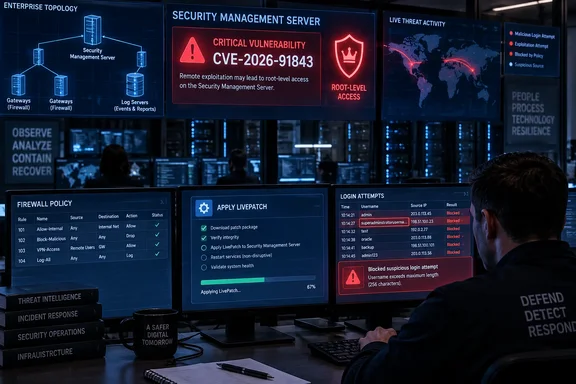
BleepingComputer first reported the disclosure, while Check Point’s own CheckMates advisory confirms that no credentials, user interaction, or complicated attack chain are required. NHS England’s cyber alert independently lists Security Management Server, Multi-Domain Security Management Server, Log Server, and Multi-Domain Log Server among the affected products.
This is a management-plane emergency, not a routine firewall maintenance item. A compromised Security Management Server can hold policy objects, gateway configuration, administrator access paths, and security telemetry for a Check Point estate. Root-level execution there can give an intruder a far more useful position than access to one edge appliance: the attacker may be able to tamper with the system trusted to define and distribute network security policy.
CVE-2026-91843 reaches the systems that run the firewall estate
The vulnerable code sits in the login path rather than in a VPN service or an optional inspection feature. Check Point says an unauthenticated attacker can exploit the overflow through the login process, and BleepingComputer reports that the trigger involves an excessively long username. The important operational point is that the attack occurs before a valid administrator identity has been established.
Affected roles include the standard management and logging servers as well as their Multi-Domain equivalents. Multi-Domain environments deserve special attention because a single management installation can administer separated customer, business-unit, or tenant-like domains. Check Point has not described a narrower configuration prerequisite, and its public warning says the issue affects Security Management and Log Servers—not merely servers with a particular VPN configuration enabled.
The product-role distinction matters during triage. A security gateway may be unpatched for a different issue yet outside the direct scope of CVE-2026-91843; conversely, an internal management server that has no public-facing web portal can still be exposed if a compromised workstation, jump host, VPN user, or reachable internal segment can contact its management interface. Treating this as only an internet-perimeter problem risks leaving the more valuable target unaddressed.
Censys observed 3,836 hosts worldwide carrying the Check Point management or log-server role’s default SIC identity. That is useful evidence that the affected role is visible across the internet, but it is not a count of vulnerable systems: Censys cannot determine a host’s installed build or Jumbo Hotfix level from that passive identifier. Administrators should avoid using exposure counts as a reason either to panic about a precise global total or to assume their own environment is not reachable.
Version numbers and patch numbers are easy to confuse
Check Point’s advisory covers a broad range of self-managed releases. NHS England’s alert, citing the vendor advisory, identifies the following affected software families:
- R82.20 is affected across all currently listed builds.
- R82.10 is affected through Jumbo Hotfix Take 44.
- R82 is affected through Jumbo Hotfix Take 126.
- R81.20 is affected through Jumbo Hotfix Take 166.
- R81.10 is affected through Jumbo Hotfix Take 190, while R81 and the R80.x branches are end of support.
The record contains a potentially costly source of confusion: the relevant Jumbo Hotfix Take numbers are not the same as the current LivePatch remediation numbers. Censys, which reviewed Check Point’s advisory, says the LivePatch fix is Take 28 for R81.20, R82, and R82.10, and Take 29 for R82.20. An administrator who sees “Take 28” in a LivePatch status display should not compare it directly with “Jumbo Hotfix Take 166” in an installed-version report; they identify different update streams.
For R82.20, the distinction is sharper. The affected-version list says all builds are vulnerable and that no Jumbo Hotfix alone currently provides protection. The remedy is the designated LivePatch, rather than waiting for a conventional Jumbo Hotfix cycle. That makes checking LivePatch deployment status a priority, not simply confirming that the appliance is on the newest base release.
Check Point says customers with automatic LivePatch updates enabled are already protected. That statement is about customers whose automatic-update configuration successfully received and installed the relevant package; it is not proof that every licensed appliance in an organization has done so. Enterprises with staged updates, disconnected management networks, maintenance freezes, or restricted update repositories need to verify the applied patch on each management and log-server role.
Smart-1 Cloud is outside the affected population, according to Check Point’s advisory, because the company says it implemented the fix in that hosted environment before disclosure. That exclusion should not be generalized to self-managed Smart-1 appliances or on-premises Security Management Servers without checking their specific software branch and patch state.
“Username too long” is an investigation lead, not an all-clear test
Check Point says administrators can look for the alert text “Administrator failed to log in: Username too long” in Audit and Admin login logs to identify attempted exploitation. This is valuable because it gives defenders a concrete hunting term, but it should be treated as an indicator of suspicious activity—not as proof that every failed long-username event achieved code execution, nor that an absence of the message proves no attack occurred.
A practical response should preserve the relevant records before a patching reboot or configuration change overwrites the useful window. Pull Audit and Admin login events around any matching alerts, correlate source addresses with VPN, proxy, bastion, and identity logs, and review whether the source reached other management services. If the management server is internet reachable, preserve network telemetry and confirm exactly which access-control path allowed the connection.
The bigger concern is successful compromise after an attempted overflow. Root-level execution on the management server warrants a review of recent administrator account creation and modification, policy-publish activity, SIC trust changes, gateway configuration pushes, scheduled tasks, remote-access configuration, and unusual outbound connections from the management host. Those actions are consequences of the disclosed privilege level, even though Check Point has not reported active exploitation of CVE-2026-91843.
There is no public proof-of-concept exploit identified in the records reviewed by Censys as of September 18, and Check Point says it has no indication of exploitation in the wild. That lowers neither the severity nor the patch priority. The vulnerability’s published CVSS vector describes network reachability, low attack complexity, no privileges, and no user interaction; public technical detail is already sufficient for attackers to focus on the login parser.
Restricting Trusted Clients buys time but does not remove the flaw
For organizations that cannot apply LivePatch at once, Check Point recommends its Management and Gateway hardening guidance and restricting Trusted Clients to known, specific internal IP addresses in SmartConsole under Manage & Settings > Permissions & Administrators > Trusted Clients. That should be implemented as an exposure-reduction measure while the update is scheduled.
Trusted Client restrictions are especially sensible when management access has gradually expanded to broad corporate address ranges, remote-access pools, temporary vendor networks, or administrative VLANs with many endpoints. Limiting management login access to dedicated jump hosts and tightly controlled administration subnets cuts down the number of machines that can deliver the malformed request. It does not fix a vulnerable parser, and it does not protect against an attacker who has already gained a foothold on an allowed management client.
Organizations should also verify that management interfaces are not reachable through unintended NAT rules, remote-access VPN groups, cloud security-group exceptions, or legacy network paths. The right question is not whether SmartConsole access was intended to be internal; it is which networks can actually establish a session to the service today.
End-of-support versions need a separate escalation path. The affected list includes R81, R81.10, and R80.x variants that no longer receive normal supported remediation. Where a supported LivePatch or upgrade route is unavailable, restricting exposure is only a temporary containment measure. Owners should plan a supported-version migration rather than accepting a permanently vulnerable management plane.
The earlier VPN disclosures raise the urgency, but they are separate flaws
CVE-2026-91843 arrived one week after Check Point disclosed two other critical vulnerabilities: CVE-2026-85102, an authentication bypass and remote code execution issue in Remote Access and Site-to-Site VPN, and CVE-2026-85103, a heap overflow in VPN certificate ASN.1 decoding. The Canadian Centre for Cyber Security lists both as affecting Check Point security products, while the Dutch NCSC said on September 10 that it expected exploitation attempts soon.
Those September 9 VPN flaws are technically distinct from the new login overflow. Their relevance is operational: teams may have concentrated remediation on exposed gateways and VPN services, while CVE-2026-91843 requires an immediate inventory of the management and logging systems behind them. A gateway-focused patch campaign can leave the central administration tier exposed.
Check Point also disclosed other actively exploited authentication-bypass bugs earlier in 2026, including CVE-2026-50751 and CVE-2026-16232, according to BleepingComputer. That history does not establish active exploitation of CVE-2026-91843, and it should not be presented as such. It does show why defenders should not wait for a known-exploited designation before protecting a pre-authentication root-RCE condition on a firewall management platform.
The immediate task is straightforward: inventory every self-managed Security Management, Multi-Domain, Log Server, and Multi-Domain Log Server instance; verify the correct LivePatch is applied rather than relying on base-version assumptions; restrict management access while rollout is underway; and hunt for the long-username login failures Check Point identified. For an appliance that controls firewall policy, “not currently known to be exploited” is not a reason to defer a root-level patch.