

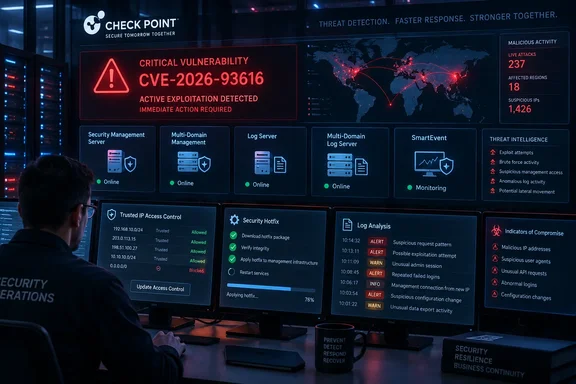
Check Point’s CVE-2026-93616 reaches beyond the primary management server
BleepingComputer reports that Check Point describes CVE-2026-93616 as a path-traversal vulnerability exploitable through low-complexity attacks. The publication quotes the company’s warning: “This vulnerability is exploited in the wild. Check Point is aware of a handful of customers who have been attacked.”
The reported affected products are:
- Security Management Server.
- Multi-Domain Security Management Server.
- Log Server.
- Multi-Domain Log Server.
- SmartEvent.
That list determines the first operational task: identify the affected server roles across the deployment. An inventory limited to the main Security Management Server would leave dedicated logging and SmartEvent systems outside the response, even though Check Point explicitly includes them.
Security Management Server stores and manages security policies, processes administrator changes, and collects system logs. Those responsibilities explain the concern for enterprise administrators, including teams protecting Windows networks. The vulnerable products sit in the infrastructure used to administer security and observe activity; this is not a reported Windows vulnerability.
The confirmed behavior described in the reporting is arbitrary script upload and execution. Because the target is management infrastructure, reviewing the integrity of its administrative activity is a reasonable operational consequence. The available evidence does not establish that attackers changed firewall policies, compromised connected Windows endpoints, or obtained a particular execution privilege level in these attacks.
Path traversal makes file handling an execution risk
A path-traversal weakness concerns the boundaries software places around file locations. In this case, the reported outcome extends to uploading and executing attacker-controlled scripts, which is why the warning requires more attention than a description of unauthorized file access alone.
There is relevant background in the May 2024 warning from CISA and the FBI. As reported by BleepingComputer at the time, the agencies explained that directory-traversal flaws can allow attackers to create or overwrite critical files used to execute code or bypass security mechanisms. Their recommendations to developers included avoiding user-controlled filenames, restricting permitted filename characters, and ensuring uploaded files lack executable permissions.
Those recommendations explain the vulnerability class; they are not a customer-side repair procedure for CVE-2026-93616. Administrators should not improvise file-permission changes on Check Point appliances as a substitute for the vendor’s correction.
The exploitation history also needs careful separation. SecurityWeek reported active exploitation of a different Check Point issue, CVE-2026-16232, in July, affecting Security Management and Multi-Domain Management products. For that incident, Check Point described attacked environments as directly exposed to the Internet without IP restrictions. Those conditions belong to the July disclosure and cannot automatically be assigned to the September path-traversal flaw.
For CVE-2026-93616, the available reporting establishes active attacks and a recommendation to restrict access. It does not establish a complete set of exploitation prerequisites. Consequently, administrators should not treat the absence of public Internet exposure as proof that an affected installation needs no correction.
R82.20 Security Hotfix needs a release-specific deployment decision
BleepingComputer identifies the R82.20 Security Hotfix as Check Point’s correction. The material available here does not include a release-by-release affected-version matrix, exact hotfix take numbers, or instructions for older supported branches. That gap matters when selecting an installation package: the name of the reported fix alone is insufficient to determine the correct action for every deployed release.
Check Point’s R82.20 release-notes download is labeled “Early Availability” and was published on July 6, 2026. It lists Security Management and Multi-Domain Security Management among its products. That document establishes the release family’s management-product coverage, but it is not a CVE-2026-93616 remediation matrix and does not establish that a move to R82.20 is the required response for every customer.
Likewise, Check Point’s R82 Jumbo Hotfix Accumulator documentation lists management, logging, and SmartEvent configurations among its supported products. A cumulative package’s general product support should not be confused with confirmation that a particular installed package fixes this newly reported vulnerability.
The practical distinction is between identifying a server that needs attention and authorizing its update. Record each affected product role and installed release, then establish the specific corrective package applicable to that combination before installation. Exact installation commands, restart requirements, and rollback steps cannot be safely supplied from the available evidence.
Patching also addresses a different question from incident assessment. Applying the correction closes the documented vulnerability; determining whether someone already exploited the server requires examining evidence. Check Point advises customers to look for indicators of compromise supplied in its security advisory. The reporting does not reproduce those indicators, so no specific filename, hash, network address, or log message can responsibly be presented here as a detection rule for CVE-2026-93616.
Check Point administrators should restrict access while arranging the fix
Administrators unable to deploy the correction immediately should use Check Point’s reported temporary mitigations: place vulnerable systems behind a firewall and limit access to trusted IP addresses. The SmartConsole location for the trusted-client restrictions is Manage & Settings → Permissions & Administrators → Trusted Clients.
Before narrowing access, establish which trusted administrative addresses need to remain permitted so the change does not unintentionally remove the team’s management access. The evidence supplies the settings location and the intended restriction, but not a universal rule set or a verified recovery workflow for an accidental lockout.
These restrictions reduce exposure while the patching decision is completed. They leave the underlying vulnerable code in place and should remain clearly recorded as mitigation, not remediation.
The immediate decisions are concrete:
- Include all five reported product roles in the response, including dedicated Log Server, Multi-Domain Log Server, and SmartEvent deployments.
- Treat the reported active exploitation as grounds for urgent attention, rather than waiting for evidence that your organization has been targeted.
- Match the corrective package to each installed release instead of assuming the R82.20 hotfix name describes every supported upgrade path.
- Use the documented firewall and Trusted Clients restrictions when patching cannot happen immediately.
- Conduct the vendor-recommended compromise assessment separately from patch deployment, using indicators specifically associated with CVE-2026-93616 rather than alerts from earlier Check Point vulnerabilities.
The actionable consequence of this disclosure is a broader management-infrastructure response: locate the affected server roles, reduce their reachability, apply the appropriate correction, and establish whether exploitation preceded it. Completing only the patch installation leaves the incident question unanswered; checking only the primary management server leaves part of the reported affected product scope untouched.
References
- Check Point warns of Management Server zero-day exploited in attacks BleepingComputer · 2026-09-22T12:32:47-04:00
- Check Point R82.20 Release Notes - Early Availability support.checkpoint.com
- Introduction to R82 Jumbo Hotfix Accumulator sc1.checkpoint.com