

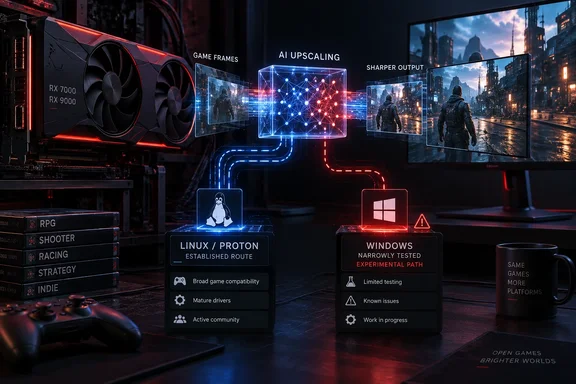
What RX 7000 and RX 9000 support actually means
D4R 0.1.2, released September 30, 2026, expanded the project with native kernels for additional RDNA3 targets and experimental RDNA4 builds. Its RX 9000 targets include the RX 9070 family and RX 9060 cards. The release also introduced a path using RDNA4’s native FP8 matrix units, rather than the widened 16-bit calculations used on RDNA3.
That is a meaningful engineering change, but it is not a measured performance breakthrough. For that release, the developer reported:
- gfx1201, covering cards such as the RX 9070 XT: emulator checks.
- gfx1200, covering RX 9060 targets: compilation checks only.
- Physical hardware testing by the project: an RX 7700 XT.
The release explicitly left RDNA4 speed, image quality and driver stability unknown. Consequently, NoobFeed’s suggestion that RX 9000 cards should run substantially faster is an expectation, not a benchmark result.
The distinction matters: a compiled kernel proves that a software build exists for a GPU target. It does not prove that a particular game will render correctly—or that the result will be worth the overhead.
This is DLSS execution, not an FSR rename
According to D4R’s documentation, the Linux implementation runs NVIDIA’s official DLSS Super Resolution library through a compatibility stack. OptiScaler routes the game’s inputs, a Wine CUDA bridge connects to ZLUDA, and ZLUDA translates CUDA work for AMD hardware through ROCm/HIP. Hand-written RDNA3 and RDNA4 kernels replace particularly expensive portions of the workload.
The documented models include DLSS 3 preset E, DLSS 4 preset K and DLSS 4.5 preset M, with experimental preset L also present. However, Super Resolution is the boundary: Frame Generation, Ray Reconstruction and DLSS 5 are unsupported. The project is not affiliated with AMD or NVIDIA.
That makes D4R an interesting compatibility experiment, not an official Radeon driver feature. Getting the network running and reproducing RTX image quality are separate achievements; the project does not claim proven one-to-one visual parity.
Windows support now exists—but read the small print
The release history adds useful context beyond NoobFeed’s reference to a Windows fork. D4R 0.1.4, released October 2, 2026, includes separate Linux/Proton and experimental native Windows downloads. Windows work has been integrated into the main project rather than remaining merely an unnamed fork.
Its documented Windows hardware validation is narrowly scoped:
- Windows 11 x64.
- Radeon RX 9070 XT, targeting gfx1201.
- DLSS presets K and M.
- Upstream development-build testing involving Silent Hill 2.
The crucial qualification is that the downloadable Windows ZIP is a Linux cross-build that has not itself undergone Windows GPU-rendering or gameplay testing. Validation of the upstream development build should not be presented as validation of that exact package. Windows 10 and other GPUs are not established as supported by those tests.
There is another wrinkle: the Windows baseline disables native FP8. The release notes say native M FP8 experiments did not demonstrate a full-network speedup. Therefore, the Linux RX 9000 FP8 announcement cannot be carried over wholesale into Windows performance claims.
For experimenters, the practical boundaries are clear: keep the supplied runtime versions, do not substitute Linux DLL bundles or configuration instructions for Windows setup, and avoid games with anti-cheat. This is a test-bench project, not a universal upgrade button.
Performance: the newest model is not automatically fastest
The developer’s published RX 7700 XT results illustrate the trade-off. In SILENT HILL: Townfall at 2560×1440, Quality-mode averages were:
| Upscaler/model | Reported average |
|---|---|
| DLSS 3 preset E | 71.7 fps |
| DLSS 4 preset K | 67.9 fps |
| DLSS 4.5 preset M | 49.3 fps |
| FSR 4 | 76.0 fps |
These are project measurements, not independent testing. FSR 4 was measured in an earlier session; the developer says the machine ran roughly 2–4% slower during the later DLSS session. They are also historical results, not benchmarks of the newer Windows package.
The sensible interpretation is modest: D4R demonstrates execution, but DLSS 4.5’s computational cost can consume much of the benefit from upscaling. These figures do not predict RX 9000 performance.
Microsoft’s shader delivery is a separate development
NoobFeed also discusses Microsoft Advanced Shader Delivery. It addresses a different problem: delivering precompiled shaders to reduce local compilation work, rather than changing the upscaler.
Microsoft’s October 1 announcement identifies Gears of War: E-Day as the first title supporting ASD across its expanded Windows ecosystem. Microsoft reports approximately 95% less first-launch shader-compilation time; that is the company’s result, not an independently verified benchmark.
The listed requirements include Windows 11 24H2 or later. AMD RDNA 1 through RDNA 4, including RDNA 3.5, require Adrenalin 26.6.1 or later; Snapdragon X2 requires driver 2026.08.3 or later. Intel and NVIDIA expansion is scheduled for later in October—not already universal as of October 5. Microsoft instructs players to install the Xbox PC app before downloading the game, and identifies “Precompiled shaders installed” as the launch-window confirmation.
NoobFeed briefly mentions an Intel desktop-CPU leak too, but provides no specifications or underlying evidence sufficient for a substantive assessment. It should not be confused with Microsoft’s confirmed hardware-support announcement.
Bottom line: D4R broadens what enthusiasts can attempt with Radeon hardware. Its most useful lesson is also its least glamorous: distinguish architecture support, development-build validation and tested release packages before expecting better everyday gaming.
References
- AMD DLSS 4.5 Mod Adds Support to RX 7000 and RX 9000 - NoobFeed NoobFeed · 2026-10-03T00:00:00+00:00
- GitHub - countervolts/d4r: NVIDIA's official DLSS 3/4/4.5 on AMD RDNA3/4 GPUs on Windows and Linux. · GitHub github.com
- Advanced Shader Delivery Coming Soon across Windows 11 and Available for Gears of War: E-Day Today - DirectX Developer Blog devblogs.microsoft.com