

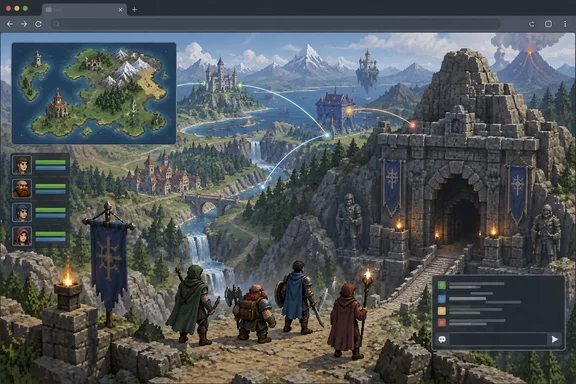
Daggerfall Enhanced translates Daggerfall Unity into a browser-native game
To see what Daggerfall Enhanced is, start with what it's built on. Daggerfall Unity is a fan-made open-source recreation of the 1996 action role-playing game The Elder Scrolls II: Daggerfall developed by Bethesda Softworks and created using the Unity engine. It has been the standard way to play the game on modern hardware for years, and it reached feature parity with classic Daggerfall in 2019, allowing players to complete the main questline from start to finish.
Daggerfall Enhanced is a translation of that codebase. The project's GitHub repository calls it free and open source and describes it as a 1:1 port of Daggerfall to the browser, translated from Daggerfall Unity and running on a hand-rolled WebGL2 renderer instead of the Unity engine. The project site credits the upstream work plainly. It lists Interkarma and contributors, MIT licence. Daggerfall Enhanced is a separate project translated from its C#. The developer's Reddit announcements use the same "1:1 port" wording. That's the creator's own description, and nobody has independently audited the code for parity.
The project is not an official Bethesda product. The site says it is a fan project, not affiliated with or endorsed by Bethesda or ZeniMax. Bethesda and ZeniMax now belong to Microsoft's Xbox division, so this is a community revival of a Microsoft-owned franchise that no rights holder has signed off on.
You still need the original ARENA2 files to play Daggerfall Enhanced
"Play it in your browser" doesn't mean everything is provided for you. Daggerfall Enhanced runs on data from the original 1996 game, just as Daggerfall Unity does. The landing page puts it briefly: Bring your own ARENA2 folder; nothing is uploaded. The repository says the same thing: Original game data (ARENA2) is required and never committed.
ARENA2 is the folder in the original DOS release that holds the game's textures, models, sounds and world data. Getting it legally costs nothing. Bethesda has given the game away since 2009, to commemorate the 15th anniversary of the Elder Scrolls franchise, Daggerfall was made free to download from the Bethesda website. Daggerfall Unity's own documentation says you can get a free copy of DOS Daggerfall from Steam. That free Steam copy is the most practical source of ARENA2 for most Windows users.
"Nothing is uploaded" also shows how the browser build handles data. The game reads your local files instead of streaming Bethesda's copyrighted assets from a server. That's how the project stays on the right side of the line between reimplementing a game engine and distributing someone else's game.
An Electron build brings Daggerfall Enhanced to the desktop
The developer's first announcement on September 14 said the project could be tested in the browser, with a stable installable build still to come. The repository now describes that downloadable build. According to the GitHub documentation, the app/ directory is an Electron shell that loads the same dist/ the website deploys and adds what a browser can't.
The desktop version fixes two things browsers handle badly. Saves become real files on disk, laid out the way Daggerfall Unity lays them out. The app also reads ARENA2 directly from a folder you choose once through a native file dialog, so there's no import step. The repository notes that the browser build is unchanged, which means both versions run the same game code.
MakeUseOf, which reported the multiplayer launch, says players can either download a full installer package or play straight from the browser. The repository confirms a desktop Electron build exists. It doesn't say which release channel counts as stable, and a project only a few weeks old may still treat any download as a preview.
Daggerfall Enhanced's online mode adds parties, chat and a shared clock
The main new feature is the shared world. In the developer's announcement, it's a single persistent, "MMO-like" world where players can meet, explore and keep playing their characters. An update the next day, September 15, said players were logging in, creating characters, fighting enemies and running into each other. The developer listed enemy synchronization, combat, chat, player visibility and general stability as areas still being worked on.
That devlog also listed specific early bugs. Some players couldn't damage dungeon enemies. Performance dropped when many players were on screen. Chat history was being compressed in a way that made old messages unreadable. The developer reports all three as fixed. A friend-and-party system went into alpha in a separate post on September 16.
MakeUseOf adds more detail: global world chat, friend lists, parties of up to four players, and map tracking so friends can find each other. No other source found here confirms the four-player limit or the tracking feature, so treat those as the outlet's description of how the launch build behaved.
Why a single-player game's clock had to change
Daggerfall was built for one player, and its systems assume the whole world waits for you. Resting is the obvious case: sleep for eight hours and the game clock moves forward eight hours. On a shared server, one player skipping time would skip it for everyone. The developer's September 15 update says resting online is now instant instead of advancing the shared world clock, and earlier posts called some of this behavior a placeholder while the design is worked out. MakeUseOf also reports that town shops stay open 24 hours online, which fits the same problem. No primary project post found here confirms that change.
Characters can move between modes. The developer's announcement says you can take an offline character online and bring it back offline later, and MakeUseOf says existing single-player saves can be imported. Neither source gives a full list of which saves, versions or mod setups carry over.
Daggerfall Unity mods need porting before they work in Daggerfall Enhanced
Daggerfall Unity is known for its mods. Its project page promises extensive mod support with an active creator community, ranging from full asset overhauls like DREAM to quest packs and new guilds. Those mods are Unity-engine code and assets written against a C# codebase. Daggerfall Enhanced is a JavaScript translation with its own renderer, so the developer has said mods must be ported one by one, with their authors' permission, and won't work unchanged.
What Daggerfall Enhanced ships is a curated set. MakeUseOf says it bundles popular Daggerfall Unity mods along with upgraded skyboxes, water, lighting and a re-orchestrated ambient soundtrack, and that you can switch back to the classic look at any time. The developer's posts confirm an enhanced presentation layer and a classic-visual toggle. They also confirm support for bringing in character models from The Elder Scrolls III: Morrowind, which MakeUseOf says requires owning Morrowind. The developer has said enhancements and mods were enabled by default in the online world at launch.
The result is that online play is a fixed configuration, not the do-it-yourself setup Daggerfall Unity players are used to. That's probably the right choice for a shared world, since everyone needs to be running the same rules. If your Daggerfall Unity install depends on a large mod list, expect a noticeably different game.
Daggerfall Enhanced runs on $600 a month and a lot of goodwill
The repository is open about what the project costs. It says active development currently costs about $600 per month to sustain across development tooling, multiplayer infrastructure, testing, builds, releases, and mod compatibility work. Funding comes through Ko-fi, and the project promises that sponsorship does not lock gameplay, source code, or normal releases behind a paywall.
The number shows what persistence costs. A single-player port can sit on static hosting indefinitely, and the repository says both the site and the game deploy from the main branch to GitHub Pages. A persistent world needs servers running all the time, and those cost money every month. As long as the multiplayer mode depends on donations, its future depends on them too.
Launch week was busy. YouTube creators promoted a "Daggerfall 30th Anniversary Celebration" with a first look at the multiplayer server, and invited viewers to join. MakeUseOf describes a community "server slam" where heavy early traffic caused some lag and stuttering, and says the developers pushed hotfixes throughout the day. No participant counts or server measurements have been published. The best evidence is the developer's own devlogs, which describe multiplayer being tested in ways one developer couldn't reproduce alone and admit there is "plenty to fix."
Daggerfall Enhanced is also one of several multiplayer efforts. A separate Reddit project describes a dedicated-server framework for configurable co-op, role-play, PvP or public worlds, with public beta testing still planned. Nexus Mods hosts a "DFU Multiplayer" collection for Daggerfall Unity. These are unrelated projects that happen to share a goal.
What this means for you
For most people this is a free, low-commitment weekend experiment, not something to move a long-term playthrough into. If you've always wanted to try Daggerfall but were put off by DOSBox or setting up Daggerfall Unity, the browser build is the simplest way in. If you already have a heavily modded Daggerfall Unity save, keep it where it is until the project documents save and mod compatibility.
- Download the free DOS release of The Elder Scrolls II: Daggerfall first. Both the browser and desktop builds need its ARENA2 folder, and the project never hosts that data.
- Use the Electron desktop build if you want saves stored as real files on your Windows drive. The browser build handles storage differently, so treat browser saves as more fragile.
- Back up any offline character before taking it online. The project says characters can move between modes, but it hasn't published a compatibility list.
- Don't expect your Daggerfall Unity mods to work. Only mods the developer has ported with permission are included, and the online world runs a fixed configuration.
- Expect lag, desync and rule changes for now. Resting and other time-based mechanics are being redesigned for a shared clock, and the developer calls some current behavior a placeholder.
- Treat future features such as player-run shops, custom factions and world bosses, which MakeUseOf reports as planned, as ideas that haven't been confirmed.
Thirty years after release, Daggerfall is still mostly playable thanks to its fans. Bethesda gave the game away, the Daggerfall Unity team rebuilt it under an MIT licence, and Daggerfall Enhanced has taken that code into the browser and onto a shared server. The engine port looks solid. Whether the online world lasts depends on two concrete things: shipping the stable desktop build, and raising roughly $600 a month to keep the servers running.
References
- The Elder Scrolls II just became an MMO, and it only took three decades MakeUseOf · 2026-09-23T21:02:45+00:00
- GitHub - trashBattery/daggerfall-js-source: Daggerfall JavaScript: a 1:1 port of The Elder Scrolls II: Daggerfall to the browser, translated from Daggerfall Unity, on a hand-rolled WebGL2 renderer. · GitHub github.com
- What is Daggerfall Unity? github.com