

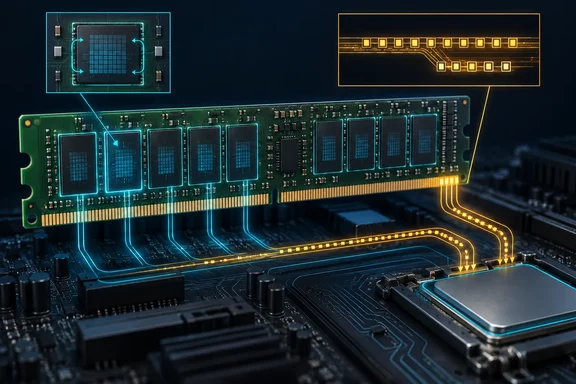
Two different things are both called "ECC"
The confusion comes from one acronym covering two separate mechanisms. Memory vendor ATP puts it plainly: on-die ECC, built into every DDR5 chip, corrects single-bit errors inside the chip; side-band (DIMM-wide) ECC, the kind servers have always used, protects data across the whole link to the CPU. ATP also states the conclusion that matters for buyers: on-die ECC does not make a standard DDR5 module an ECC module.
The wording matters here. XDA's headline says every DDR5 stick has ECC. It's more accurate to say every DDR5 chip does. ATP says every DDR5 chip includes on-die ECC by JEDEC mandate, allocating 8 bits of ECC storage for every 128 bits of data. Micron's DDR5 feature table gives the same figure. It lists on-die ECC as "128b+8b SEC, error check and scrub", notes that DDR4 had none, and describes the feature as one that strengthens on-chip RAS (reliability, availability and serviceability).
Section summary: On-die ECC is built into the DRAM chip and required by the DDR5 standard. Side-band ECC is a separate system-level feature. Seeing one on a spec sheet doesn't mean you have the other.
Why DDR5 needed its own error correction
This part of the XDA piece is on solid ground. Each DRAM generation packs cells more tightly, so each cell holds a smaller charge and flips a bit more easily. PassMark's MemTest86 documentation explains that DDR5 added on-die ECC and Link ECC to compensate for higher bit error rates (BER) due to increased speed and density of DDR5 RAM. It adds that due to increasing error rates as process technology reduces the size of memory cells, on-die ECC sustains the yield of "good" memory cells.
In practice, on-die ECC mainly keeps shrinking DRAM viable to manufacture. It makes DDR5 dependable enough to ship. It was never meant to guarantee the integrity of your data end to end.
The code itself also has limits. Micron describes it as single-error correction (SEC). Eight check bits over 128 data bits can't reliably catch every multi-bit error pattern, so it doesn't catch everything even inside the chip.
Where the protection stops
On-die ECC only works while the data sits inside the DRAM chip. Once corrected data leaves the chip, it still has to cross the module, the slot, the motherboard traces and the memory controller, and nothing on-die covers any of that. Synopsys, which designs DDR memory controller IP, says this directly: as this scheme does not offer any protection against errors occurring on the DDR channel, on-die ECC is used in conjunction with side-band ECC for enhanced end-to-end RAS on memory subsystems.
Side-band ECC works differently. Developer Quentin Santos describes it this way: extra check bits travel along additional, dedicated, wires to the CPU, which finally use them to detect and correct any errors in the data. The memory controller creates the check data on the way out and verifies it on the way back, so the whole round trip is covered.
That's why ECC modules are physically different. ATP notes that DDR2-DDR4 ECC uses a 72-bit bus (nine x8 chips for 1Rx8); a DDR5 RDIMM uses an 80-bit bus, and registered DIMMs are always side-band ECC. XDA says in general terms that ECC modules are wider and carry extra chips, which is true of conventional designs. Exact layouts vary by module type, so don't read it as a single universal chip count.
| DDR5 on-die ECC | Side-band ECC | |
|---|---|---|
| Where it works | Inside each DRAM chip | Across the DIMM, channel and memory controller |
| Code (per sources) | 128 data + 8 check bits, single-error correct | Typically SEC-DED on conventional ECC DIMMs |
| Needs platform support | No, it's always present | Yes: CPU, motherboard and firmware |
| Reports to the OS | Not through normal host channels | Yes, where the platform supports it |
Section summary: On-die ECC protects the data where it's stored. Side-band ECC protects it on the way to and from the CPU. They add to each other, and one can't stand in for the other.
The silence problem, and where the XDA piece goes too far
The most useful point in the XDA article is that on-die corrections happen silently. MemTest86's documentation agrees: On-die ECC is completely invisible to the system. Santos draws the practical consequence: you get no report of corrected and detected errors. A DDR5 chip that's slowly failing can hide its problems behind on-die correction until the errors outgrow what the code can fix.
There's one caveat. DDR5 does include an Error Check and Scrub (ECS) feature that can count corrected errors, and XDA mentions it. Current Linux kernel EDAC documentation includes interfaces for ECS devices, such as setting an error threshold "per gigabits of memory cells." Whether you can actually see those counts depends on the chip and the platform. On a typical desktop you shouldn't expect to, but "never, anywhere" goes further than the evidence.
XDA also says that when side-band ECC corrects an error, the event shows up in Windows' hardware error log or Linux's EDAC. That's broadly right, but it's conditional. Microsoft's Windows Hardware Error Architecture (WHEA) documentation describes a chain where the platform's error source notifies a low-level handler, the kernel builds an error record, and, for corrected errors, the kernel writes an event to the system event log if the error condition exceeds the error source's threshold. Every step depends on the hardware and firmware reporting the error in the first place. Linux EDAC likewise separates corrected, uncorrected and fatal errors, but only when a supported driver is present.
Practical takeaway for Windows users: ECC DIMMs in a system don't guarantee that corrected errors will ever show up in Event Viewer. Reporting depends on the CPU, the motherboard firmware and the platform's error-source support.
How to tell what you actually have
If system-level ECC matters to you, check each of these:
- The module: Look for unbuffered ECC UDIMMs on desktop platforms, or RDIMMs on server platforms. A consumer kit whose only ECC claim is the standard on-die feature isn't an ECC module.
- The CPU and memory controller: Confirm that the processor officially supports ECC. It varies by product family and even by SKU.
- The motherboard and firmware: The board vendor has to enable ECC. Check the manual and the memory support list, not just the chipset's name.
- Reporting: On a supported system, look in the platform's firmware tools and in the operating system's error reporting (WHEA events on Windows, EDAC on Linux). Remember that seeing no events doesn't prove ECC is running.
Do home users need side-band ECC?
XDA concludes that for gaming, office work and even most home servers, standard DDR5 is fine, and that ZFS users may do better spending on redundancy. That's a reasonable judgement for plenty of people, but it's an opinion, not a measured result. The piece offers no error-rate data, and neither does any source reviewed here.
Its ZFS argument relies on a claim, credited to ZFS co-founder Matt Ahrens, that ZFS needs ECC no more than any other filesystem does. That line is widely repeated, but its original source couldn't be verified for this piece. The OpenZFS project's own FAQ takes a more careful position. It says ECC is "strongly recommended for enterprise environments where the strongest data integrity guarantees are required," warns that without it bit flips can go undetected and get written to disk by ZFS or any other filesystem, and admits that for home users the extra safety "might not justify the cost."
That's the right way to think about it: a tradeoff between risk, cost and platform support. If your home server holds irreplaceable photos and you'd want warning that a DIMM is failing, side-band ECC on a platform that reports errors is worth the premium and the extra checking. If the machine is a gaming rig, the on-die ECC it already has is keeping the DRAM working reliably, and it was never designed to do more than that.
Bottom line: DDR5's built-in ECC is real and necessary, but it works silently and only inside each chip. Don't confuse it with the protection an ECC workstation provides. Decide whether you need side-band ECC based on how much your data is worth to you, not on what the spec sheet label says.
References
- Every DDR5 stick has ECC built in, but it's not the ECC that matters XDA · 2026-09-27T16:00:19+00:00
- PassMark MemTest86 - Memory Diagnostic Tool - ECC Technical Details memtest86.com
- Error Correction Code (ECC) in DDR Memories | Synopsys IP synopsys.com