

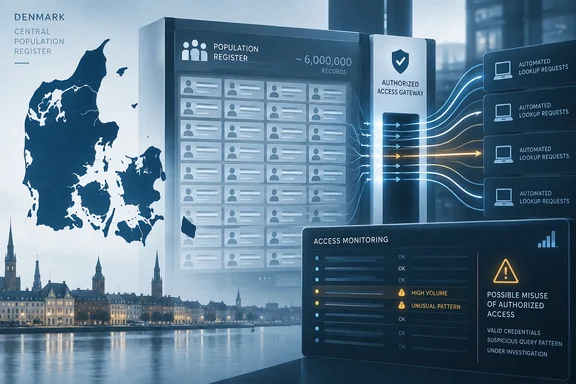
Denmark's Central Population Register (CPR) says the personal information of about 8.8 million registered individuals was exposed. The Ministry of Research, Education and Digitalization announced it on Monday, 5 October 2026. For IT administrators, the interesting part is how it happened, because that part is relevant to any organization that hands partners, vendors or customers programmatic access to a sensitive database.
What officials say happened
The ministry's statement says unauthorized parties abused a Danish company's lawful ability to search the CPR system. The searches stayed within the scope of data that private companies can normally reach. The ministry says the exposed data includes names, addresses, CPR numbers and "other information".
Some qualifications matter:
- Protected records were reportedly excluded. The ministry's review found the access did not cover names and addresses for people registered with name-and-address protection. The announcement does not say that every other detail about those people was untouched.
- The register is bigger than the population. The CPR holds roughly 11 million records, covering living residents, people who have moved abroad and deceased people. The figure exceeds Denmark's population of roughly six million because the register also holds records of people who have moved abroad and those who have died. The 8.8 million is therefore about 80% of the register's records, not 80% of the people living in Denmark. The ministry has not given a count of affected living residents.
- No full field list. The ministry has not published which fields were accessed for each record. The register can hold information such as marital status, birth registration and family relationships, but the ministry has not said exactly which fields were accessed. Don't assume every record contains every field.
Automated enumeration
The Danish Data Protection Agency (Datatilsynet) said it received a notification from the CPR administration on Sunday, 4 October. According to the agency's own short statement, the notification describes a very large number of automated lookups against the CPR system, made to identify valid CPR numbers.
That is a classic enumeration pattern. A valid-number space is probed at scale, and each hit is then used to pull the associated record. BleepingComputer, reporting on the incident, characterized the agency's account as some form of brute-forcing.
The agency's wording is narrower than some headlines. Nothing in the official statements establishes any of the following:
- a cracked password
- stolen credentials
- a software vulnerability
- a breach of the CPR core systems
- a confirmed compromise of the company's own network
Some outlets have gone further. Cybernews reported that attackers leveraged stolen access, and another outlet described compromised credentials. The ministry's statement says only that the company's lawful access was misused. Treat the credential-theft claims as unconfirmed until investigators say so. BleepingComputer also said it had asked the agency how the company was compromised and had received no answer when it published.
Timeline
- September 2026: Irregular behavior occurred in the CPR system. The ministry has not given exact start and end dates.
- Friday evening, 2 October: The CPR administration noticed the irregular activity.
- Weekend of 3–4 October: Officials worked out that about 8.8 million records were affected. The company's access was stopped, and the incident was reported to Datatilsynet and the police.
- Sunday, 4 October: Datatilsynet received the notification.
- Monday, 5 October: The ministry went public. Minister Christina Egelund called it a deeply serious incident and said she had briefed Parliament's Business and Digitalization Committee. She also ordered a thorough security review of the CPR system.
The ministry says it has already put measures in place to prevent similar incidents. It has not said what those measures are. It has also not said whether other private users are being audited, or how long the review will take. The police investigation is in an early phase, and officials say they cannot yet say who is behind it.
How private companies get CPR access
The ministry's explainer says businesses with a legitimate interest may receive CPR data under section 38 of the CPR Act. The right covers a larger, defined group of people the company has already identified individually. The identifiers can be a CPR number, date of birth and name, or name and address. The company must also be entitled to receive the data under the GDPR and Denmark's data protection act.
That design assumes a company looks up people it already knows about. It does not obviously anticipate someone running a very large number of automated queries to discover which CPR numbers exist. Whether rate limits, anomaly monitoring or volume caps applied to that access, and why a month of activity wasn't caught sooner, are open questions. The initial notices don't answer them, and the review should.
Why enterprise IT teams should care
This is not a Windows bug, and no Microsoft product is implicated in the official statements. The lesson is still familiar to anyone who manages identity or data platforms.
- Authorized access can be the attack path. Valid credentials or integrations used abnormally don't trip signature-based defenses. Behavioral baselines and volume alerts matter.
- Third-party and partner integrations extend your attack surface. Review which external accounts, API keys and service principals can query bulk data, and what each one is permitted to pull.
- Rate limiting and query-pattern detection. Sequential or random identifier probing leaves a recognizable footprint if you log and alert on it.
- Plan for the case where identifiers can't be rotated. A CPR number is a lifelong identifier and, as far as the announcement says, the ministry is not issuing new ones. A leaked password can be reset. A leaked national ID mostly cannot.
This is general industry analysis, not a finding from the Danish investigation.
What affected people are being told
The ministry points people to sikkerdigital.dk and to the Cyber Hotline for Digital Security on +45 33 37 00 37. The hotline was to have extended hours of 08:00–24:00 for the coming days. That is a temporary arrangement, so check the current hours before relying on them.
The core advice is to never give out passwords or other confidential information in response to calls, emails or similar contact. That applies even if the contact already knows your name, address and CPR number. This is the realistic near-term risk. A caller who recites accurate personal details sounds far more credible than one who doesn't.
The ministry has not announced new CPR numbers, replacement identity documents or a credit-monitoring scheme. An exposed identifier is also not proof of misuse. The official sources do not report confirmed fraud, a public data dump, or a motive. They also haven't named the company.
What to watch
- Whether the Danish authorities name the company and explain how its access was abused.
- Whether Datatilsynet's inquiry into responsibility for the data processing leads to formal findings.
- What the security review changes about how private companies can query the register.
- Whether any exposed data surfaces for sale or in fraud attempts.
The Danish authorities have said that details may be revised as the mapping of events continues. The numbers and the account above reflect the first official statements.
References
- Denmark population registry data breach affects 8.8 million people BleepingComputer · 2026-10-05T11:21:10-04:00
- Denmark suffers a massive data breach: 8.8 million people's data exposed cybernews.com
- Denmark’s CPR breach exposes 8.8 million people as experts warn over trusted third-party access - IT Security Guru itsecurityguru.org