

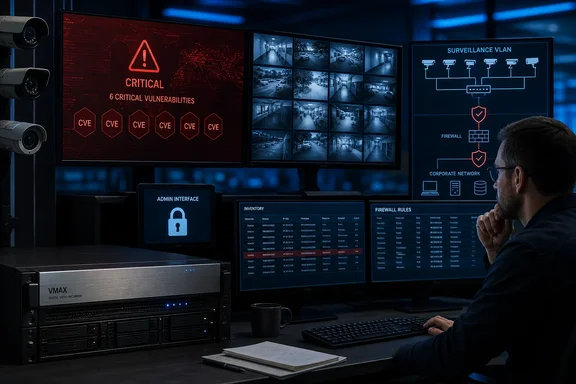
The September 15 advisory, ICSA-26-258-01, names six CVEs affecting VMAX A1 G4 DVRs, VMAX IP G4 NVRs, VMAX A1 Plus units, VA1G4 recorders, and VG4 recorders. CISA assigns the collection a CVSS v3 score of 9.6 and says the flaws include missing authentication for critical functions, hard-coded credentials, missing authorization, and a predictable pseudo-random number generator. Researcher Scot Berner of TrustedSec reported the issues to CISA.
CISA also makes two limits clear that should shape the response: it has received no reports of public exploitation, and it says the vulnerabilities are not remotely exploitable. That means an internet-exposed VMAX interface is still a serious configuration problem, but the advisory does not establish a direct unauthenticated attack from the public internet. The more immediate risk is local: someone with physical access, a foothold on the surveillance VLAN, access through a compromised workstation, or a trusted remote-access path could potentially turn a recorder into both a video-surveillance compromise and a network pivot.
Six CVEs, but no published fix in the advisory
The affected identifiers are CVE-2026-68953, CVE-2026-66890, CVE-2026-68070, CVE-2026-68950, CVE-2026-66887, and CVE-2026-66372. CISA groups them under four weakness types rather than providing a public technical breakdown for each CVE, so administrators should not assume that mitigating one apparent credential or authorization issue clears the other five.
Most importantly, the advisory identifies every version of the named product lines as affected. It does not list a fixed firmware version, temporary vendor patch, configuration workaround, or a date by which supported remediation will arrive. That omission is the operational story here: organizations cannot close this finding merely by confirming that they installed what Digital Watchdog currently labels as the latest available firmware.
Digital Watchdog’s support site shows recent firmware releases for the VMAX A1 G4 and VMAX IP G4 product lines, including VMAX A1 G4 firmware 4.0.1.0 published September 3, 2026, and VMAX IP G4 firmware 1.6.0.21 published August 27, 2026. But the public release listings located during this reporting do not establish that either release addresses these six CVEs. Until Digital Watchdog publishes a security bulletin tying a specific firmware build to ICSA-26-258-01 or its CVE set, those updates should be treated as normal maintenance releases rather than verified remediation.
That distinction matters in audit reports. “Current firmware” and “not affected” are separate claims when CISA’s affected-version field reads all/*.
The attack path is local, but VMAX deployments often bridge it
CISA’s “not remotely exploitable” assessment reduces one attack scenario; it does not make these recorders low-priority assets. VMAX DVRs and NVRs are routinely placed on networks that also host cameras, management PCs, video-management software, routers, storage, and sometimes broader corporate resources. A full administrator-level compromise on a recorder can expose live and retained video, allow changes to recording and alerting settings, and offer a useful staging point inside a facility network.
Digital Watchdog’s own documentation illustrates why “local” needs to be interpreted carefully. Its VMAX A1 G4 guidance describes browser-based access from a workstation on the same LAN, while its VMAX IP G4 materials document administrator access through direct IP connections, peer-to-peer Pathfinder access, and DDNS. The vendor also supports Windows desktop software for management functions across VMAX product families.
None of that contradicts CISA’s finding. It means the device may have legitimate management routes that cross physical locations and network segments before arriving at the recorder. A compromised Windows endpoint used for facilities management, a VPN user with overly broad routing permissions, an unmanaged contractor laptop, or a flat camera network can satisfy the practical access requirement even when the recorder itself has no open port on the internet.
Digital Watchdog’s support documentation also says that VMAX devices may initially have only an Administrator account and may be left without a password. Its password-management article lists admin with a blank password as the default login state for applicable standalone recorders. The CISA advisory independently identifies hard-coded credentials among the issue categories, but it does not say that the documented default account is the hard-coded credential involved in these CVEs. Administrators should not conflate the two. They should, however, treat every recorder with an unset, weak, shared, or legacy administrator credential as an urgent exposure while the vendor’s full technical details remain unavailable.
Inventory needs model numbers, not a generic “VMAX” label
The advisory’s product naming is broad enough to complicate asset inventories. A site that records only “Digital Watchdog VMAX” in a CMDB cannot determine exposure from the label alone. The affected scope covers analog-oriented DVR and IP NVR lines, including VMAX A1 Plus, VMAX A1 G4, and VMAX IP G4 equipment.
Digital Watchdog’s compatibility documentation identifies VMAX A1 G4 and VMAX IP G4 systems as 4K product families, with model numbers such as DW-VA1G44xT, DW-VA1G48xT, and DW-VA1G416xT on the A1 G4 side, and DW-VG49xT4P, DW-VG412xT8P, and DW-VG416xT16P on the IP G4 side. That is useful for a first-pass search of procurement records, network-discovery results, remote-management platforms, and physical asset tags.
The VA1G4 and VG4 recorder names in CISA’s affected list should be handled as additional matching criteria rather than dismissed as duplicates. They closely track Digital Watchdog’s A1 G4 and IP G4 naming, but the advisory presents them separately. If the organization has a VMAX G4-era recorder and cannot positively rule it out from a model number or support contract, it belongs in the affected inventory until Digital Watchdog clarifies the mapping.
Windows administrators should also inventory the clients and service accounts around the recorder. A VMAX unit might be managed from a browser, Digital Watchdog’s desktop tools, C3 CMS, a video-management server, or mobile and cloud-mediated services. The recorder is the vulnerability target, but compromised credentials, saved browser passwords, permissive Windows firewall rules, and management workstations on the camera VLAN can determine whether an attacker ever gets the required local foothold.
Containment should not wait for a firmware bulletin
CISA recommends minimizing network exposure, placing control-system and remote devices behind firewalls, separating them from business networks, and using a current VPN when remote access is required. Those recommendations are familiar, but this advisory makes them more immediate for VMAX deployments because the available public record does not offer a confirmed software fix.
Security teams should take these actions now:
- Identify every VMAX A1 G4, VMAX IP G4, VMAX A1 Plus, VA1G4, and VG4 recorder, recording its precise model, serial number, firmware version, IP address, physical location, owner, and management method.
- Block direct inbound access to recorder administration and video interfaces from the internet, and remove old port-forwarding, DDNS, or peer-to-peer access arrangements that are no longer required.
- Restrict recorder management to dedicated administration workstations or a tightly controlled jump host, with firewall rules allowing only necessary protocols from known addresses.
- Separate cameras and recorders from ordinary user endpoints, guest networks, printers, and general server segments; permit narrowly defined traffic to video-management systems rather than broad east-west access.
- Change all administrator and service-account passwords on affected devices, eliminate shared credentials, and confirm that installers, former staff, and third-party support accounts no longer retain access.
- Review recorder configuration, user lists, remote-access settings, firmware-update settings, alert destinations, and video-retention policies for unauthorized changes.
- Preserve logs and configuration exports before factory resets or recovery procedures, since a recorder that has been tampered with may contain the evidence needed to establish how access occurred.
The last point deserves care. Digital Watchdog’s recovery guides say that recovery firmware can return a VMAX recorder to factory defaults and roll it back to an older firmware version before a subsequent update. That may be appropriate for an operational recovery, but it is not an established fix for these CVEs and could erase local evidence or leave the unit on an older vulnerable build. Treat recovery as a vendor-directed maintenance action, not a substitute for containment.
What Digital Watchdog still needs to answer
CISA’s advisory gives defenders enough information to prioritize network controls, but not enough to calculate exposure precisely. Digital Watchdog has not publicly linked a corrective firmware version to the six CVEs in the material available at publication. It has also not published the specific vulnerable functions, the local access prerequisites for each flaw, whether the problems are shared across a common firmware base, or whether any models have reached end of support.
Those gaps affect remediation planning. A site may be able to isolate a recorder quickly, but it cannot make a reliable replacement-versus-upgrade decision without knowing whether the vendor intends to issue fixes for every affected line. This is especially important for surveillance equipment installed in healthcare, commercial facilities, government buildings, and transportation environments, where recorder replacement can require outage planning, chain-of-custody controls, and validation that cameras continue recording.
For now, the defensible position is straightforward: treat the named VMAX recorders as locally exploitable administrative assets, reduce access to the smallest possible set of managed systems, and do not mark the advisory resolved based solely on firmware currency. The closure condition is a Digital Watchdog remediation notice that names the affected CVEs and the exact fixed builds—or a documented compensating-control decision to keep the recorder isolated until replacement.
References
- Digital Watchdog VMAX DVR and NVR Product Lineups CISA · 2026-09-15T12:00:00+00:00